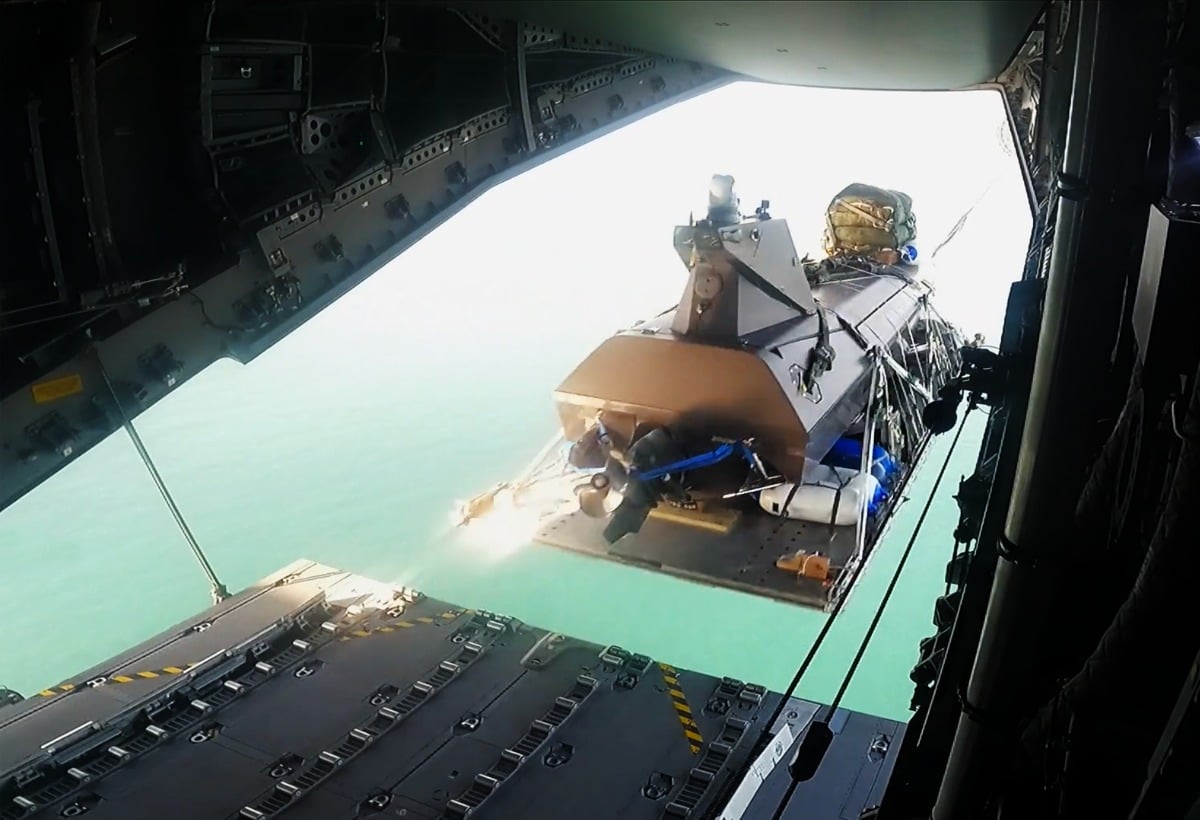
Navies have traditionally viewed air power as an extension of maritime force projection. The recent deployment trials under the Royal Navy’s Project Beehive invert this paradigm: maritime power is now being projected directly via strategic airlift. By successfully executing four live extracted-load airdrops of an uncrewed surface vessel (USV) over a six-day campaign in the North Sea, the UK Ministry of Defence has validated a structural framework for rapid, global hull deployment that bypasses the range and logistical bottlenecks inherent to small autonomous craft.
To evaluate the operational and economic implications of this development, the system must be disassembled into its core engineering, aerodynamic, and maritime variables. Meanwhile, you can explore similar events here: The Invisible Draft Driving the Future of Code.
The Operational Bottleneck of Small-Scale USVs
Small uncrewed surface vessels face a fundamental engineering trade-off governed by the physics of hydrodynamic drag and fuel storage volume. For a vessel like the Kraken K3 Scout—the 12-meter craft utilized in the Project Beehive trials—self-deployment over transoceanic or long-range theater distances is mathematically unfeasible.
The range of a displacement or planing hull scales inefficiently as length decreases due to the fuel-to-weight ratio needed to overcome water resistance over extended timelines. Consequently, conventional deployment models rely on two primary mechanisms, both of which introduce distinct tactical vulnerabilities: To explore the complete picture, check out the recent report by Gizmodo.
- Mothership Dependency: Launching a USV from a conventional naval vessel requires the carrier ship to enter or approach the contested maritime zone. This places high-value assets and crewed platforms within the engagement envelope of shore-based anti-ship cruise missiles (ASCMs) and loitering munitions.
- Forward Operating Ports: Deploying autonomous craft from nearby friendly infrastructure limits operational flexibility to pre-existing geographic footprints. In contested environments, these fixed installations represent primary targets for preemptive strike degradation.
Airborne insertion breaks this reliance. By leveraging a strategic transport aircraft like the Airbus A400M, a navy can transport a strike or surveillance hull to a theater thousands of miles away at cruising speeds exceeding 400 knots, bypassing choke points and sea-state delays entirely.
The Physics of Extracted-Load Aerial Delivery
The engineering milestone demonstrated in the North Sea rests on the integration of three distinct systems: the aircraft, the delivery platform, and the maritime payload. The trials utilized Capewell's Universal Maritime Craft Aerial Delivery System (UMCADS), a flat-packed, reconfigurable variant of the standard US Type V airdrop platform.
Understanding the mechanics of an extracted-load airdrop reveals why this trial represents an engineering departure from standard cargo delivery. The process follows a strict mechanical sequence:
- Drogue Deployment: While the A400M maintains a stable flight profile at 1,300 feet, a drogue parachute is deployed into the slipstream through the open rear cargo ramp.
- Kinetic Extraction: The aerodynamic drag generated by the drogue parachute provides the continuous horizontal force necessary to pull the UMCADS sled—with the K3 Scout securely attached—along the dual-row roller system of the aircraft floor.
- Main Canopy Inflation: Once clear of the aircraft ramp, the main parachute canopies deploy to decelerate the system from aircraft forward velocity to a survival terminal velocity.
- Mid-Air Separation and Dissipation: Prior to or precisely at water entry, the delivery platform must separate from the vessel. This was achieved via a newly validated electro-mechanical release system known as the IN-Release mechanism. The system ensures synchronized, multi-point load disconnection, preventing the heavy metal sled from rebounding into or fouling the hull upon impact.
The structural survival of the USV during this sequence requires specialized engineering. The vessel was fitted with an optional airdrop kit designed to absorb the multi-axis kinetic shocks of parachute opening and water impact. The trial validated this structural integrity by conducting all four drops into waters experiencing up to Sea State 4, characterized by chaotic wave heights up to 8 feet.
The Logistics of Platform Reusability
A critical metric of the Project Beehive campaign is the execution of four distinct live drops within a single six-working-day window using the exact same vessel and UMCADS platform. In military logistics, reusability directly dictates operational cadence and cost-efficiency.
[A400M Airlift] ➔ [1,300ft Extracted Drop] ➔ [Sea State 4 Impact] ➔ [Autonomous Activation]
       ▲                                                                    │
       └─────────────────── [6-Day Rapid Reset Loop] ───────────────────────┘
The ability to rapidly reset and re-fly the same hardware indicates that the mechanical stresses of a 1,300-foot drop do not cause cumulative material fatigue or sensor misalignment in the payload. From a lifecycle cost perspective, a reusable, non-modified aerial delivery platform allows standard transport fleets to pivot between moving troops, heavy vehicles, and autonomous strike fleets without requiring permanent, dedicated airframe alterations.
Strategic Implications for the Hybrid Fleet
The integration of air-delivered USVs underpins the Royal Navy’s transition toward a distributed, hybrid surface fleet. By deploying 20 Kraken USVs under Project Beehive, the service is building a scalable mass intended to operate alongside traditional crewed warships.
By shifting the insertion mechanism to air assets, a fleet commander alters the defensive calculus of an adversary in three specific areas:
- Temporal Compression: A response that would take days for a surface group to steam toward can be executed in hours via strategic airlift.
- Area Denial Penetration: USVs configured for electronic warfare, mine countermeasures, or precision strikes can be dropped directly behind anti-access/area-denial (A2/AD) bubbles, establishing localized maritime control prior to the arrival of crewed assets.
- Unpredictable Vectoring: Because transport airframes can fly over landmasses to reach landlocked seas or isolated littoral zones, the direction of maritime insertion is no longer constrained by navigable waterways or maritime choke points.
The technical validation of the K3 Scout and UMCADS integration establishes a clear trajectory for future amphibious and littoral operations. The next logical phase of this capability is the scaling of simultaneous drops—deploying swarms of autonomous vessels from a single airframe or a coordinated formation of transports to overwhelm peer defensive networks.