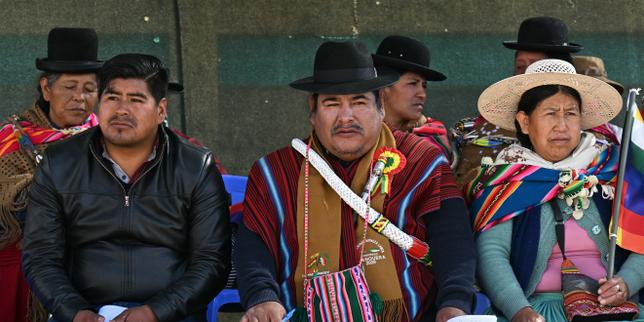
The arrest of Vicente Salazar, executive secretary of the Tupac Katari peasant federation, alters the operational equilibrium between the Bolivian state and agrarian labor unions. By using targeted legal prosecution to decapitate the leadership of the country's most disruptive blockade infrastructure, the administration of President Rodrigo Paz is testing a strategy of selective neutralization to dismantle a multi-week logistics stranglehold. This intervention occurs within a wider structural crisis characterized by structural economic reallocation, shifting political allegiances, and a clear test of state coercive power under an active state of exception.
To understand the trajectory of this confrontation, the situation must be analyzed through three distinct structural frameworks: the physics of geographic supply-chain vulnerabilities, the institutional power dynamics of the Andean syndicalist movement, and the legal-military architecture deployed by the executive branch.
The Logistics Choke Point Framework
The primary weapon of Bolivian agrarian protest is not kinetic confrontation, but spatial control. The geography of the country creates natural bottlenecks that allow relatively small, organized groups to exert asymmetric leverage over major urban economies.
[Agrarian Production Zones] ---> (Altiplano Highway Arteries) ---> [La Paz / El Alto Urban Core]
                                            |
                                  [Target of Blockade]
Topographical Isolation
La Paz and its twin city, El Alto, sit within an alpine bowl and an adjacent high plain, connected to the rest of the domestic agricultural supply network by a limited number of high-altitude highways. By placing physical barriers along the primary routes crossing the Altiplano, the Tupac Katari federation can systematically isolate the administrative capital from the agricultural centers of the lowlands and the valleys of Cochabamba.
Symmetrical Deprivation Dynamics
The immediate effect of a sustained blockade is a sharp drop in supply volumes for essential commodities, causing rapid spikes in urban inflation. Urban consumer markets operate on thin inventory margins for fresh food, medicine, and refined petroleum products. When these arteries are severed for over forty days, the state suffers a severe drop in customs revenues and general economic output. The executive branch calculated the cumulative economic loss of the recent mobilization cycle at over 1.2 billion dollars.
The Fuel Bottleneck
Because Bolivia relies heavily on imported diesel and gasoline to maintain basic transport and mining operations, the blockades created a compounding crisis. Tanker trucks entering from neighboring borders were trapped at the barricades. This halted urban transit networks and created long lines at fuel stations, shifting public sentiment. As urban populations faced severe shortages, the political cost of the blockades began to outpace the population's frustration with the government's economic reforms.
Institutional Power and the Radicalization Fracture
The arrest of Salazar highlights a deep institutional divide within Bolivia's social movements. The current protests are not a uniform popular front, but rather a fragmented coalition experiencing internal friction over goals and tactics.
The Syndicalist Corporate Model
Organizations like the Tupac Katari federation do not function as loose activist networks. They are highly disciplined, hierarchical institutions rooted in decades of indigenous agrarian syndicalism. They possess clear internal governance, localized command structures, and the ability to mandate participation in collective actions through community enforcement mechanisms. This structure allows leaders to execute national blockades with high compliance.
The Strategic Split over Negotiations
The escalation of the crisis revealed a major divide between traditional urban labor unions and radicalized agrarian factions. The Central Obrera Boliviana, the country's largest trade union umbrella organization, chose a path of institutional negotiation. They signed an agreement with the Paz administration that secured commitments against the privatization of state-owned enterprises in exchange for lifting their strike actions.
This compromise exposed a deep rift with the Altiplano peasantry and the coca growers of the Chapare region—the traditional base of former President Evo Morales. These groups rejected the compromise, pivoting from initial economic demands for higher wages and inflation controls to an absolute political goal: the immediate resignation of President Paz.
The following matrix illustrates the strategic positions of the main domestic actors following this institutional fracture:
Executive Branch (Paz Administration)
- Core Objective: Maintain fiscal stabilization and secure structural economic adjustments.
- Primary Tool: State of exception decrees and targeted legal prosecution of union leadership.
- Strategic Vulnerability: Deep operational dependence on military compliance and high urban economic volatility.
Moderate Labor (Central Obrera Boliviana)
- Core Objective: Preserve public sector employment and prevent state asset privatization.
- Primary Tool: Institutional collective bargaining and conditional strike suspensions.
- Strategic Vulnerability: Loss of credibility among radical agrarian factions and rank-and-file workers.
Radical Agrarian Factions (Tupac Katari Federation / Chapare Coca Growers)
- Core Objective: Force presidential resignation and reverse free-market reforms.
- Primary Tool: Sustained highway blockades and total logistical isolation of major cities.
- Strategic Vulnerability: Supply depletion, economic exhaustion of participants, and legal exposure to state crackdowns.
The Legal and Military Coercion Architecture
Faced with a direct challenge to its authority, the Paz administration moved away from early concessions—such as the president's symbolic 50 percent salary cut—and turned to the formal legal tools of state coercion.
[Executive Decree] ---> [State of Exception] ---> [Military Deployment + Legal Immunity] ---> [Targeted Arrests]
The State of Exception Decree
The declaration of a national state of exception provided the legal framework for using the armed forces to clear highways. Historically, deploying the military to manage domestic protests carries immense political risk in Bolivia, often leading to fatal clashes that can destabilize a government. To mitigate this risk and counter the memory of the 2019 post-electoral crisis, the administration introduced a specific legal shield: a statutory presumption of legality for military personnel engaged in clearing blockades, combined with guaranteed state-funded legal defense.
Legal Decapitation Tactics
The arrest of Salazar shows a shift toward neutralizing the leadership of these movements rather than engaging in mass dispersal operations on the highways. By acting on direct government complaints and using state prosecutors to issue swift arrest warrants, the administration aims to break the command-and-control structure of the blockades. Without centralized coordination, individual local checkpoints face a difficult choice: dissolve voluntarily or risk isolation and targeted enforcement by security forces.
The Risk of Retaliatory Re-escalation
The primary limitation of this legal strategy is the potential for a backlash. In highly organized syndicalist systems, arresting a senior leader often triggers an immediate defensive reaction from the base. Instead of dampening resistance, it can validate the radical faction's claim that the government is closing off democratic channels. The immediate aftermath of such arrests typically sees a temporary surge in local blockades as communities demand the release of their leaders. The success of the government's approach depends on whether the state can maintain its presence on key highways longer than the rural base can sustain the economic strain of the shutdown.
Economic Reallocation and the Political Transition
The current unrest is directly tied to a major transition in Bolivia's economic model. The country is moving away from a state-led, resource-dependent system toward a market-oriented framework led by a conservative administration that took office just seven months ago. This transition has ended nearly twenty years of continuous governance by the Movimiento al Socialismo.
The Fiscal Crisis of the Gas Model
For nearly two decades, the Bolivian state relied on profits from natural gas exports to fund public subsidies, keep currency values stable, and support domestic social programs. The depletion of active gas fields, combined with a lack of new investment, turned Bolivia from a net exporter into a net importer of liquid fuels. This structural shift drained international reserves and caused a severe shortage of US dollars, triggering inflation and making it difficult to import key goods.
The Friction of Austerity Reforms
The Paz administration took office on a platform of market reforms, aiming to cut public spending, reduce fuel subsidies, and attract foreign capital. However, these changes hit the country's poorest sectors first. Agrarian producers face rising costs for imported tools and fertilizer, while inflation erodes the value of their wages. The resulting protests reflect a deep collision between necessary fiscal stabilization and the immediate survival needs of the rural population.
The Strategic Path Forward
The confrontation has moved past a simple labor dispute and is now a direct contest over state authority. The Paz administration cannot back down on its core economic reforms without losing the confidence of international lenders and its urban support base. Conversely, the radical agrarian unions view these market adjustments as an existential threat to their community economies and political influence.
The state's next move will likely focus on securing the main transport route between Santa Cruz and La Paz. By keeping this economic artery open, the government can stabilize food supplies and ease the pressure on urban markets, weakening the effectiveness of the blockades. At the same time, the administration will likely continue using the legal system to target secondary leaders within the Tupac Katari and Chapare networks.
For the agrarian federations, the key challenge will be maintaining internal unity. As the economic costs of the blockades rise for rural families and moderate unions choose negotiations, the radical factions risk becoming isolated. Their long-term leverage depends on whether they can expand their protests beyond the Altiplano and build a broader coalition with frustrated urban informal workers. If they fail to bridge this divide, the government's strategy of combining targeted legal enforcement with tactical military deployment could set a new precedent for managing social protest in Bolivia.