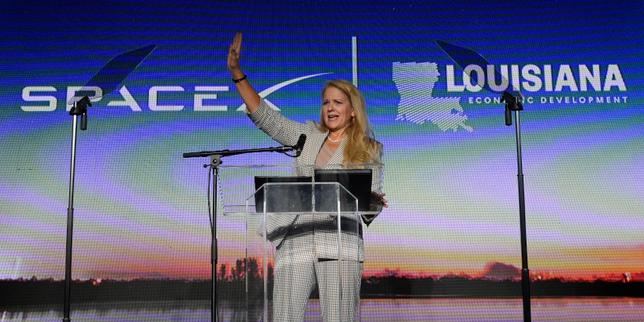
SpaceX has formally committed to a $100 billion capital allocation strategy for Starbase Louisiana, a 125,000-acre marshland footprint in Vermilion Parish designed to transform coastal wetlands into an ultra-high-cadence orbital hub. This infrastructure bet exceeds the financial magnitude of historical aerospace endeavors, targeting operational capacity of over thirty daily launches across ten distinct pads. Understanding the structural mechanics of this project requires deconstructing the geographic constraints, propellant economics, and orbital trajectory constraints that dictate modern heavy-lift scheduling.
The Geography of Orbital Yield and Trajectory Mechanics
Launch site selection is governed by vector physics rather than real estate availability. Earth's rotational velocity imparts an initial eastward momentum boost of roughly 465 meters per second at the equator, a kinetic subsidy that decreases with latitude. However, raw rotational velocity is secondary to the azimuth clearance—the unobstructed flight corridor required during ascent.
Pecan Island provides a southern and southeastern vector over the open waters of the Gulf of Mexico. This trajectory profile enables two distinct orbital mechanics advantages:
- Sun-Synchronous Orbit Access: Launches directed on specific southern inclinations optimize satellite solar array exposure, a critical constraint for constellations designed to power heavy onboard computing architecture.
- Downrange Safety Margins: Vermilion Parish offers hundreds of miles of open marine buffer before stage separation and booster return vectors intersect populated landmasses, minimizing public exclusion zone liabilities during routine flight recovery.
The 125,000-acre plot, formerly held by industrial operators, presents a massive spatial buffer. While Boca Chica is geographically restricted by neighboring state parks and municipal boundaries, the Vermilion footprint allows for localized zoning insulation, separating explosive propellant farms from worker housing and vehicle processing bays.
The Cost Function of Multi-Pad High-Cadence Operations
Targeting thousands of annual flights demands a complete inversion of traditional launch pad architecture. Historical spaceports treat each pad as a singular, highly bespoke asset requiring weeks of refurbishment between static fires and orbital insertions. The Louisiana blueprint shifts from a bespoke model to an industrial assembly-line paradigm featuring five distinct complexes housing twin pads.
Achieving a cadence of thirty flights per day requires decoupling launch operations from ground-support bottlenecks through four structural pillars:
- On-Site Methane Generation: Transporting cryogenic propellants via highway or rail introduces severe scheduling friction and variable cost inflation. Integrating localized feedstock processing removes transport dependencies.
- Dedicated Power Generation: Cryogenic chilling, environmental control systems, and high-pressure pumps demand continuous multi-megawatt electrical input, requiring dedicated local power infrastructure to avoid destabilizing regional grids.
- Deep-Water Logistics: Transporting fully integrated Starship structures across coastal waterways from manufacturing nodes in Texas utilizes barge infrastructure to bypass weight and clearance limits inherent to highway transit.
- Integrated Airfield Access: High-frequency engineering deployments and executive transport require private aviation infrastructure directly adjacent to the complex, compressing iteration cycles.
The $100 billion capital expenditure envelope functions as a multi-year balance sheet commitment. It relies heavily on cash generation from existing commercial constellations and public market capitalization to fund civil engineering works across unstable marshland soils.
Geotechnical and Environmental Engineering Realities
Building heavy orbital infrastructure on a coastal wetland introduces extreme geotechnical engineering challenges. Silt, clay, and high water tables cannot support the static loads of a 407-foot-tall Starship stacked atop a Super Heavy booster without extensive subsurface remediation.
Constructing foundations capable of withstanding acoustic shockwaves and multi-megarankine exhaust plumes requires driving deep concrete pilings through shifting marsh sediment into stable load-bearing strata. Furthermore, coastal erosion mitigation and storm surge protection demand engineered barriers to safeguard propellant farms and avionics processing centers against Gulf hurricane events.
Environmental compliance frameworks represent a primary project risk factor. Navigating federal and state wildlife clearances on a site serving as a seasonal habitat for migratory bird species requires meticulous mitigation banking, habitat restoration commitments, and structural acoustic dampening to secure regulatory approval without terminal delays.
The Compute-Infrastructure Feedback Loop
The economic rationale behind a $100 billion spaceport extends beyond traditional payload delivery or lunar logistics. The operational velocity of Starbase Louisiana is explicitly pegged to the deployment economics of orbital data-processing infrastructure and high-density satellite arrays.
Ground-based data centers face mounting power supply constraints and cooling bottlenecks. Positioning heavy-lift launch cadence as a primary utility enables the continuous lofting of solar-powered orbital compute clusters. By internalizing the entire logistics chain—from propellant synthesis to orbital placement—the enterprise aims to capture the margin spread between terrestrial power generation costs and zero-latency space-based solar capture.
The structural success of this venture depends on vehicle reusability metrics. If turnaround times between booster flights fail to drop below historical thresholds, even a dozen launch towers will sit underutilized. Conversely, if rapid reuse is achieved, Starbase Louisiana will function as the primary transit node for industrializing Earth orbit.
Strategic Execution Playbook
- Finalize Geotechnical Core Sampling: Prioritize driving test pilings across target pad locations to map load-bearing strata and mitigate differential settling risks inherent to coastal marshland.
- Secure Regional Environmental Protocols: Establish formal mitigation banking agreements and transparent public engagement channels to address coastal erosion concerns and secure federal launch licenses without protracted litigation.
- Construct Primary Logistics Corridors: Complete deep-water dredging and marine dock facilities first to enable the uninhibited delivery of heavy construction equipment and structural steel components via barge.
- Build Self-Sustaining Utility Grids: Commission dedicated local power generation and methane production plants before pouring concrete for launch mount flame trenches, ensuring utility independence upon activation.