Two degrees.
On a thermometer hanging outside a kitchen window, two degrees Celsius is the difference between putting on a light cardigan and leaving it draped over the back of a chair. It is a rounding error. It is the slight chill of an overzealous air conditioner in a grocery store aisle, something you forget three seconds after stepping back out into the parking lot.
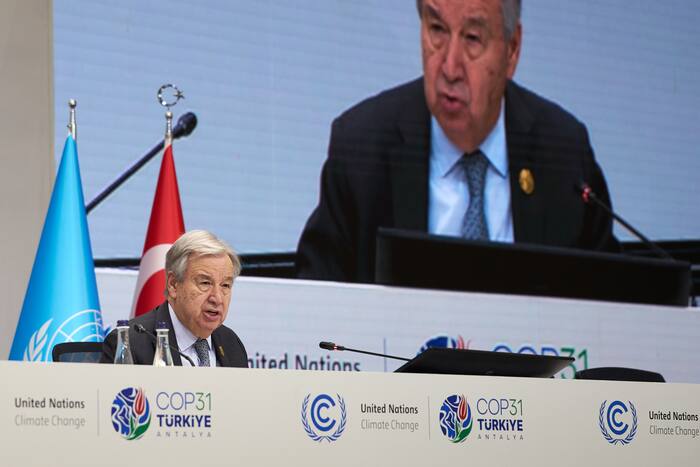
When António Guterres, the Secretary-General of the United Nations, stands behind a polished podium in Geneva or New York and demands "immediate and drastic" cuts to global greenhouse gas emissions, his words land in our living rooms with all the urgency of a muted television commercial. We hear catastrophe. We hear existential threat. We hear net zero by 2050. And then we check our phones, refill our coffee mugs, and wonder if it is going to rain on Saturday.
We have a translation problem. The scientists and diplomats speak in parts per million, gigatons of carbon, and fractions of a degree above pre-industrial averages. Human beings do not live in gigatons. We live in mortgages, grocery bills, pediatric urgent care waiting rooms, and the quiet dread of watching a backyard creek dry up three weeks earlier every August.
To understand what the UN is actually screaming about, we have to leave the podium behind. We have to stop looking at the global thermostat and start looking at the fever.
The Fever in the Room
Think of the Earth’s atmosphere not as a weather machine, but as a human body. A healthy body runs at roughly 98.6 degrees Fahrenheit. If your temperature climbs by a single degree, you feel sluggish. Your joints ache. You cancel dinner plans. If it climbs by two degrees Celsius—about 3.6 degrees Fahrenheit—you are running a 102.2-degree fever. You are delirious, dehydrated, and dangerously close to organ failure.
For the past ten thousand years, human civilization flourished inside a climatic sweet spot so stable that we built every port city, drew every national border, and planted every breadbasket assuming the weather would stay roughly the same forever. We mistook a temporary truce with nature for a permanent law of physics.
Since the late nineteenth century, we have burned enough coal, oil, and natural gas to push the planet’s average temperature up by roughly 1.2 to 1.3 degrees Celsius. According to the Intergovernmental Panel on Climate Change (IPCC)—the massive coalition of thousands of scientists whose reports form the backbone of every UN warning—we are hurtling toward the 1.5-degree threshold faster than almost anyone predicted a decade ago.
Why does that extra fraction of a degree terrify the people who spend their lives staring at ice cores and ocean buoys?
Because climate change does not move in a straight line. It moves like a row of dominoes standing on the edge of a table. Push one slowly, and nothing happens. Push it a millimeter further, and the entire table clears in three seconds. Scientists call these tipping points: thresholds where a small, incremental rise in temperature triggers an irreversible collapse. Once the Greenland ice sheet begins melting past a certain point, or the Amazon rainforest dries out enough to turn from a carbon sponge into a carbon chimney, no international treaty can put the ice back or unburn the trees.
A Hypothetical Tuesday in 2038
Numbers are protective armor; they keep the grief at a safe distance. So let us take off the armor for a moment and step into a hypothetical scenario—a composite built directly from current meteorological projections and economic risk models.
Meet Elena. She is forty-two, a logistics coordinator living in a mid-sized coastal city on the American Gulf Coast, though she could just as easily live in Rotterdam, Mumbai, or Manila. In this hypothetical Tuesday in the summer of 2038, no asteroid has struck the Earth. Society has not collapsed into a post-apocalyptic wasteland. People still go to work, complain about traffic, and argue about sports.
Yet Elena’s life is governed by a quiet, relentless suffocation.
Her morning begins at 4:30 AM, not because she is a fitness enthusiast, but because the wet-bulb temperature—a measurement combining heat and humidity that marks the limit at which the human body can no longer cool itself by sweating—makes outdoor activity lethal by 10:00 AM. Her eight-year-old son has never played an afternoon Little League game in June. Recess happens indoors under fluorescent lights.
At breakfast, Elena opens a letter from her mortgage lender. Her home has never flooded, not once. It sits twelve feet above sea level. It does not matter. Three major private insurers pulled out of her state two years ago after back-to-back Category 5 storms wiped out their solvency reserves. The state-backed insurer of last resort just doubled her annual premium to eleven thousand dollars. Her house is technically worth four hundred thousand dollars on paper, and functionally worth zero, because no bank will issue a thirty-year mortgage on a zip code that actuarial tables predict will be chronically inundated before the loan is paid off.
When she drives to work, she passes the municipal water treatment plant, where crews are installing massive, taxpayer-funded desalination filters to keep brackish saltwater from corroding the city’s drinking supply. At the grocery store on her way home, olive oil is locked behind plastic security cases alongside baby formula, the result of three consecutive years of historic drought across the Mediterranean basin. Coffee is a luxury item. Wheat prices fluctuate wildly every time a heat dome parks itself over the American Midwest or the Ukrainian steppe.
None of this looks like a Hollywood disaster movie. There is no single dramatic explosion. Instead, it is a slow, grinding erosion of middle-class stability—a permanent tax levied by physics on every paycheck, every meal, and every breath.
That is the catastrophe the UN chief is trying to describe. It is not the end of the world. It is the end of the world being affordable, predictable, and safe.
The Illusion of the Slow Transition
I remember standing on the banks of a reservoir in the American West a few summers ago, staring at a stark white "bathtub ring" etched fifty feet up the red canyon walls. A local rancher standing next to me kicked a dry clod of dirt into the dust and said something I have never forgotten: "We spent forty years arguing about whether the water was going down, and now we’re spending the last five arguing about whose fault it is that the pump is sucking air."
That rancher captured the exact psychological trap currently paralyzing global politics.
When the UN calls for "immediate and drastic" cuts, the immediate pushback from boardrooms and parliaments is always the same: We have to be realistic. We cannot crash the global economy today to save the climate tomorrow. We need a gradual, measured transition.
On the surface, that sounds like the voice of mature, pragmatic adulthood. In reality, it is a catastrophic misreading of basic arithmetic.
Carbon dioxide does not vanish from the sky at the end of the fiscal year. Once emitted, a significant portion of it stays in the atmosphere for centuries, trapping heat every single day like an extra blanket tossed onto a bed. Think of the atmosphere as a bathtub with the drain nearly plugged. Turning the faucet down from a full blast to a steady trickle does not lower the water level. The tub still overflows; it just takes twenty minutes longer to ruin the floorboards.
To stabilize the global temperature, human emissions cannot merely decline. They have to reach net zero—meaning we stop adding new carbon to the sky altogether. And because we spent the last thirty years negotiating targets instead of cutting fossil fuel production, the remaining "carbon budget" for staying below 1.5 degrees Celsius has shrunk to a razor-thin margin.
According to UN emissions gap reports, global greenhouse gas output needs to fall by roughly 43 percent by 2030 compared to 2019 levels to keep the 1.5-degree goal alive. Instead, global emissions hit record highs in recent years. Every year we delay those drastic cuts, the required slope of the reduction gets steeper, turning what could have been a manageable forty-year renovation of our energy grid into an emergency, white-knuckle demolition and rebuild.
Why We Keep Hitting the Snooze Button
If the science is settled and the economic math is undeniable, why are we still moving at a crawl? It is easy to blame villainous oil executives or corrupt politicians—and make no mistake, decades of coordinated disinformation and lobbying bought us precious, irrecoverable time we could not afford to lose.
But if we are being completely honest with ourselves, the resistance also lives inside our own habits.
Human brains evolved to sprint away from tigers, not to sacrifice immediate convenience to prevent an abstract statistical curve from bending upward forty years from now. Our political systems run on two- and four-year election cycles; a leader who asks voters to accept short-term disruption today so their grandchildren can avoid coastal displacement in 2070 rarely survives the next primary.
Worse, we are trapped by a false binary. We have been conditioned to believe that protecting the climate means wearing hair shirts, shivering in the dark, and abandoning modern prosperity. Fossil fuels built the modern world—they lifted billions out of poverty, powered hospitals, and connected continents. Letting go of the engine that built everything we know feels terrifying, like stepping off a solid bridge onto a rope ladder suspended over a canyon.
Except the bridge is already on fire. And the rope ladder has quietly turned into steel.
The Quiet Revolution Already Underway
Here is the part of the story that rarely makes it into the breathless doom-scrolling headlines: the solution is no longer a theoretical science project.
Ten years ago, decarbonizing the global economy looked impossibly expensive. Solar panels and wind turbines were boutique luxuries subsidized by wealthy nations, and electric vehicles were quirky status symbols with range anxiety baked into the dashboard.
Today, the economics have flipped entirely. Solar power is now the cheapest source of new electricity in human history across most of the globe. The cost of lithium-ion battery storage has plummeted by nearly 90 percent over the past fifteen years. In countries from China to Texas to Germany, renewable energy is no longer being deployed purely out of environmental altruism; it is being built because private capital chases the lowest cost per kilowatt-hour.
Look at what happens when policy finally aligns with economics. When nations strip away the hundreds of billions of dollars in annual subsidies still propping up coal, oil, and gas, and redirect that capital toward grid modernization, heat pumps, public transit, and regenerative agriculture, the transition accelerates at breathtaking speed.
Consider the air over cities like Beijing or London compared to decades past, or the rapid electrification of bus fleets in cities from Shenzhen to Santiago. When we stop treating clean energy as a moral chore and start treating it as an industrial upgrade—the equivalent of trading dial-up internet for fiber optics—the momentum becomes unstoppable.
The obstacle is no longer technology. The obstacle is the sheer inertia of legacy industries fighting to squeeze one last decade of profit out of assets that history has already rendered obsolete.
What "Drastic" Actually Demands of Us
So when the UN Secretary-General demands immediate, drastic action, what does that actually look like outside of diplomatic conference halls? It is not a vague wish for better recycling habits. It comes down to three brutal, non-negotiable shifts:
First, an immediate halt to new fossil fuel expansion. The International Energy Agency—hardly a radical environmental group—stated plainly that there is no room for new oil, gas, or coal fields if the world intends to reach net zero by 2050. Continuing to approve massive new extraction projects while pledging climate leadership is like buying cases of vodka on your way to an Alcoholics Anonymous meeting.
Second, tripling renewable energy capacity and doubling energy efficiency by the end of this decade. That means streamlining the permitting bottlenecks that currently leave thousands of gigawatts of clean solar and wind projects sitting in bureaucratic queues waiting to connect to aging power grids.
Third, climate finance that treats the Global South as partners, not charity cases. The nations least responsible for historical emissions—from small island states watching their cemeteries wash into the Pacific to sub-Saharan farmers enduring historic droughts—are paying the highest price. Without massive transfers of capital and clean technology from wealthy nations to developing ones, the global South will have no choice but to build its growing cities on cheap coal, guaranteeing defeat for everyone.
The Choice at the Edge of the Water
I admit there are mornings when reading the latest climate data feels like staring into a dark well. It is easy to slide from alarm into cynicism, to tell yourself that the problem is too big, the politics too broken, and your own choices too microscopic to matter. Cynicism feels sophisticated. It protects you from disappointment.
It is also completely useless.
History is not a spectator sport, and the climate is not an all-or-nothing switch. There is no cliff where 1.49 degrees is paradise and 1.51 degrees is instant extinction. Every tenth of a degree we prevent saves millions of lives, preserves entire coastal ecosystems, keeps billions of dollars in agricultural yields intact, and spares future generations from unimaginable grief. We are not fighting to prevent every scar; we are fighting to make sure the patient survives.
Years from now, nobody will ask what our gross domestic product was in the third quarter of 2026, or how smoothly we protected the quarterly dividends of legacy energy conglomerates. They will ask a much simpler, much sharper question.
They will walk along the seawalls, look out over the water line, and ask whether we loved our children enough to change our minds while the tide was still coming in.



