You can walk right past a miracle and never know it. For centuries, shepherds and locals in the rugged Vromoner region of southern Albania, right on the tense border with Greece, noticed nothing but casual plumes of steam rising from cracks in the limestone. It looked like ordinary volcanic venting. Nobody guessed that 127 meters straight down, through a terrifyingly tight vertical abyss, sat a body of water that defies everything we know about underground geology.
It is called Lake Neuron. It is not just big; it completely rewrites the record books as the largest active underground thermal lake on the planet.
Most people assume the grandest natural wonders have already been mapped, tagged, and geotagged on social media. They aren’t. Because of Albania's long history of isolation under the communist dictator Enver Hoxha, large swaths of the country's subterranean world stayed untouched and unmapped throughout the twentieth century. When a team of stubborn Czech cave explorers finally followed the steam to its source, they stumbled into a toxic, boiling, breathtaking alternate world.
The Chilling Descent Into Atmos Cave
Reaching this geological marvel is a nightmare. It requires professional speleological training, heavy-duty technical ropes, gas monitoring equipment, and an extreme tolerance for claustrophobia. The entry point is a 100-meter vertical drop named the Atmos Abyss.
Imagine dangling from a single rope in pitch darkness, dropping through a narrow limestone slot while the air gets progressively hotter, stickier, and more foul. The heat doesn't come from the sun. It radiates directly from the Earth's core.
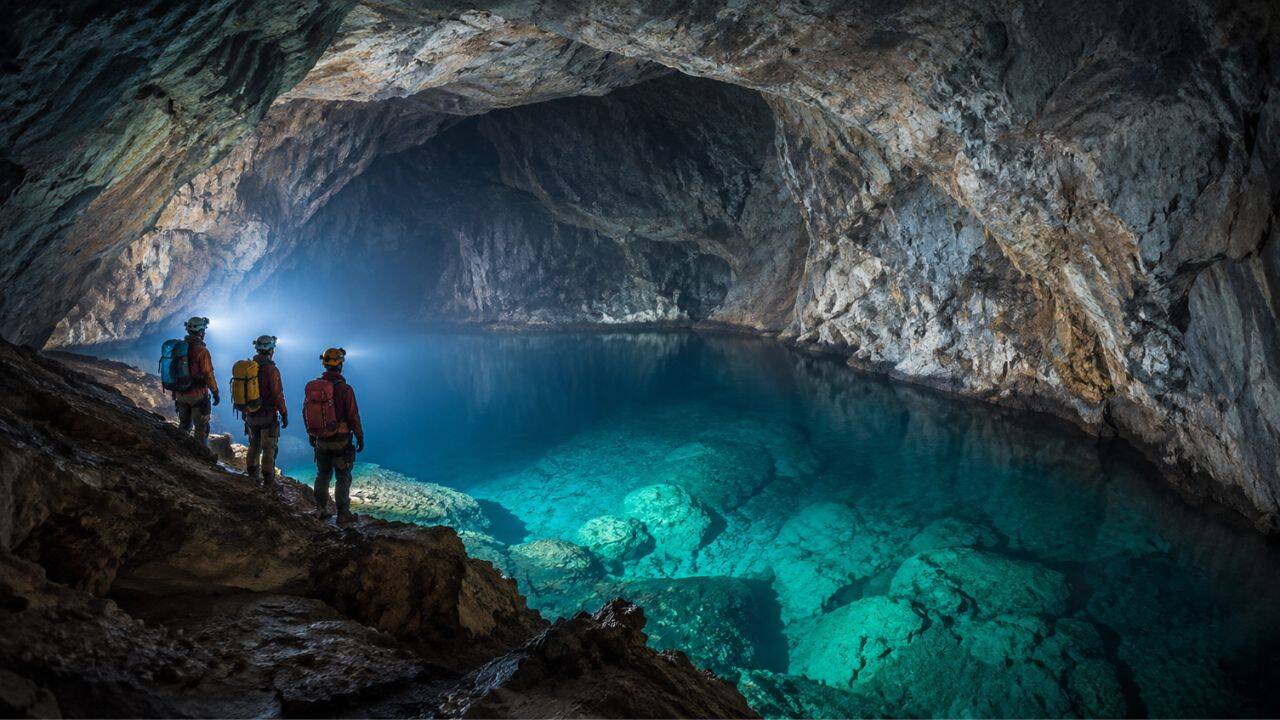
When the expedition team, led by veteran explorer Marek Audy and funded by the Czech Neuron Foundation, finally hit the floor of the cavern, they found themselves standing on the edge of an alien sea. The cavern dome enveloping the water is staggering. To give you some scale, the chamber is roughly three times larger than the main hall of the National Theatre in Prague.
The air inside Atmos Cave is thick with the stench of rotten eggs. That smell is hydrogen sulfide gas. At high concentrations, it is highly lethal. The team had to monitor air quality constantly to avoid suffocating in the dark.
Dropping the Tape Measure on a Giant
For a long time, the exact size of Lake Neuron was a matter of guesswork. The Czech cavers first breached the cavern years ago but lacked the tools to map an environment cloaked in absolute darkness and heavy steam. Traditional laser measures bounce off thick vapor, giving false readings.
The team changed the game by returning with mobile LiDAR technology and sonar scanners. By firing millions of laser pulses per second and combining them with underwater acoustic tracking, they built a highly accurate 3D model of the space. The verified numbers are staggering:
- Maximum Length: 138.3 meters
- Maximum Width: 42 meters
- Perimeter: 345 meters
- Total Volume: Approximately 8,335 cubic meters of water
To make those numbers hit home, that is enough hot mineral water to fill three and a half Olympic-sized swimming pools. The water temperature sits at a steady, bathtub-warm 26 to 27 degrees Celsius (around 79 degrees Fahrenheit).
Before this discovery, the title of the world’s largest underground thermal lake belonged to a subterranean pool hidden beneath the historic Turkish baths of Budapest, Hungary. Lake Neuron didn’t just break that record; it practically doubled it.
The Chemistry of a Cave That Eats Itself
Most caves form from the top down. Rainwater absorbs carbon dioxide from the air, turns slightly acidic, and slowly trickles down from the surface, eating away at limestone over millions of years. Lake Neuron formed in reverse. It is a product of what geologists call hypogene speleogenesis.
Deep, hyper-heated groundwater saturated with hydrogen sulfide is forced upward by geothermal pressure. As this water nears the surface and encounters oxygenated air in the rock fractures, the hydrogen sulfide gas oxidizes. This chemical reaction creates sulfuric acid.
Instead of a gentle stream carving a path, you have a highly corrosive acid eating the mountain from the inside out. The sulfuric acid attacks the limestone, dissolving it rapidly and transforming the hard rock into soft, crumbly gypsum. The cave is actively growing, hollowed out by its own toxic chemistry.
This isolated environment is a goldmine for biologists. Because the lake has been sealed in total darkness for thousands of years, its ecosystem does not rely on sunlight or photosynthesis. It is fueled entirely by chemosynthesis. Scientists are currently analyzing water samples to isolate extremophile microorganisms—bacteria and archaea that thrive on sulfur and extreme heat. There is a very high probability that some of these microscopic species are entirely new to science.
Navigating the Frontier of Modern Speleology
If you are thinking about packing a backpack and hunting for Lake Neuron yourself, don't. The site is strictly off-limits to casual tourists, and for good reason. Aside from the lethal gas levels and the technical ropework required to survive the drop, the geography itself presents massive logistical headaches.
The Vromoner valley sits squarely on the border zone between Albania and Greece. This border has been a point of political and military sensitivity for over a century. Obtaining permits from local authorities requires extensive bureaucratic navigation, and unauthorized exploration can land you in military custody or worse.
For the scientific community, the next steps don't involve tourism. They involve protection and tracing. The Czech team, including speleologist and photographer Richard Bouda, has established that Lake Neuron acts as a massive subterranean pressure valve, feeding several thermal springs throughout the surrounding valley. However, the exact pathways remain a puzzle.
Geologists are planning future expeditions using non-toxic chemical dyes to track exactly where this warm, sulfur-rich water goes when it leaves the cavern. Understanding these hidden plumbing systems is crucial for protecting the regional watershed from surface pollution and industrial disruption. The mountain is holding onto more secrets, and mapping the adjacent cave complexes like Sulfur, Breška, and Kobyla is the only way to find out how deep the network really goes.