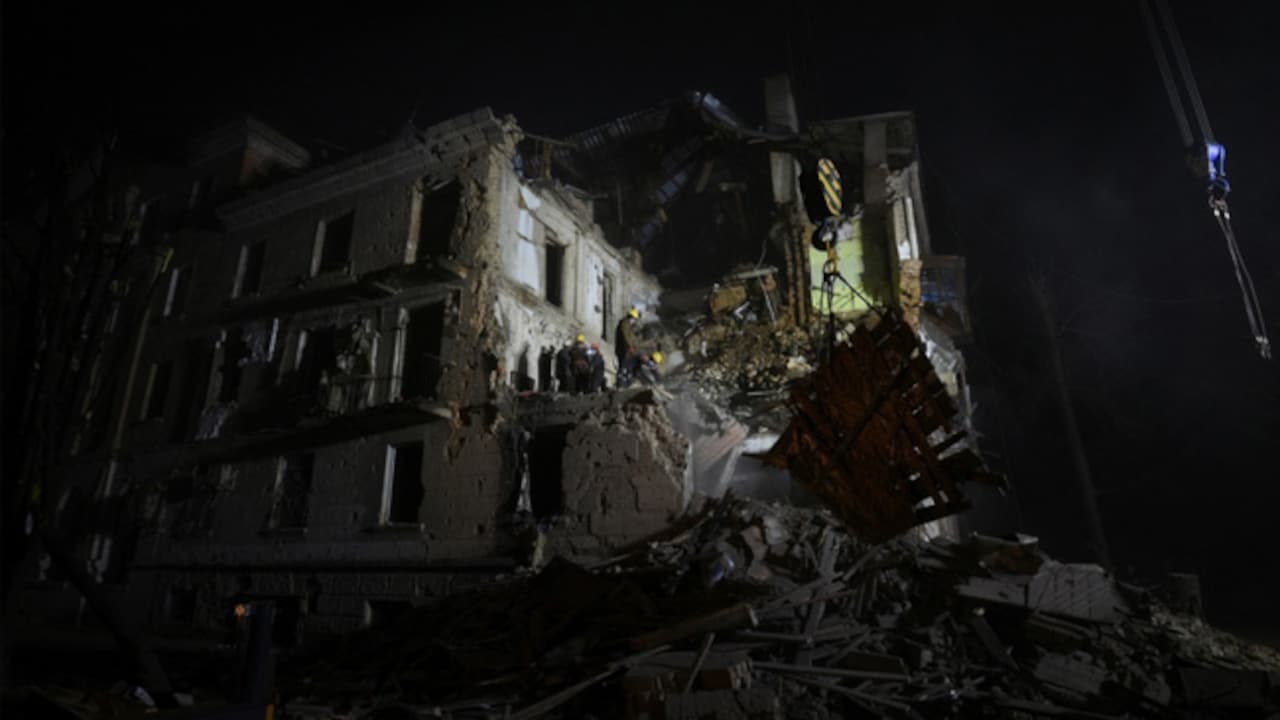
The defense establishment is currently obsessed with shading maps red. Open any mainstream military analysis website, and you will find a brightly colored graphic showing concentric circles radiating from Ukraine’s borders, deep into Russian territory. The accompanying commentary reads like a victory lap: ATACMS, Storm Shadows, and domestic Ukrainian drones can now theoretically strike thousands of square miles of Russian soil. The lazy consensus insists that reaching half of Russia means paralyzing half of Russia.
It is a comforting illusion. It is also fundamentally wrong. If you liked this post, you should check out: this related article.
Range does not equal reach, and reach does not equal impact. For two decades, military theorists have warned against the temptation of "map fatigue"—the cognitive error of assuming that because a missile can touch a coordinate, it can alter a geopolitical reality. The current media fixation on range extensions treats war like a video game where unlocking a new weapon automatically unlocks a new level of strategic advantage.
The harsh reality of deep strike mechanics tells a completely different story. The expanded strike zone is not a shortcut to victory; it is a massive logistical and operational hurdle that could drain critical assets away from the front lines where the war will actually be decided. For another look on this development, see the recent coverage from Associated Press.
The Tyranny of the Targeting Cycle
To understand why a 300-kilometer or 1,000-kilometer strike radius is not a magic wand, you have to look at the kill chain. A weapon system is only as good as the real-time intelligence driving it.
When a missile’s range doubles, the geographic area that must be scouted does not just double—it expands exponentially. Mapping, tracking, and validating targets across half of European Russia requires an immense intelligence, surveillance, and reconnaissance (ISR) architecture. Ukraine does not own a constellation of synthetic aperture radar (SAR) satellites. It relies heavily on Western intelligence sharing, commercial satellite passes, and human intelligence networks on the ground.
Imagine a scenario where satellite imagery detects a cluster of Russian Sukhoi Su-34 fighter-bombers at an airbase 400 kilometers behind the front line. By the time that image is processed, sent to a command node, verified against civilian casualties risks, translated into a mission profile, and programmed into a cruise missile, hours have passed.
Russian forces are not static statues. They have wheels. They have wings.
The moment Ukraine gained the authorization to use Western long-range weapons deeper inside Russia, the Russian military began relocating its most valuable aviation assets further inland, well beyond the reach of ATACMS. What is left within the newly opened strike zone? Hardened bunkers, empty tarmacs, and decoy targets.
Targeting an airfield without hitting the aircraft stationed there is a spectacular waste of a million-dollar missile. Yet, the media continues to tally up the number of Russian bases "within reach" as if every base contains a helpless fleet waiting to be destroyed.
The Linear Math of a Nonlinear War
Let’s look at the brutal math of ammunition stockpiles. This is where the mainstream narrative completely collapses.
The public discussions around these missile systems treat them as infinite resources. They are explicitly finite. The United States and its European allies are facing severe production bottlenecks for critical precision-guided munitions. The Pentagon is managing its own strategic readiness risks, meaning the flow of these weapons to Kyiv will always be rationed.
When you have a limited number of high-end missiles, every deep strike is a trade-off.
- Option A: Fire a salvo of Western-supplied missiles at a logistical hub 300 kilometers deep into Russia to disrupt supplies that might reach the front line in two weeks.
- Option B: Use those same precision assets to destroy a Russian command post or an air-defense radar directly threatening Ukrainian troops defending a crumbling trench line in the Donbas today.
Choosing Option A satisfies the hunger for dramatic headlines, but it starves the tactical fight. Air defense systems like the Russian S-400 and Pantsir networks are highly concentrated around deep-tier strategic assets. To get a single missile through to an inland target, Ukraine often has to fire multiple decoys and suppression missiles just to saturate the local air defenses.
You are burning through precious, irreplaceable inventory for a low-probability hit, while the front-line Ukrainian infantryman faces a relentless daily bombardment from Russian glide bombs launched just outside the tactical missile envelope.
The Air Defense Asymmetry
The contrarian truth about deep strikes is that they often play directly into Russia’s structural advantages. Russia possesses one of the most dense, multi-layered integrated air defense systems (IADS) on earth. While it has notable gaps and has been embarrassed by creative Ukrainian drone tactics, it is highly optimized to detect and intercept predictable, high-altitude ballistic trajectories or low-flying cruise missiles tracking toward fixed coordinates.
When a missile travels 500 kilometers through contested airspace, it gives the enemy’s early-warning radars ample time to track, calculate the intercept vector, and prepare a response. The deeper you strike, the more air defense layers your missile has to penetrate.
Domestic Ukrainian long-range strike drones have bypassed this through sheer volume and low radar cross-sections, hitting oil refineries and ammunition depots with impressive ingenuity. But replacing those cheap, swarm-style drone strikes with incredibly scarce Western cruise missiles changes the economic equation entirely in Russia’s favor. It costs far more to build a Storm Shadow than it costs Russia to fire an interceptor or simply rebuild a destroyed fuel tank with cheap labor.
The Myth of the Logistics Collapse
The core argument of the competitor’s piece is that putting Russian logistics within reach will choke their war machine. This assumes Russian logistics are fragile and centralized.
They were fragile in 2022. They are not in 2026.
I have watched analysts predict the imminent collapse of Russian military logistics for years based on the destruction of specific rail bridges or depot nodes. It never happens. Why? Because the Russian military is structurally designed around redundant, low-tech, brute-force logistics. They do not rely on just-in-time delivery models like a Western corporate supply chain. They rely on massive, distributed stockpiles and a willingness to absorb high friction.
If you blow up a major ammunition dump in Voronezh, the Russians do not stop firing artillery. They split their remaining stockpiles into ten smaller, civilian-looking truck depots spread across fifty villages. They adapt. By pushing the strike zone deeper, you do not stop the flow of supplies; you merely force the enemy to decentralize. And decentralization is an incredibly effective defense against a military that has a strictly limited number of precision missiles to spend.
Redefining the Real Target
If expanding the map is an illusion, what is the actual utility of these long-range weapons?
The answer lies not in widespread destruction, but in highly targeted, systemic disruption. The goal should never be to strike half of Russia just because the political green light exists. The goal must be to create localized, acute operational crises for Russian commanders.
This means ignoring the deep, flashy targets on the far edge of the circle and focusing relentlessly on the immediate operational rear—the zone between 50 and 150 kilometers behind the line of contact. This is the sweet spot. It is close enough that targeting data remains fresh and actionable, yet deep enough to disrupt the immediate reinforcement of Russian assaults.
Chasing targets near Moscow or deep in the Rostov oblast looks great on an interactive map. It makes for compelling television. But it does absolutely nothing to stop the grinding, attritional reality on the ground.
Stop looking at the red circles on the map. Stop counting the square mileage of Russia that is suddenly vulnerable. War is not an exercise in geography; it is a contest of wills, resources, and systemic endurance. The side that wins is not the one with the longest reach, but the one that uses its limited strength with the most ruthless efficiency. Dropping a multi-million-dollar missile on an empty Russian airfield just to prove you can reach it isn't strategy. It's theater.