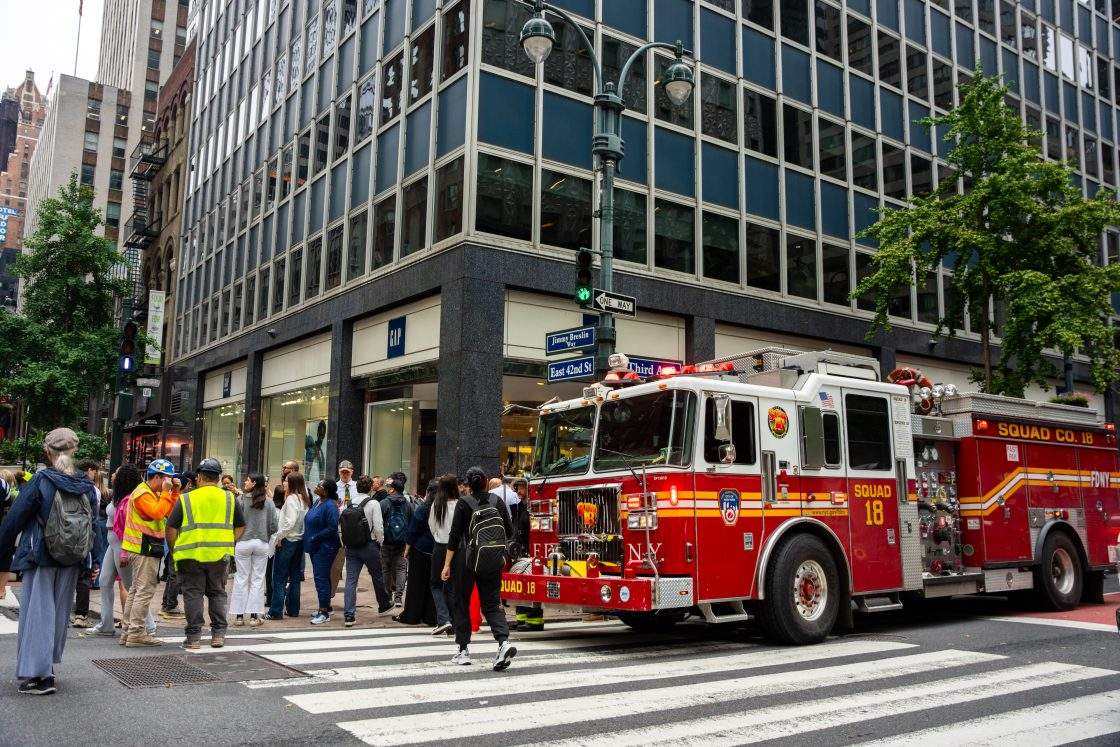
A 37-story tower doesn't just start shedding bricks during the morning rush hour unless something went terribly wrong. On a Tuesday morning in July 2026, Midtown Manhattan found out exactly what that looks like.
Emergency crews rushed to 235 East 42nd Street after reports of falling debris. What they found inside was much worse than a few loose bricks. Two massive support columns on the 21st and 22nd floors had visibly buckled. The floors between the 21st and 26th stories were sagging, and the entire structure was actively moving.
This isn't just a construction mishap. It's a wake-up call for the most hyped real estate trend in New York City history. The building, the former global headquarters of pharmaceutical giant Pfizer, was in the middle of being converted into more than 1,600 luxury apartments. Billed by architectural firm Gensler as the largest office-to-residential conversion in the city's history, the project is now a dangerous, unstable mess.
The Chaos on the Ground
The timing couldn't have been worse. At around 8 a.m., as thousands of commuters streamed out of Grand Central Terminal, the facade began to give way. First responders quickly realized the structural integrity of the high-rise was compromised.
Mayor Zohran Mamdani confirmed that nearby buildings had to be evacuated immediately. That included a neighborhood school packed with roughly 400 children. Police cordoned off 42nd and 43rd Streets between First and Third Avenues, shutting down vehicle and pedestrian traffic just a block away from the landmark Chrysler Building.
Drones are currently buzzing around the midsection of the tower. Fire Department Chief John Esposito stated that the building remains highly unstable and continues to shift. Engineers can't even enter the worst-hit floors safely, so they're relying on remote tech to figure out how to shore up the sagging sections. Miraculously, all construction workers were accounted for, and no injuries have been reported.
Why Adding Stories to Old Towers is Risky Business
To understand how a massive steel-and-concrete tower starts warping, you have to look at the engineering blueprints. The plan for the old Pfizer complex wasn't just a simple interior remodel. The developers planned to add more than a dozen new stories right on top of the original 1970s-era frame while simultaneously redesigning an adjoining tower.
Structural engineers know that vintage office buildings are heavy, but they weren't designed to be infinite blocks of Jenga. When you stack twelve or more floors of residential concrete on an existing framework, the weight distribution shifts dramatically.
Reports from workers at the scene suggest the site was plagued by fundamental structural cutting errors. Union steamfitters working nearby pointed out that the project was running with non-union labor and alleged that structural beams were cut through without proper shoring. If you cut into a core support beam under the immense pressure of added floors, gravity wins every single time. The wall framing on the 21st floor didn't just sag; it tilted completely out of alignment.
The Problem with Cheap Conversions
Everyone wants to solve the housing crisis by turning empty midtown offices into apartments. It sounds great on paper, but the reality is messy, expensive, and clearly dangerous if corners are cut.
Old office towers have massive deep floor plates. They lack the plumbing infrastructure needed for thousands of individual apartments. To make these projects financially viable, developers often try to maximize space by building upward.
Building records show that the joint venture behind the project, 235 GC LLC, was already fined by the Department of Buildings for falling debris. This wasn't a surprise freak accident. It was the predictable result of pushing an old structure past its physical limits without updating the foundation or using highly experienced crew members who know how to stabilize a shifting skyscraper.
What Happens Next to the Midtown East Corridor
Don't expect 42nd Street to return to normal anytime soon. The city's building department inspectors face a logistical nightmare. You can't just slap a brace on a buckling column when five floors above it are sagging under thousands of tons of weight.
If the building can't be stabilized by drones and remote shoring rigs, the city might have to order a partial, highly controlled demolition of the upper floors. That means extended street closures, massive traffic gridlock near the United Nations, and a complete halt to one of the city's flagship redevelopment projects.
For anyone managing an office conversion or investing in commercial real estate, the lesson is obvious. Stop treating old commercial frames like blank slates. If you're going to alter the structural load of a high-rise, skipping union expertise, ignoring minor debris fines, and rushing structural modifications will cost you far more than doing it right the first time. Watch the city building department updates closely over the next few days, because the fate of 235 East 42nd Street will dictate how strictly NYC regulates the residential conversion boom going forward.