Midnight in Tokyo. Rain slicked the neon-lit asphalt of Chiyoda City. Inside a brightly illuminated, tightly packed store, a tired salaryman reached for a warm plastic tray of chicken katsu curry. The bell above the door chimed a cheerful, synthesized greeting as a teenager walked in, desperate for a phone charger, while an elderly woman paid her electricity bill at the counter.
Every single day, this exact scene plays out millions of times across the globe. We take it for granted. We treat the convenience store as a natural feature of the modern landscape, as permanent and inevitable as trees or concrete.
It was not inevitable.
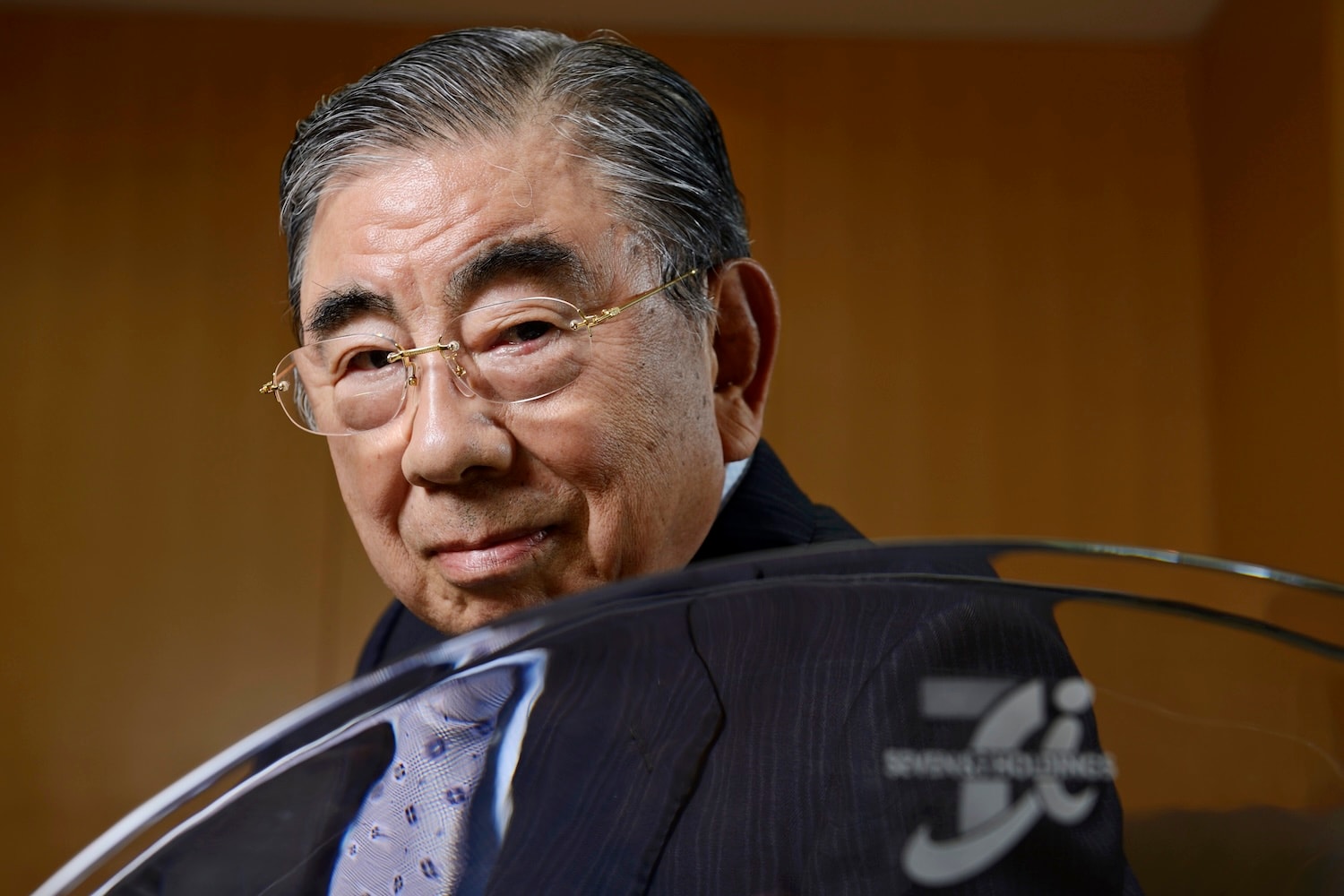
Behind the ubiquitous red, green, and orange stripes of 7-Eleven lies the story of an stubborn corporate rebel who looked at a failing American concept and saw the future of human behavior. Toshifumi Suzuki did not just build a retail empire. He re-engineered how humanity lives, eats, and spends money. When he passed away recently at the age of 93, he left behind a world completely remade in his image—spanning over 85,000 stores globally.
But to understand how he did it, you have to understand the sheer, terrifying scale of his gamble. You have to go back to 1973, when everyone thought Toshifumi Suzuki was completely out of his mind.
The American Reject
Imagine the boardrooms of Ito-Yokado, a major Japanese supermarket chain, in the early 1970s. The global economy was shaking from the oil crisis. Inside the company, executives were desperate for new growth. Suzuki, then a young, sharp-eyed executive, returned from a trip to the United States with a wild proposal. He wanted to license a strange American retail format called 7-Eleven.
His colleagues mocked him.
The logic against him was ironclad. Japan was already suffocating under the weight of small, family-owned mom-and-pop shops. The neighborhood shotengai—shopping streets—were fiercely protected by local communities and complex regulations. Supermarkets were the future; massive, cavernous spaces where people bought in bulk. Who would want a tiny store with limited selection and higher prices?
Even the American creators of 7-Eleven, Southland Corporation, were skeptical. They viewed the Japanese market as an inhospitable terrain for their model.
Suzuki saw something else. He looked past the shelves and the inventory. He looked at the changing rhythm of Japanese society. Young people were moving to the cities. Women were entering the workforce in unprecedented numbers. The traditional, multi-generational household was fracturing into single-person apartments.
People did not have time to wait for the weekend supermarket run. They did not have the space to store bulk groceries.
Suzuki realized that in a hyper-dense, fast-moving society, the ultimate currency was not money. It was time. He was not selling milk and bread; he was selling convenience.
Against overwhelming internal resistance, Suzuki pushed the deal through. The first Japanese 7-Eleven opened in Toyosu, Tokyo, in May 1974. It was a modest, cramped affair. Yet, it marked the beginning of a quiet revolution.
The Battle of the Rice Ball
To make the American concept work in Japan, Suzuki had to destroy the American playbook.
The US version of 7-Eleven relied heavily on frozen slurpies, hot dogs, and large boxes of processed goods. That would never fly in Tokyo. Japanese consumers demanded absolute freshness. They wanted their food to taste like it came from a home kitchen, not a factory assembly line.
Consider the humble onigiri—the rice ball. It is the quintessential Japanese comfort food, wrapped in crisp nori seaweed. For centuries, it was strictly homemade. The idea of buying a mass-produced rice ball from a corner store was offensive to the culinary sensibilities of the average Japanese citizen.
Suzuki insisted that 7-Eleven must sell them.
The early iterations were disastrous. If you wrapped the rice in seaweed ahead of time, the moisture from the rice made the seaweed soggy and rubbery by the time the customer bought it. Suzuki refused to accept mediocrity. He pushed engineers and packaging designers to find a solution.
The result was a stroke of mechanical genius: a patented, three-tier plastic film packaging system that kept the crispy seaweed entirely separate from the moist rice until the exact moment the customer pulled the tab to open it.
It was a massive hit. It changed the entire fast-food culture of a nation. Suzuki proved that convenience did not have to mean a sacrifice in quality. He transformed the convenience store from a place of desperate, late-night necessity into a daily culinary destination.
The Ghost in the Machine
By the late 1980s, Suzuki faced a new crisis. The sheer volume of products moving through his growing network of stores was becoming impossible to manage. Stores were running out of popular items while unpopular stock collected dust on the shelves.
In a traditional retail setup, managers guessed what would sell based on intuition. Suzuki hated guessing. He demanded precision.
He pioneered the implementation of the Point of Sale (POS) system in Japan long before it became a global standard. Every time an item was scanned at a 7-Eleven register, data was harvested. But Suzuki’s genius was not just in collecting data; it was in understanding the human element behind the numbers.
He realized that data without context is useless noise.
He trained store managers to look at the weather forecasts, local school schedules, and neighborhood festival calendars. If a sudden heatwave was predicted for Tuesday afternoon, the store did not wait for the shelves to empty of cold noodles; they ordered extra shipments on Monday night based on the data-driven hypothesis of human discomfort.
This became known as Tanpin Kanri—item-by-item inventory management. It turned every single store clerk into a sociologist. They weren't just ringing up purchases; they were predicting human desires on an hourly basis.
The efficiency was terrifyingly beautiful. Trucks rolled through Tokyo in tightly coordinated, temperature-controlled fleets, delivering fresh food up to four times a day. The inventory flipped constantly. A store could completely change its face between the morning rush hour and the midnight lull.
The Student Becomes the Master
While Suzuki’s empire flourished in Japan, the original American parent company, Southland Corporation, was bleeding out.
Blinded by corporate debt, real estate missteps, and a failure to adapt to changing American demographics, Southland slid toward disaster. By 1990, the pioneers of the convenience store were facing bankruptcy. The American dream that Suzuki had borrowed was dead on its home turf.
Then came the ultimate corporate plot twist.
In 1991, Suzuki’s Seven-Eleven Japan, along with its parent company Ito-Yokado, bought a majority stake in Southland Corporation. The student had acquired the master. Suzuki took over the failing American giant and systematically applied his obsessive Japanese operational standards to the neglected US stores. He cleaned them up, upgraded the logistics, and refocused them on fresh, high-quality offerings.
It was a stunning validation of his life’s work. The corporate world watched in awe as a Japanese executive rescued an iconic American brand using principles that those same Americans had once dismissed as unworkable.
The Infrastructure of Existence
As the decades marched on, Suzuki stopped viewing 7-Eleven as a chain of retail stores. He began treating it as social infrastructure.
When a devastating earthquake struck Kobe in 1995, regular supply chains shattered. The government struggled to get food and water to survivors. Suzuki did not wait for official clearance. He ordered 7-Eleven delivery helicopters to bypass broken roads, flying fresh food and supplies directly into the disaster zones.
During subsequent disasters, 7-Elevens were often the first businesses to turn their lights back on, serving as beacons of safety, electricity, and hot food in pitch-black, traumatized neighborhoods.
He integrated life into the stores. Need to print a government form? Go to 7-Eleven. Need to withdraw cash from an international bank account at 3:00 AM? Go to Seven Bank, an ATM network Suzuki created inside his stores despite fierce resistance from traditional Japanese banks. Need to ship a package across the country? Drop it off at the counter with your morning coffee.
He turned the convenience store into the central nervous system of modern Japanese life.
The Cost of the Clock
To achieve this level of perfection, Suzuki was notoriously demanding. He was a perfectionist who could be cold, uncompromising, and relentlessly focused on execution. He did not tolerate excuses. If a product failed, it was because the team had not thought deeply enough about the consumer.
This obsession created an ecosystem of relentless pressure. Behind the bright, welcoming lights of the stores stood legions of franchise owners working grueling hours, delivery drivers racing against strict digital countdowns, and corporate suppliers caught in a never-ending cycle of product reinvention.
In his later years, Suzuki faced internal corporate battles. The world was changing again, with digital e-commerce challenging physical retail. In 2016, following a bitter boardroom clash over succession plans and activist investor pressure, the aging titan stepped down from active leadership of Seven & i Holdings.
It was a messy, human end to a legendary corporate tenure. Yet, his departure did nothing to dim the lights of the empire he built.
The Light That Never Goes Out
We live in an era of digital frictionlessness, where we expect everything to appear at the swipe of a thumb. We forget that before there was an app, there was a physical store on the corner that figured out how to make the world bend to our immediate needs.
Toshifumi Suzuki understood something fundamental about the trajectory of modern civilization. He understood that as life grew more complex, individuals would crave simplicity. He realized that the greatest luxury you could offer a person was the ability to reclaim five minutes of their day.
He did not just witness history; he built the stage upon which modern daily life is performed.
Tonight, somewhere in a bustling metropolis, a door will chime. A lonely worker will find warmth, a student will find fuel, and a neighborhood will find a steady, reliable pulse. That bright, unassuming corner is the monument of a man who looked at a chaotic world and decided he could make it run on time.