The mud of the Malaysian peninsula does not easily give up what it has swallowed. It clings to boots, weights down machinery, and preserves the heavy, rhythmic prints of an animal whose memory stretches back further than the asphalt roads cutting through its ancestral home.
Imagine the sound of timber falling in a rain-soaked valley. To us, it is commerce. To an elephant, it is a falling wall.
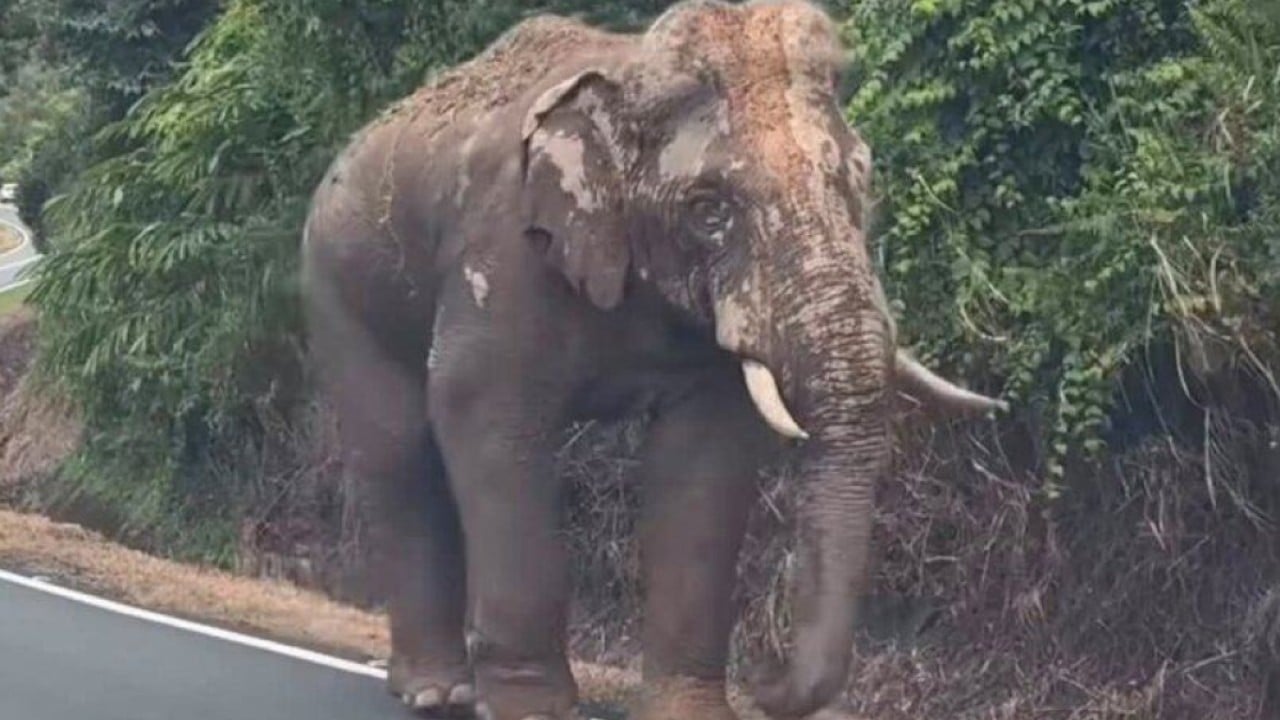
His name is Sulong. He is thirty-two years old, standing nearly three meters tall at the shoulder, carrying tusks that curve like broken scythes. For over a century, his lineage walked these exact ridgelines in Terengganu and Kelantan, moving in quiet herds across unbroken canopies that stretched from horizon to horizon. They knew every salt lick, every fruiting fig, every ancient path carved deep into the soil.
Then came the red earth.
By the time wildlife authorities found Sulong, he was moving with a terrible, listing limp. He had traversed roughly one hundred kilometers of fragmented terrain—crossing paved highways where cars shrieked past like metal hornets, skirting palm oil plantations where the trees stood in sterile, military rows, and navigating muddy drainage ditches carved by heavy excavators. His left front leg was swollen, scarred by what veterinarians later identified as an old snare injury exacerbated by the sheer, grinding agony of continuous travel.
He was walking home. Not because he wanted to graze on new pastures, but because the forest that used to be his bedroom had been replaced by rows of acacia and the raw, bleeding gashes of a commercial logging concession.
Wildlife officials from the Department of Wildlife and National Parks Peninsular Malaysia, known locally as Perhilitan, intervened not a moment too soon. They found him standing in a patch of secondary scrub, exhausted, his ribs pressing hard against his dusty hide, blinking slowly against the tropical sun. He had nowhere left to go, yet his feet were still pointed north, toward the deep interior where the air smelled of damp moss and rotting leaves instead of diesel exhaust.
His journey sparked a firestorm across the country. But the debate is not just about a single, battered bull elephant. It is about a collision between two irreconcilable worlds.
The Geography of Disappearance
To understand Sulong’s trek, you have to look at a map of modern Malaysia not as lines and provinces, but as a fractured mirror.
Peninsular Malaysia has lost vast swathes of its primary rainforest over the past few decades. According to data from environmental monitoring groups like Global Forest Watch, the country experienced tree cover loss that steadily chipped away at the Central Forest Spine—a vital ecological corridor designed to allow megafauna to move safely between protected reserves.
When you cut a road through a forest, you do not just divide trees. You fracture populations. You turn living creatures into refugees in their own land.
Consider what happens next to an elephant herd when a logging concession is approved. The canopy opens up. Heavy machinery compacts the soil. Streams run thick with silt, choking out freshwater fish and altering the drinking holes that animals have relied on for generations. Deprived of their traditional foraging grounds, elephants do what instinct commands them to do: they look for home.
They walk.
Sometimes, they walk straight into smallholder farms, tipping over banana trees and chewing on sugar cane. This is what farmers call human-wildlife conflict. It is a sterile term for a terrifying reality. Picture standing on your front porch in the dead of night, hearing the splintering of wood, and shining a flashlight to find a four-ton animal standing in your backyard, looking just as confused and desperate as you are.
Sulong’s one-hundred-kilometer trek brought this invisible crisis into the bright, uncomfortably public glare of national media. Newspapers ran headlines about his injury. Conservationists pointed to his scarred leg as physical proof of habitat fragmentation. Timber industry representatives countered with economic statistics, pointing out that logging provides jobs, sustains rural livelihoods, and contributes heavily to the regional economy.
Both sides are speaking fluent truth. And both sides are missing the forest for the timber.
The Cost of Convenience
I remember standing on the edge of a newly cleared logging tract in Southeast Asia several years ago. The silence was the first thing that struck me. A healthy rainforest is never quiet; it is a chaotic, deafening symphony of cicadas, gibbons, hornbills, and the rustling of countless unseen lives. A cleared tract is dead silent, save for the whining buzz of blowflies and the distant rumble of a logging truck grinding up a gravel grade.
The air tastes different there. It lacks the heavy, fertile perfume of decay and rebirth. It is hot, flat, and sharp with the smell of scorched topsoil.
When forests are logged under selective management systems—a practice championed by forestry departments to ensure sustainable timber yields—the theory is that the canopy will eventually regenerate. And biologically, to an extent, it does. Pioneer species like macarangas and ferns rush in to fill the gaps.
But an elephant does not eat ferns. An elephant needs massive amounts of calories, diverse vegetation, and, crucially, space. When logging roads crisscross a forest, they act as vectors for poachers, illegal miners, and human encroachment. They break the wild into bite-sized pieces, transforming a continuous sanctuary into a series of isolated islands.
An animal trapped on an island cannot survive indefinitely. Inbreeding depression, resource depletion, and direct conflict with humans become inevitable. Sulong’s journey was an act of biological desperation. He was trying to cross the gaps in a broken map.
The Science of the Path
Why did Sulong pick that specific route?
Elephants possess spatial memories that rival our own. Older matriarchs and bulls carry mental maps passed down through generations, encoding the locations of seasonal water sources and ancient migration corridors. When loggers move into a valley, they disrupt these mental coordinates.
Imagine trying to navigate your hometown after every building has been knocked down, the street signs removed, and deep trenches dug across your daily commute. You would rely on muscle memory. You would follow the general direction of the sun, the lie of the hills, the pull of home.
That is what Sulong did. Every step on that injured leg was a testament to an internal compass that refused to yield to industrial zoning permits.
Veterinarians who treated him noted that the wound on his leg was likely caused by a wire snare, a cheap and indiscriminate trap often set by poachers looking to catch wild boar or deer. These snares do not discriminate. They clamp down on anything that steps into them, tightening with every frantic pull. Sulong had managed to break free, but the metal had chewed deep into his flesh, leaving an open, weeping sore that became infected as he dragged it through miles of mud and swamp.
Despite the pain, he kept walking north.
There is a profound humility required to witness an animal endure such suffering simply to reach the place where he belongs. We build fences, plant crops, pave highways, and extract timber, operating under the assumption that the earth is a blank ledger waiting to be balanced. Yet every so often, a creature like Sulong steps out of the treeline, bleeding and defiant, to remind us that we share this geography with beings who remember a time before the chainsaws.
Beyond the Headlines
The debate ignited by Sulong’s trek has settled into the familiar grooves of modern environmental politics. Environmentalists demand immediate moratoriums on logging within critical elephant corridors. Industry advocates warn of economic stagnation and job losses in rural timber towns. Politicians promise committees, studies, and balanced approaches.
Meanwhile, the rain falls hard on the logged ridgelines of Terengganu.
The mud washes down the slopes, choking the rivers below with red silt. Somewhere out there in the remaining tracts of old-growth forest, younger elephants are growing up in an environment far smaller and more perilous than the one their parents knew.
Sulong’s story did not end with his rescue. After receiving medical treatment, anti-inflammatory drugs, and wound cleaning from Perhilitan veterinary teams, he was translocated to a safer, deeper forest reserve—away from the highways, away from the active concessions, away from the immediate threat of human conflict.
He woke up in a strange new valley. The trees were tall, the water was clean, and the air smelled of deep earth.
Whether he knows he is safe now is impossible to say. But as he steps out into the morning mist, testing his healing leg against the damp soil, the silence of the forest closes in around him, unbroken and vast.