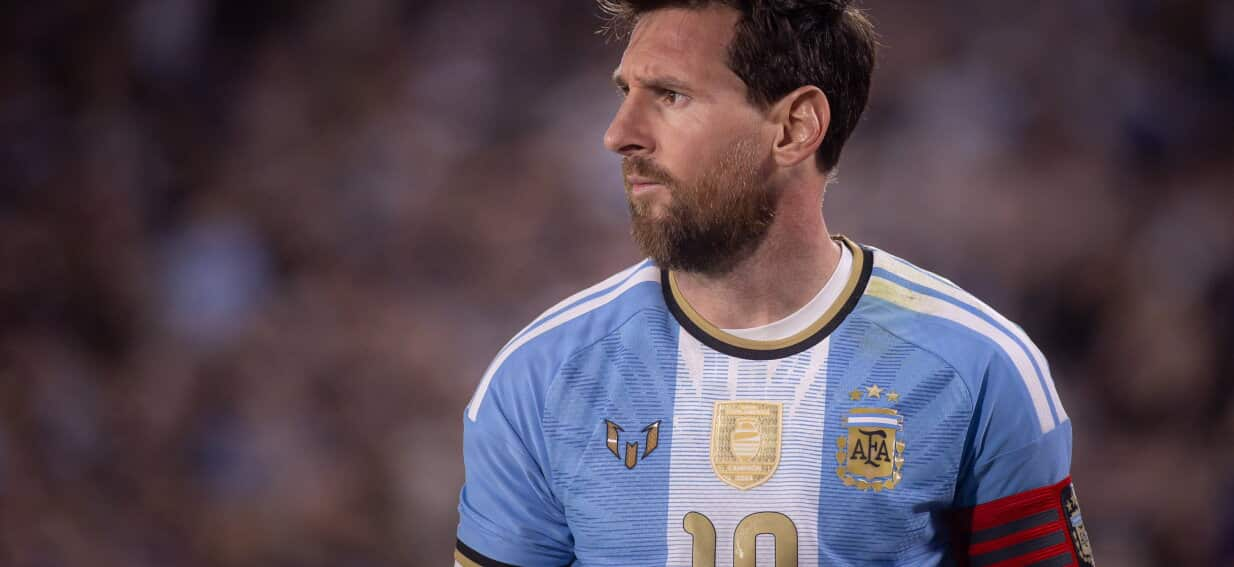
The air in Buenos Aires tasted like wet asphalt, roasted choripán, and the quiet electricity of a million people holding their collective breath. It was past midnight, but the streets were rivers of shifting blue and white. They had not come to celebrate a victory in a sterile tournament opener or a routine qualifier against a lesser opponent. They had come to guard a ghost. Or worse, the departure of one.
For two decades, the name Lionel Messi had been more than a noun. It was a weather pattern. It was an excuse to leave work early, a reason to weep into a lukewarm beer at a corner café in Palermo, a shared language spoken by cab drivers and architects alike. And now, the whisper was spreading through the cracked speakers of neighborhood radios and glowing smartphone screens: He is tired. He is done.
To understand why a nation of forty-five million people treats the retirement of a soccer player like a national bereavement, you have to understand what it means to carry the weight of an unpayable debt. Argentina has survived economic collapses, hyperinflation, and political tremors that would flatten lesser societies. Through every dark chapter, football was the communal living room where everyone spoke the same truth. And for a long time, that truth was agonizingly incomplete.
Messi left home at thirteen. He crossed an ocean with a growth hormone deficiency, a heavy heart, and a left foot that moved like a compass needle finding true north. In Barcelona, he became a myth encased in Catalan gold. He won everything. He broke every record that stood in his path. He danced through defenses of grown men who looked like statues caught in a storm. Yet, back home, the skepticism lingered like a persistent fog. He speaks with a Catalan accent, they muttered. He plays for Barcelona, not for us.
They forgot that home is not just a place on a map; it is an ache in the ribs.
Consider the summer of 2016. East Rutherford, New Jersey. MetLife Stadium. Another final. Another penalty shootout slipping through clutching fingers like dry sand. When Messi blasted his penalty over the crossbar, he did not just miss a kick. He shattered under the unbearable accumulation of expectation. In the suffocating humidity of the post-match press room, his voice was hollowed out, stripped of its usual armor.
"For me, the national team is over," he said.
That was the first retirement. It was not a tactical decision. It was an exhaustion of the soul. He had run himself ragged trying to buy the love of a country that demanded perfection as the price of admission. He wanted to lay down the cross. Who could blame him?
Yet, humans are stubborn creatures, bound to their grief and their hopes. The country did not accept his exit. They flooded the streets, not in anger, but in a sudden, blinding clarity of loss. Children held handwritten cardboard signs in the rain. Fans chased his car. A nation realized, with a jolt of pure terror, what life would look like in the gray, Messi-less expanse. It would be efficient, perhaps. But it would be cold.
So he returned. He always returned. Because love, true love, is rarely clean. It is messy and demanding and irrational.
Fast forward through the brutal cycles of pain and perseverance. The 2018 heartbreak in Russia. The shifting tides under a new generation of teammates who looked at him not as a distant god, but as an older brother they needed to protect. By the time Qatar arrived in the winter of 2022, Messi was no longer the electric twenty-something burning defenders with blinding pace. He was older, slower by a fraction of a second, but infinitely wiser. He played with the stillness of a chess grandmaster who already knew the final three moves of the game.
When he finally lifted that heavy, golden trophy under the artificial lights of Lusail Stadium, it felt less like a sporting triumph and more like a cosmic ledger finally balancing its accounts. The ghost was laid to rest. The boy from Rosario had brought it home.
And yet, time remains undefeated.
International retirement does not arrive with a dramatic curtain call. It creeps in through the joints. It announces itself in the heavy legs after a ninety-minute slog against a bruising South American defense in the high altitude of La Paz. It whispers in the quiet spaces between club seasons in Miami, where the traffic is slower and the sunsets bleed orange over Biscayne Bay.
When Messi recently spoke of his international future—acknowledging the physical reality of the years stacking up against him—it carried a different resonance than that desperate night in New Jersey. There was no panic in his voice. There was no self-flagellation. There was only the quiet acceptance of a man who has given every drop of marrow he possessed to a game that demanded everything.
"I want to be here the rest of my life," he confessed, speaking of the connection he finally forged with his people, the invisible tether that stretches from the dusty pitches of Grandoli to the roar of Monumental Stadium.
He is not gone yet. But the twilight has a distinct beauty all its own.
Think of a master painter who has spent fifty years staring at the same canvas, applying layer upon layer of oil until the texture becomes a history of its own. He no longer needs to rush his strokes. Every movement of his brush is deliberate, freighted with memory. That is what watching Lionel Messi in his international autumn has become. Every touch of the ball is an act of preservation. Every chipped pass into the box is a postcard from a career we will spend decades trying to explain to people who weren't lucky enough to witness it.
Down on Avenida Corrientes, the cafes are still loud. The waiters are still arguing about tactics that no manager will ever implement. But beneath the noise, there is a collective maturity. Argentina has grown up alongside its greatest son. They no longer need him to be a savior every single minute of every single match. They just need him to be there, walking the same earth, wearing the same shirt, carrying the same impossible dream.
The sun dips below the horizon of the Río de la Plata, turning the water the color of bruised silver. Somewhere out there, a kid is kicking a deflated ball against a concrete wall, trying to curl it into an imaginary top corner. He is not thinking about age. He is not thinking about retirement. He is just watching the ball spin, tracing the geometry of a miracle, waiting for the magic to begin.