The air inside the transport van smelled of industrial-grade disinfectant and old, cold fear. It was a sterile, metallic scent that had defined every second of their lives until this moment. There were no names in the facility, only numbers tattooed in blue ink on the inside of velvet-soft ears.
For the four thousand beagles bred at the Envigo research facility in Cumberland, Virginia, the world was a series of stainless steel bars and concrete floors. They had never felt the uneven give of grass under their paws. They had never seen the sun except as a filtered, artificial glare through reinforced glass. They were "biological models," a clinical term used to scrub the life out of a living creature.
Then, the engines started.
The Quiet Inside the Cages
To understand the scale of the rescue that unfolded in the summer of 2022, you have to understand why beagles are the preferred choice for laboratory testing. It isn't because they possess some unique physiological trait that mirrors human biology better than a spaniel or a terrier. It is because they are pathologically forgiving.
Beagles are bred for their docility. They are small enough to be easily handled and remarkably reluctant to bite, even when subjected to invasive procedures. They are the "good students" of the animal kingdom, conditioned by millennia of evolution to want to please the humans standing over them. In a lab setting, this gentle nature is a liability. It makes them the perfect, compliant subjects for toxicology reports and pharmaceutical trials.
Consider a hypothetical beagle—let’s call him Seven. Seven has lived his entire three years in a cage roughly the size of a dishwasher. He has been fed a nutritionally complete but tasteless kibble. He has seen humans, but usually, those humans are wearing PPE, carrying clipboards or needles. He doesn't know what a ball is. He doesn't know that his tail is meant to wag at the sound of a front door opening.
When the Department of Justice filed its complaint against Envigo, the details were harrowing. This wasn't just about the ethics of animal testing; it was about a systemic failure of basic care. Inspectors found dogs being euthanized without anesthesia. They found nursing mothers denied food. They found a mortality rate that would be unthinkable in any home or reputable shelter.
The Logistics of Mercy
Moving 4,000 dogs is not a simple act of opening doors. It is a massive, grinding gear-shift of logistics that involves the Humane Society of the United States (HSUS), dozens of shelters across the country, and hundreds of volunteers. It is an operation that looks more like a military extraction than a puppy adoption drive.
Imagine the coordination required. You cannot simply put 4,000 traumatized animals into the back of a truck and hope for the best. Each dog needed a medical assessment. Each dog needed a transport crate. Most importantly, each dog needed to be taught how to be a dog.
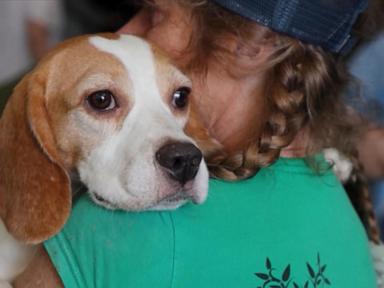
When the first wave of beagles—a group of about 1,500—began their journey toward freedom, the rescuers noticed something heartbreaking. Many of the dogs didn't want to leave their cages. The cage was a place of suffering, yes, but it was the only reality they had ever known. To a dog that has spent its life on a wire floor, the sensation of solid earth is terrifying.
One volunteer described the "beagle crawl." Instead of walking upright, many of the rescued dogs would press their bellies to the ground, sliding forward an inch at a time, their eyes wide with the sensory overload of the outside world. The wind on their fur was a threat. The sound of a bird was a jump-scare.
The Human Element in the Chaos
Behind every one of those 4,000 beagles was a person—often a volunteer who had taken weeks off work to drive across state lines. These people weren't just transporting cargo; they were acting as transitional anchors for souls that had been adrift in a sea of clinical indifference.
The cost of this operation was staggering. Beyond the fuel and the crates, the medical bills for a population of dogs that had been neglected for years ran into the hundreds of thousands. Many of the dogs had dental issues from chewing on cage bars. Many had skin infections. Others were simply shut down emotionally, staring at the back of their crates in a state of learned helplessness.
But then, the shifts started to happen.
It happened in small, quiet ways. A volunteer would sit outside a crate for four hours, reading a book aloud, until a wet nose finally poked through the door. A foster parent would spend a week sleeping on the kitchen floor because their new charge was too terrified to be left alone in the dark.
This is the invisible work of animal rescue. It isn't just the high-stakes moment of the "bust" or the dramatic video of the cages opening. It is the three-month-long process of teaching a dog that a human hand raised toward them is meant for a scratch behind the ears, not for an injection.
The Legislative Shadow
The Envigo rescue wasn't just a feel-good story; it was a symptom of a much larger, uglier battle regarding how we treat the "least of these" in the pursuit of scientific progress. While the facility in Cumberland was shut down due to egregious violations of the Animal Welfare Act, the industry itself remains largely opaque.
The facts are sobering. Thousands of animals are still used in testing facilities across the globe every year. While many scientists argue that animal models are currently necessary for life-saving medical breakthroughs, the Envigo case proved that even within that framework, the basic standards of decency can vanish when profit and efficiency become the only metrics of success.
The legal victory that led to the release of these dogs was a rarity. It required a mountain of evidence and the intervention of the federal government to break the seal on those facility doors. It serves as a reminder that the law is often the only barrier between a living being and its total commodification.
The First Step on the Grass
There is a video, filmed by one of the foster families who took in a mother beagle and her pups from the facility. In it, the mother is standing at the edge of a deck. Below her is a lush, green Virginia lawn.
She pauses. She sniffs the air—air that doesn't smell like bleach. She looks back at the human holding the camera, a look of profound uncertainty in her eyes. Then, she puts one paw down. Then another.
She doesn't run. She doesn't bark. She simply stands there, her toes sinking into the grass for the first time in her life. She looks up at the sky, her long ears twitching at the sound of the wind in the trees. In that moment, she is no longer a number. She is no longer a biological model. She is just a dog, finally realizing that the world is much bigger, and much kinder, than the four walls of a cage.
The 1,500 beagles that led the exodus from Envigo weren't just being moved to new locations; they were being returned to themselves. They were being given the right to be curious, to be messy, to be loud, and to be loved.
The blue ink in their ears will eventually fade or be hidden by the growth of their fur, but the memory of the cage remains in the way they flinch at a loud noise or the way they treasure a soft bed. Yet, for every flinch, there is now a hand to steady them. For every memory of the cold metal, there is the warmth of a living room floor.
The long road from the research facility didn't end when the trucks stopped. It ends every day, in thousands of homes across the country, where a beagle finally decides it’s safe enough to close its eyes and sleep.
And they finally do. Deeply. Without fear.