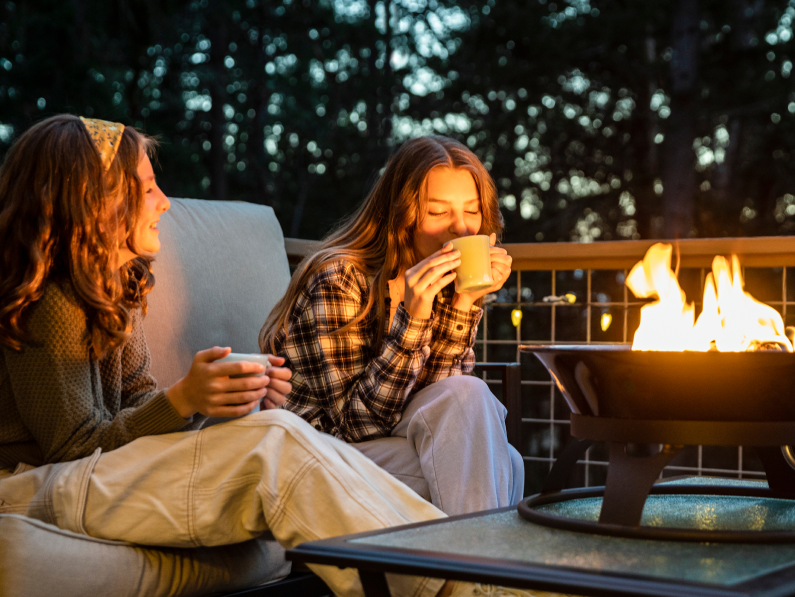
October arrives with a quiet theft. One morning, the air smells sharper, carrying the unmistakable scent of damp earth and woodsmoke from a chimney three houses down. You step outside with your morning coffee, wearing a light sweater, and you feel it—that abrupt, chilling reminder that the world outdoors is about to close its doors. For months, the backyard was an extra room. It was where dinners stretched past twilight, where bare feet found warmth on sun-baked stone, and where time seemed elastic enough to hold just one more conversation.
Then the frost hits. And we retreat.
We pack away the cushions like winter coats, dragging heavy fabric bins into the damp gloom of the garage. We roll up the outdoor rugs and shut off the gas line to the fire table. It is an annual surrender, graceful perhaps, but entirely unnecessary.
Consider Sarah and Mark, who live in a split-level brick house with a modest flagstone patio that catches the afternoon southern exposure. For five years, their outdoor life followed a strict calendar dictated by the weather bureau. Memorial Day to Labor Day was the season of living outside. September was the awkward transition. October was the padlock.
Until the year they decided to stop watching the calendar and start managing the microclimate.
The mistake most of us make is treating the patio as a seasonal appliance rather than a permanent architectural horizon. We buy flimsy chairs designed for a three-month lifespan and fire pits that throw heat sideways instead of down. When the mercury drops below sixty degrees, the physics of our outdoor spaces fail us. The wind steals our body heat, the hard ground freezes our soles, and the gathering dark feels less like dusk and more like eviction.
To extend the patio season deep into November—and sometimes right through the teeth of December—requires a shift in perspective. You do not fight the cold; you curate an ecosystem of resistance.
It starts from the ground up. Concrete and stone are thermal sponges, drinking the chill of the earth and radiating it straight up through your shoes. Sarah learned this the hard way, standing in wool socks that felt like wet cardboard while her upper body roasted near an infrared heater. The first non-negotiable upgrade is a high-pile outdoor rug. Not a decorative flat-weave mat, but a dense, substantial barrier that traps a layer of stationary air between your feet and the frozen stone. Physics is unforgiving, but it can be managed with loft.
Next comes the architecture of the wind. A patio in autumn is rarely too cold because of the ambient air temperature; it is cold because of convection. A five-mile-per-hour breeze strips the warm micro-layer of air from your skin in seconds, making sixty degrees feel like forty.
Mark spent a weekend building what they now call the acoustic baffle—a series of strategically placed planters and a low-profile privacy screen made of western red cedar. It didn't block the view of the garden, but it broke the laminar flow of the northern wind. Suddenly, sitting outside was no longer an endurance test. It was an invitation.
But windbreaks and rugs only stop the bleeding. To truly conquer the shoulder seasons, you have to master the thermodynamics of radiant heat.
Traditional wood-burning fire pits are romantic, but they are inefficient performers. They demand constant tending, fill your fleece jackets with the smell of unburned creosote, and send ninety percent of their thermal energy straight up into the stratosphere. If you want to sit outside when the leaves are gone, you need directional firepower. Propane-fueled infrared towers or mounted overhead quartz heaters change the math entirely. They heat objects, not air. When you sit beneath them, you feel like you are standing in a beam of Mediterranean sunlight, even as your breath mists in the shadows beyond the patio's perimeter.
Lighting, too, undergoes a metamorphosis in the autumn garden. Summer lighting is about ambiance—tiny fairy lights and flickering candles meant to accent a warm night. Autumn lighting must be protective. It needs to fight the oppressive, early-falling dark.
By late October, the sun vanishes by six o'clock, plunging the yard into an ink-black abyss that feels hostile. Replacing stark security floods with warm, low-slung LED path markers and amber Edison bulbs strung beneath the pergola creates a psychological boundary. Inside the glow, it is still an afternoon terrace. Outside is just the wilderness.
There is also the matter of textile psychology. In July, we crave linen and canvas—fabrics that breathe, that shrug off moisture and dry in minutes. October demands weight. Heavy wool blends, faux shearling throws, and heavy-duty canvas cushion covers treated with water-repellent polymers. When you wrap yourself in a ten-pound wool blanket that smells faintly of lanolin and cedar, the drop in temperature stops being a physiological threat and becomes part of the sensory charm.
We have been conditioned to view our homes as airtight boxes, sealed against the elements from Halloween to Easter. This is a relatively modern invention. For most of human history, the transition between indoor hearth and outdoor yard was porous and continuous.
When you refuse to pack the patio away, something subtle shifts in your domestic rhythm. You notice the migrating geese flying low over the roofline because you are actually outside to hear their cries. You watch the frost etch geometric ferns across the metal table while you drink your black tea. You reclaim sixty, ninety, a hundred days of your year that were previously written off as lost time.
Sarah and Mark still put the cushions away eventually—usually around mid-January when the snow drifts pile four feet deep against the sliding glass door. But even then, they leave one chair out. Just to prove a point.
The season isn't over when the calendar says it is. It's over when you stop showing up.