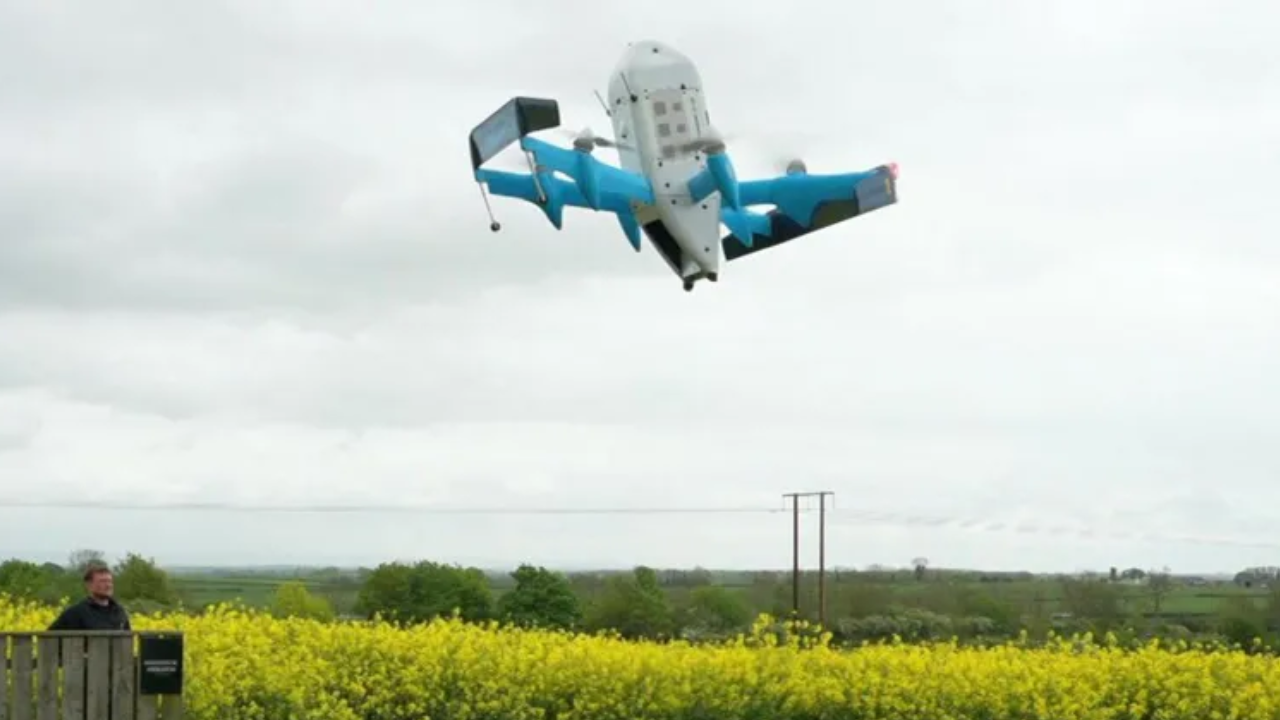
Amazon’s deployment of the MK30 drone in Darlington represents more than a regional logistics trial; it is a live-environment stress test of the unit economics and regulatory thresholds required to bypass traditional road-based last-mile delivery. While public discourse focuses on the novelty of aerial packages, the strategic value lies in the transition from a labor-dependent delivery model to a capital-intensive, automated system. This transition is governed by three primary variables: operational throughput, airspace integration, and the energy-to-payload ratio of the MK30 platform.
The Operational Mechanics of the MK30 System
The Darlington pilot utilizes the MK30, a hexacopter designed to function in weather conditions that grounded previous iterations. The efficacy of this hardware is measured by its ability to operate within a "Prime Air" delivery window of sub-60 minutes. The shift from the MK27-2 to the MK30 introduces two critical engineering adjustments: a 25% reduction in perceived noise and an expanded temperature range.
From a structural standpoint, the delivery cycle follows a rigid four-stage sequence:
- Automated Induction: Packages under 2.27kg (5lbs) are sorted and loaded within the fulfillment center's secure airside perimeter.
- Vertical Ascent and Transition: The drone utilizes vertical take-off and landing (VTOL) to minimize the physical footprint required at the launch site, transitioning to wing-borne flight for efficiency.
- Sense and Avoid (SAA) Execution: Onboard sensors detect uncooperative obstacles—such as birds, other drones, or power lines—without relying on ground-based radar or ADS-B signals from other aircraft.
- The Delivery Drop: The drone descends to a safe altitude over a designated "marker" at the customer's property, releases the package, and returns to base.
The Darlington site is strategically positioned to test this sequence in the UK’s idiosyncratic meteorological conditions. The success of the pilot depends on the drone's ability to maintain a high "sortie rate"—the number of flights per day—despite rain or wind speeds that would typically compromise lightweight carbon-fiber frames.
The Economics of the Last Mile Bottleneck
Last-mile delivery accounts for approximately 53% of total shipping costs. In a traditional van-based model, these costs are dominated by driver wages, fuel, and the inefficiencies of urban congestion. Amazon’s drone strategy seeks to decouple delivery volume from headcount.
The cost function of a drone delivery can be expressed through its energy consumption and maintenance cycles. Unlike a delivery van that carries 100+ packages on a circuitous route, a drone operates on a point-to-point radial model.
- Variable Cost Reduction: Once the infrastructure is capitalized, the marginal cost of a flight is reduced to electricity and periodic rotor/battery replacement.
- Throughput Density: The Darlington pilot tests whether a single operator (overseeing a fleet of drones via a central monitoring station) can achieve a higher packages-per-hour rate than a driver navigating the North East's road network.
- Payload Constraints: The 2.27kg limit excludes approximately 15-20% of Amazon’s total inventory by weight, but covers the high-margin, high-frequency categories like health, beauty, and small electronics.
The primary economic risk is "Density Dilution." Drones currently lack the ability to drop multiple packages at different houses in one flight. If the flight time between the fulfillment center and the customer exceeds the efficiency gained by bypassing traffic, the unit economics collapse.
Regulatory Integration and the BVLOS Threshold
The UK Civil Aviation Authority (CAA) has granted Amazon permission to operate Beyond Visual Line of Sight (BVLOS). This is the most significant regulatory hurdle in autonomous aviation. Without BVLOS, a human observer must maintain eye contact with the drone, which necessitates a 1:1 human-to-aircraft ratio, effectively negating the cost benefits of automation.
The Darlington pilot operates under a "Special Category" authorization. This requires Amazon to prove their SAA (Sense and Avoid) technology is statistically safer than a human pilot. The data collected in Darlington will likely form the basis for the CAA’s future "certified" category for cargo drones.
This regulatory framework creates a high barrier to entry for smaller competitors. The cost of achieving CAA certification for an autonomous flight system involves millions of flight hours and rigorous safety data—capital that few entities besides Amazon, Google (Wing), or UPS (Flight Forward) possess.
Structural Limitations and Systemic Friction
The Darlington pilot is not without technical and social friction. Analysts must account for the "Noise Floor" and "Privacy Shielding" as non-technical variables that impact scalability.
- Acoustic Profile: Even with the MK30’s noise reduction, the high-pitched frequency of brushless motors is more intrusive than ambient traffic noise. Public resistance in residential areas can lead to flight path restrictions, increasing the "path length" and energy consumption.
- The Marker Requirement: Currently, customers must place a physical or digital marker in an unobstructed 2m x 2m area. This limits the service to suburban or rural properties with private gardens, excluding the high-density apartment markets where delivery demand is highest.
- Battery Energy Density: Lithium-ion technology remains the bottleneck. The weight of the battery required to power a 15km round trip with a 2kg payload significantly reduces the drone's overall efficiency. Until solid-state batteries or hydrogen fuel cells reach commercial maturity, the radial reach of the Darlington hub will remain limited to a ~10-15km radius.
The Strategic Shift to Multi-Modal Hubs
The Darlington facility is a template for the "Multi-Modal Fulfillment Center." In this model, the warehouse does not just house inventory; it functions as an airport. The integration of drone pads into existing fulfillment architecture requires a redesign of the facility's roof and sorting logic.
Rather than viewing drones as a replacement for vans, Amazon is positioning them as a specialized tier of service. The "Vans for Volume, Drones for Velocity" strategy allows the company to charge a premium for ultra-fast delivery while offloading small, urgent items from the van fleet, thereby optimizing the van's "cube utilization" for larger, heavier boxes.
This creates a tiered logistics ecosystem:
- Tier 1 (Instant): Drone delivery for small items (Sub-60 mins).
- Tier 2 (Same-Day): Flex drivers and electric vans for medium items.
- Tier 3 (Next-Day): Heavy haulage and traditional logistics for bulk items.
Forecast: The Path to Total Automation
The data harvested from the Darlington pilot will dictate the timeline for the "Prime Air" expansion into other UK regions like the West Midlands or Greater London. The immediate strategic move for stakeholders is to monitor the CAA’s response to Amazon’s SAA data. If the MK30 maintains a zero-incident record over the next 12 months, the regulatory "sandbox" will expand, allowing for higher altitude corridors and increased payload weights.
To compete or integrate with this system, third-party logistics providers must pivot toward "Drone-Friendly" packaging and automated ground-receiving stations. The Darlington pilot is the signal that the last mile is no longer a road-bound problem; it is a three-dimensional optimization challenge. The firms that solve the energy-to-weight ratio and secure BVLOS clearances first will effectively own the "low-altitude infrastructure" of the next decade.
The strategic play is to invest in the electrification of the staging ground. Amazon's Darlington pilot proves that the hardware is ready; the next battleground is the integration of this hardware into the congested, regulated, and unpredictable British airspace.