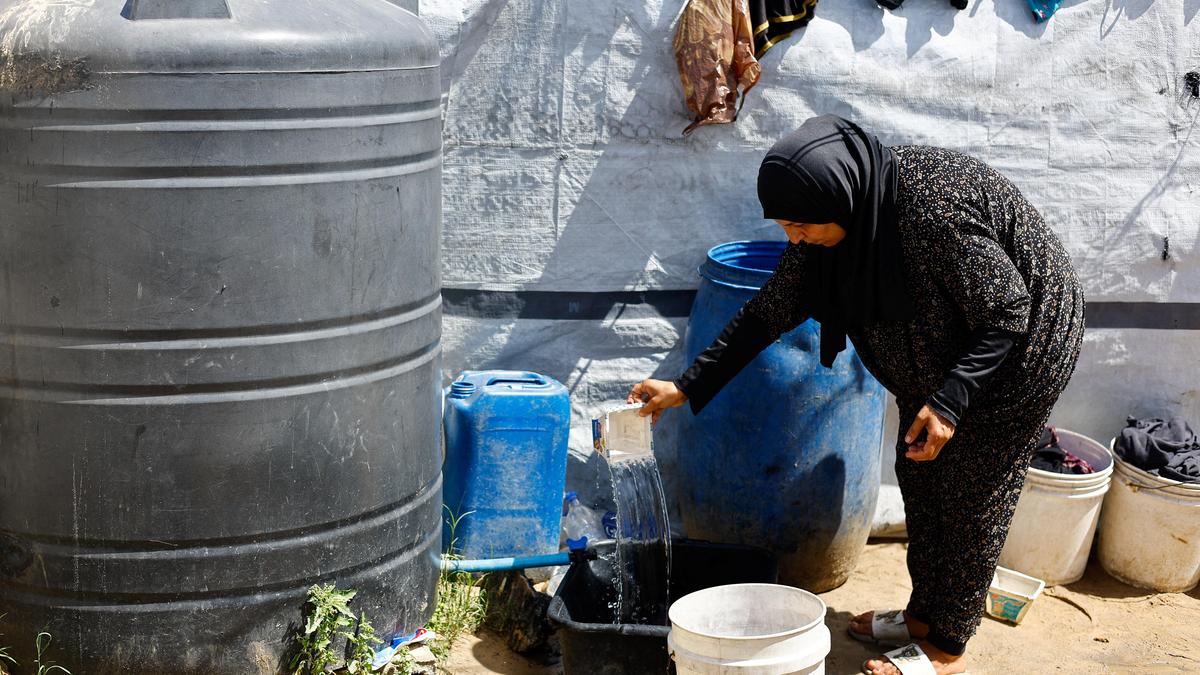
The weaponization of a utility requires the conversion of a civilian lifeline into a binary switch of survival. In the Gaza Strip, water is not merely a resource; it is a critical vulnerability within a closed-loop system where demand is static and supply is artificially throttled. To analyze the current crisis through a strategic lens, one must look past the immediate humanitarian outcry and examine the structural dismantling of the "Water-Sanitation-Hygiene" (WASH) ecosystem. The current degradation of water access functions as a force multiplier for disease, creating a secondary front in the conflict where the casualty rate is driven by enteric pathogens rather than kinetic strikes.
The Triad of Water Scarcity
Water availability in a high-density urban combat zone is governed by three primary variables. When these variables are restricted simultaneously, the result is a systemic collapse of public health.
- Direct Supply Restriction: This involves the physical closure of external pipelines. Historically, Gaza has relied on three main lines from Israel’s national water company, Mekorot. The cessation or reduction of these flows immediately removes the highest quality water from the grid, forcing a reliance on contaminated local sources.
- Energy Starvation: Gaza’s internal water production—primarily through desalination plants and groundwater pumping—is energy-dependent. Without consistent fuel delivery for generators or a stable power grid, the mechanical infrastructure required to extract and treat water ceases to function.
- Kinetic Destruction of Infrastructure: Damage to pipelines, sewage treatment plants, and storage facilities creates "dead zones" where even if water exists, it cannot be transported. This leads to the commingling of sewage and potable water, effectively poisoning the remaining supply.
The Hydro-Geological Constraint
The underlying physics of Gaza’s water crisis begins with the Coastal Aquifer. For decades, extraction rates have exceeded natural recharge rates by nearly 300%. This imbalance creates a pressure vacuum, inviting seawater intrusion and upward migration of brackish water from deeper saline layers.
The water extracted from this aquifer is chemically unfit for human consumption, often exceeding World Health Organization (WHO) nitrate limits by a factor of six or seven. When external clean water flows are cut, the population is forced back onto this degraded source. This is not a neutral shift; it is a biological tax. High salinity leads to rapid dehydration, while high nitrate levels pose acute risks to infants (methemoglobinemia).
The Mechanistic Link Between Water and Mortality
The degradation of water access follows a predictable failure chain that culminates in a public health emergency. This process can be modeled as a sequence of escalating biological threats:
Phase 1: The Dilution Failure
When water volume drops below the minimum survival threshold—roughly 15 liters per person per day for drinking and hygiene—sanitation protocols fail. People stop washing hands; utensils are reused without cleaning; and the density of pathogens in the domestic environment increases.
Phase 2: The Enteric Breach
As the population consumes untreated or brackish water, the incidence of diarrheal diseases spikes. In a conflict zone, diarrhea is not a nuisance; it is a lethal condition. It causes rapid electrolyte depletion and dehydration. Because the "cure" for dehydration is the very resource that is contaminated, a feedback loop of infection and reinfection is established.
Phase 3: The Epidemiological Pivot
Sustained lack of water for hygiene leads to the emergence of skin infections (scabies, impetigo) and, more critically, the potential for cholera or hepatitis A outbreaks. In high-density displacement camps, the "R-naught" (basic reproduction number) of these diseases is amplified by the lack of sewage management. If the pumps don't work, sewage overflows into the streets, creating a direct vector for transmission via flies and groundwater seepage.
The Energy-Water Nexus
It is an analytical error to separate the fuel crisis from the water crisis. Water in Gaza is an industrial product.
- Small-scale Desalination: These units provide the bulk of the drinking water. They require high-pressure pumps to force water through semi-permeable membranes (reverse osmosis). Without electricity or fuel, these units are inert.
- Wastewater Treatment: Treating sewage is an energy-intensive process involving aeration and sedimentation. When power fails, raw sewage is often pumped directly into the Mediterranean to prevent urban flooding, which in turn contaminates the very coastline that might otherwise be used for emergency desalination.
The strategic denial of fuel acts as a remote-controlled shutdown of the water system. This allows for the control of the population’s survival capacity without the need for direct military engagement with the infrastructure itself.
Quantifying the Deficit
Before October 2023, the average water consumption in Gaza was roughly 80 to 90 liters per capita. Following the escalation and subsequent restriction of resources, reports from MSF and other field operators indicate that consumption in some areas has plummeted to 2–5 liters.
For context, the absolute minimum for survival in an emergency (the SPHERE standard) is 15 liters.
- 3 liters for drinking (physiologically non-negotiable).
- 12 liters for basic hygiene and cooking.
When a population is forced to survive on 3 liters, hygiene is discarded. The resulting "sanitation debt" is paid in the form of increased pediatric mortality and a weakened adult population more susceptible to secondary infections or trauma complications.
The Logistics of Internal Displacement
The mass migration of the population toward the south of the Gaza Strip has created a catastrophic mismatch between infrastructure and demand. The southern water facilities were designed for a static population. Doubling or tripling that population density without an equivalent increase in water production capacity results in a "systemic brownout."
In these conditions, water becomes a commodity of the black market. Those with the means can purchase trucked water, while the most vulnerable rely on agricultural wells. This stratification ensures that the biological burden of the conflict falls most heavily on the displaced and the impoverished, creating a demographic filter for survival.
Structural Failures in Humanitarian Intervention
The current framework for providing water—trucking and bottled water delivery—is fundamentally unscalable for a population of 2.2 million.
- Friction at Border Crossings: The inspection processes for fuel and spare parts for water pumps create a logistical bottleneck.
- Intra-Gaza Distribution: Even if water enters the strip, the lack of fuel for trucks and the destruction of roads prevent it from reaching the "last mile" to the displaced camps.
- The Spare Parts Embargo: Long-term maintenance of the water system is hindered by "dual-use" restrictions. Items like pipes, pumps, and chlorine (for disinfection) are often restricted, meaning that even minor mechanical failures become permanent system outages.
Strategic Realignment of Water Assets
To mitigate the current trajectory, the focus must shift from "delivery" to "generation." Small-scale, localized solar-powered desalination units offer a decentralized solution that bypasses the fuel bottleneck. However, the deployment of such technology is restricted by the same blockade dynamics that govern fuel.
The use of water as a lever in conflict is effective because it is an "asymmetric weapon." It requires minimal effort to withhold but maximum effort to replace. The collapse of the water system in Gaza is not an accidental byproduct of urban warfare; it is a predictable outcome of a strategy that targets the industrial requirements of human life.
The long-term consequence of this depletion is the permanent degradation of the Coastal Aquifer. As seawater intrusion continues unchecked due to the lack of alternative water sources, the aquifer may reach a point of irreversible salinity. This would render the Gaza Strip hydrologically uninhabitable regardless of the political outcome of the conflict.
The immediate strategic priority for any stabilizing force must be the decoupling of water production from the fuel supply chain. This requires the establishment of "protected utility zones"—areas where power and water infrastructure are granted a form of functional neutrality, supported by direct international monitoring and supply lines that do not transit through the primary combatants. Failure to isolate the water system from the kinetic theater ensures that the final death toll will be dictated by biology, not ballistics.