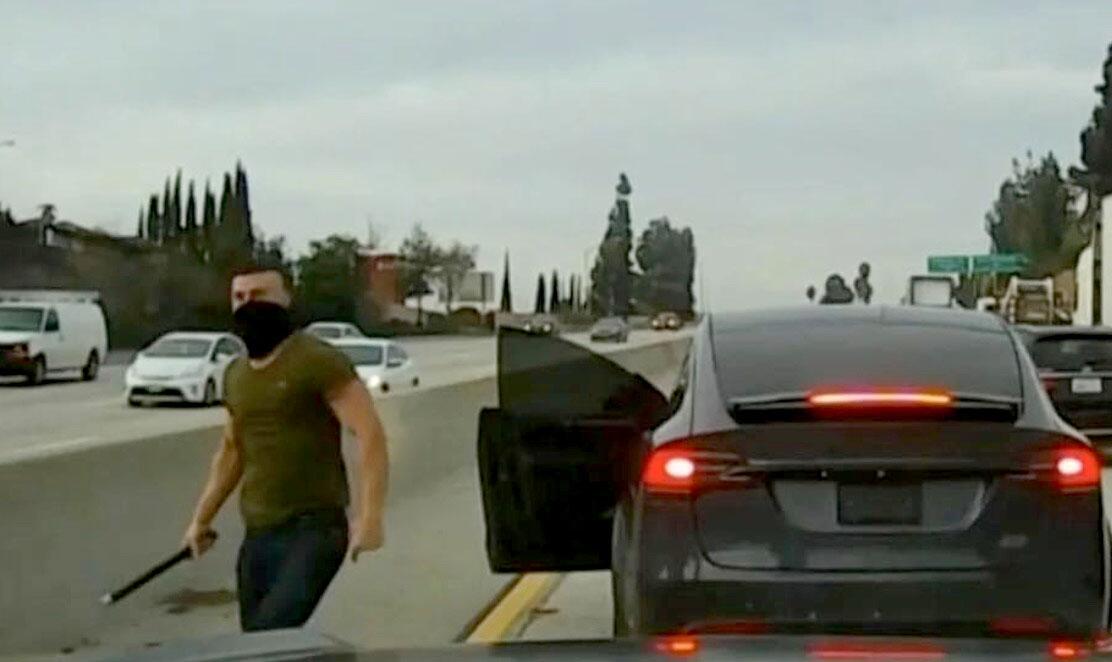
The media wants you to look at Nathaniel Radimak and see a monster finally tamed by a seven-year prison sentence in Hawaii. They want you to believe the system worked, albeit late. They want to focus on the black Model X Tesla, treating the car like a talisman of modern tech-bro arrogance, framing a terrifying series of assaults as a localized glitch in public safety.
They are entirely wrong.
The mainstream press coverage of Radimak’s latest sentencing in Honolulu is a masterclass in missing the point. By focusing on the shocking nature of his actions—bull-rushing a mother, punching a teenager practicing parallel parking, or swinging a pipe on Southern California freeways—the public conversation treats this as a failure of individual morality and car culture. The real breakdown isn't the driver. It is a predictable consequence of a judicial structure designed around the illusion of containment rather than reality.
Locking Radimak up for seven years will not make the roads safer. It merely pauses a clock on a time bomb that the state has no idea how to diffuse.
The Myth of the Clean Slate
The lazy consensus screams for longer sentences. Commentators on social media platforms celebrate that a Hawaii judge finally handed down a hefty term after California prosecutors failed to keep him behind bars. Let’s look at the actual timeline of institutional failure.
In 2023, Radimak was handed a five-year sentence in California after terrorizing at least ten motorists. He was out on parole in less than twelve months. He boarded a flight to Oahu, hopped behind the wheel, and within months, assaulted two more women on Halekauwila Street.
The public reacts with shock that a violent offender was paroled early. But anyone who has spent years analyzing the machinery of municipal courts and state correctional frameworks knows this is the standard operating baseline, not an anomaly. State penitentiaries are warehouses managed by math, not morality. They operate on a strict calculus of capacity, pre-sentence credits, and good-behavior multipliers.
When George Gascón, then the Los Angeles District Attorney, proclaimed that Radimak’s "reign of terror ends today," it was pure political theater. The state never had the tools to end it. They only had the tools to delay it.
Why the Tesla Label is a Deliberate Distraction
Every headline insists on calling him the "Tesla road rage driver." It is a brilliant bit of clickbait framing. It pairs the anxieties of modern urban driving with the polarizing nature of Elon Musk’s automotive empire.
But linking the behavior to the vehicle brand obscures a much grimmer reality. When law enforcement searched Radimak’s vehicle back in 2023, they didn't just find standard road debris; they found steroids and more than $30,000 in cash. This isn't a story about an entitled EV owner suffering from commuter stress. This is a profile of severe biochemical volatility mixed with unchecked anti-social behavioral patterns.
The vehicle was an incubator for a crisis that would have occurred whether he was driving a base-model sedan or a luxury SUV. By fixating on the brand of the car, the media commodifies the violence, turning a deep systemic failure into a lifestyle critique.
The Deterrence Illusion
The core argument for the seven-year sentence handed down in May 2026 is deterrence. The theory goes that a prolonged stay in a Hawaii facility will force rehabilitation or at least strike fear into the hearts of other aggressive drivers.
This ignores the fundamental mechanics of severe road rage. True predatory transit violence—the kind where a driver stops dead in the middle of a freeway, exits with a crowbar, and smashes a stranger’s window—is not a rational cost-benefit calculation. It is a complete neurological hijack.
"He attempted to open my driver's side door, which thankfully was locked, while yelling verbal threats at me, and I did truly fear for my life." - Beth Lamprecht, 2023 Los Angeles Victim
💡 You might also like: The Structural Collapse of Humanitarian Aid Economics: A Capital Allocation Breakdown
An individual operating at that level of psychological deregulation is not thinking about parole eligibility or interstate judicial coordination. They are reacting to an internal chemical storm.
Worse, our correctional facilities are ill-equipped to handle the root of this volatility. Days after his arrest in Honolulu in May 2025, Radimak was severely beaten by fellow inmates at the Halawa Correctional Facility, suffering trauma to his face and torso. The state's response to an individual with a history of profound, explosive violence was to place him in an environment where violence is the primary currency. To believe that seven years in an unstable environment will yield a well-adjusted citizen ready to navigate a busy intersection is pure fantasy.
Dismantling the Public Safety Premise
If you ask the average citizen how to stop the next Radimak, they will tell you to revoke his license permanently. It sounds logical. It is also entirely teeth-less.
A driver's license is a piece of plastic; it does not mechanically prevent a person from turning an ignition over or putting a foot on an accelerator. People with revoked privileges drive every single day in every major city in America. The system relies on voluntary compliance with administrative bans. For a serial offender who has already demonstrated an absolute contempt for felony laws, an administrative driving ban is a minor paperwork hurdle.
We are asking the wrong question. We shouldn't be asking how long we can lock a broken individual away. We should be asking why our transport infrastructure relies entirely on the honor system to protect us from predators.
The Real Solution Nobody Wants to Fund
If the goal is genuine public safety rather than punitive satisfaction, the approach must change.
- Biometric Ignition Integration: Instead of administrative bans, individuals convicted of violent transit offenses must be subject to mandatory vehicle hardware interventions. If the biometric signature doesn't match a verified, insured, and permitted operator, the vehicle remains bricked.
- Decoupled Institutional Housing: Violent offenders with clear behavioral or chemical pathologies need hyper-segregated, treatment-heavy confinement, not general population storage where they are simply brutalized and returned to society more damaged than before.
- Automated Transit Intervention: Modern vehicles possess the sensory architecture to detect erratic, aggressive driving profiles. The tech shouldn't just warn the driver; it should actively restrict vehicle performance and alert local transit authorities when a pattern of predatory stalking is detected in real-time.
The downside to this approach is obvious. It requires significant capital, a complete overhaul of privacy standards in automotive manufacturing, and a departure from the satisfying narrative of pure punishment. It forces us to admit that the prison system is a revolving door that treats the symptoms while letting the disease mutate.
Until we stop treating these incidents as isolated true-crime spectacles and start treating them as predictable failures of transit security, we are simply waiting for the clock to run down on the next release date. Nathaniel Radimak will eventually leave prison. And the system, as it stands today, will ensure he is no better prepared for the road than he was before.