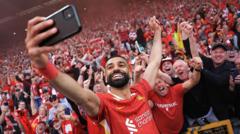
The football world is currently drowning in a sea of collective grief. Tear-soaked retrospectives, emotional highlight reels, and a dominant narrative that Fenway Sports Group (FSG) has just committed competitive suicide by letting Mohamed Salah leave Anfield. The consensus is clear, comfortable, and completely wrong.
The conventional football media wants you to believe that losing a generational winger ruins a club. They argue that replacing thirty goal contributions a year is impossible. They scream that a lack of ambition is the only reason a multi-billion-dollar sports conglomerate would let an icon walk away.
Here is the truth nobody in the mainstream media has the stomach to tell you: keeping Mohamed Salah on the terms required to match his global market value would have broken Liverpool Football Club.
Sporting director Richard Hughes and the FSG hierarchy didn't fail. They blinked, looked at the brutal reality of football economics, and made the hardest, smartest decision in modern sports management. They chose the longevity of the system over the twilight of an idol.
The Compounding Cost of Sentimentality
Football fans suffer from a acute case of recency bias mixed with emotional blindness. They look at the back of a football card, see the numbers, and assume those numbers will continue forever.
I have watched club executives across Europe destroy self-sustaining wage structures because they feared the fan backlash of letting an aging superstar leave. Look at Manchester United with Cristiano Ronaldo's return. Look at Barcelona's catastrophic handling of Lionel Messi's final years, which plunged the club into a financial crisis that will take a decade to resolve.
When a player turns 33, his value is no longer tied to his on-pitch production. It is tied to legacy.
To keep Salah, Liverpool would have had to commit to a three-year deal worth upwards of £400,000 a week. In basic accounting terms, that is over £60 million in raw wages alone, completely detached from signing bonuses and agent fees.
But the real damage isn't the headline figure. It is the wage inflation across the rest of the squad.
Squad Wage Hierarchy: The Domino Effect

[Superstar: £400k+/wk]
       │
       ▼ (Agents demand parity)
[Tier 1 Core: £250k/wk -> Demands £320k/wk]
       │
       ▼ (Floor rises)
[Tier 2 Starters: £150k/wk -> Demands £210k/wk]
The moment you hand a massive contract to a player in physical decline, every agent of a player in their prime walks into the negotiation room with leverage. Trent Alexander-Arnold's camp, Virgil van Dijk's representatives, and every incoming summer transfer target suddenly have a new baseline. You aren't just paying a premium for Salah; you are paying a premium for everyone else because he exists on the payroll.
The Physical Reality of the Cliff Edge
Let's look at sports science and data, not romance.
Salah is a physical anomaly. His durability is legendary. But elite sports data shows that elite wingers who rely on explosive acceleration do not decline linearly. They fall off a cliff.
The drop-off happens overnight. A fraction of a second lost in turning circle, a minor reduction in top-end sprint speed, and suddenly a winger who used to beat his marker three times a game is turning back and passing to the central midfielder.
- The Over-Perception of Penalties: Strip out spot-kicks, and Salah’s open-play expected goals (npxG) per 90 minutes has shown a steady, minor downward trend over the last 24 months.
- The Pressing Metrics: Arne Slot's system requires intense, disciplined, directional pressing. Elite wingers over 32 inevitably begin to ration their energy. They save their bursts for attacking transitions, leaving the right-sided fullback exposed.
By refusing to pay for past performance, Liverpool avoided locking themselves into a contract for an asset that would be untradeable in 18 months. If you buy a stock at its absolute peak when you know the company's core product is entering a obsolescence phase, you get fired. In football, fans throw a parade for it.
Dismantling the "Lack of Ambition" Fallacy
Go to any pub within a mile of Anfield or read any sports call-in show, and you will encounter the same flawed questions. Let's answer them with total transparency.
"How do you replace 30 goals a year?"
You don't. This is the fundamental mistake made by amateur scouts and angry fans. You do not replace Mohamed Salah with a single player who copies his exact output. You redistribute the tactical load.
When Moneyball principles were introduced to baseball, Billy Beane didn't look for another Jason Giambi. He found three players whose combined on-base percentages matched Giambi's output at a fraction of the cost.
Without Salah as the permanent focal point of the attack, Liverpool's frontline becomes less predictable. Opposing managers have spent seven years structuring their low-blocks specifically to negate Salah cutting inside onto his left foot. Take that predictability away, and space opens up for Darwin Núñez, Luis Díaz, and Cody Gakpo. The goalscoring burden shifts from an individual dependency to a systemic output.
"FSG has billions, why do they care about the wage bill?"
Because the Premier League’s Profit and Sustainability Rules (PSR) and UEFA’s Financial Fair Play regulations have teeth.
We are no longer in the era of unchecked billionaire spending. Squad cost ratios—which limit spending on wages, transfers, and agent fees to a percentage of club revenue—mean that every pound wasted on an aging player is a pound stolen from the recruitment of a 22-year-old rising star.
The Upside of the Empty Throne
The downside to this contrarian view is obvious: the immediate transition will be messy. Liverpool will likely miss Salah’s cold-blooded efficiency in tight, ugly December away games. There will be weeks where the media runs a side-by-side graphic of Liverpool’s current right winger vs. Salah’s stats in the Saudi Pro League or wherever he lands.
But the strategic advantages outweigh the short-term discomfort:
- Tactical Flexibility for Arne Slot: Slot inherited a squad built for Jürgen Klopp's heavy metal football. Salah was the untouchable pillar of that old system. His departure gives the manager the tactical freedom to reshape the team's shape without worrying about hurting the ego of a global superstar.
- Market Opportunity: The cleared wage bill gives Liverpool the financial health to act aggressively when elite talent becomes disgruntled at clubs like Real Madrid, Bayern Munich, or Paris Saint-Germain.
The Verdict
Football clubs survive by knowing when to sell, not just when to buy.
The greatest manager in British football history, Sir Alex Ferguson, dominated for two decades because he ruthlessly discarded icons—Jaap Stam, David Beckham, Ruud van Nistelrooy—the moment he sensed their influence or wage demands threatened the equilibrium of the club.
Liverpool fans wanted a Hollywood ending. They wanted the image of an aging king lifting trophies until his legs gave out. FSG chose a different path: the cold, calculated maintenance of an elite sporting institution.
The Egyptian King is dead. Long live the system.