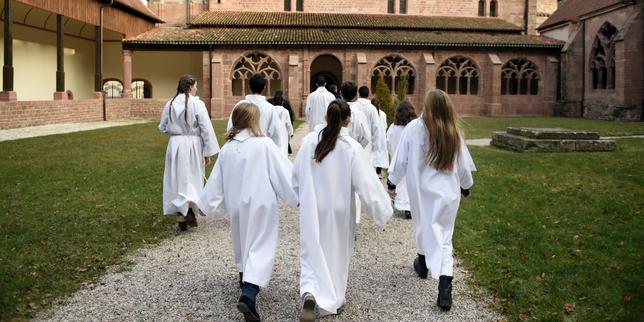
The recent high-profile visit of Pope Léon XIV to France exposed a persistent fault line running directly through the heart of Catholic liturgical practice. When hundreds of thousands gathered for grand pontifical celebrations, public attention was swiftly drawn to an ongoing domestic dispute regarding who is permitted to stand immediately adjacent to the sanctuary. Activist groups and various lay movements seized the moment of international media scrutiny to demand that young women and girls be granted an unambiguous, universal right to serve as altar servers alongside their male peers, reviving a debate that canonical regulations have attempted to settle for decades without fully appeasing grassroots reality.
To understand why a role involving carrying candles, holding liturgical books, and preparing the altar continues to ignite fierce ideological conflict, one must examine the complex machinery of Church law and local parish custom. Formally speaking, universal norms issued by the Vatican have long permitted local bishops to authorize female altar servers if pastoral need or custom suggests it. Yet canon law remains permissive rather than mandatory. This leaves a vast discretionary power in the hands of individual diocesan ordinaries and conservative pastors. In many rural French dioceses, traditionalist enclaves, and urban traditional parishes, the sanctuary remains an exclusively male domain. This creates a patchwork reality where crossing a municipal boundary can mean the difference between seeing mixed-gender service and encountering a strictly gender-segregated altar.
Critics of the status quo argue that excluding women and girls from the immediate vicinity of the Eucharistic celebration is an outdated practice that alienates half the active members of the Church. They point out that in many Western countries, including parts of the United States and Northern Europe, mixed-gender altar serving has been commonplace for a generation without causing doctrinal collapse. For these advocates, visual representation at the altar is tied directly to broader questions of dignity, inclusion, and the recognition of baptismal equality. When major national events occur under the microscope of television cameras, every detail of who stands where becomes a symbolic statement about the internal health and direction of the institution.
Conversely, defenders of an all-male server tradition approach the question through a different lens, viewing the sanctuary not merely as a stage for community representation, but as a space deeply intertwined with the theology of the ordained priesthood and historical precedent. Many traditionalists argue that serving at the altar has historically served as a nursery for priestly vocations, fostering a specific type of young male camaraderie and spiritual discernment that could be altered by changing the composition of the group. They emphasize that liturgy is received rather than invented, and that adherence to specific regional customs is a legitimate expression of liturgical diversity rather than an act of discrimination. Bishops attempting to navigate these conflicting pressures frequently find themselves caught between competing interpretations of pastoral prudence.
The friction is further complicated by the reality of generational shift within European Catholicism. Parishes that struggle with dwindling numbers of young participants often adopt whatever voluntary help is available, leading to pragmatic compromises that bypass ideological debates altogether. Meanwhile, highly committed urban parishes populated by younger, more traditional-leaning families often lean heavily into historical norms, reinforcing the divide. The result is an ecclesiastical landscape defined less by uniform obedience and more by localized negotiation.
As high-profile visits and national gatherings continue to focus public attention on these micro-rituals, the underlying tension shows no signs of dissipating. The debate over who holds the cruets or carries the processional cross is ultimately a proxy war for larger questions about authority, tradition, and the pace of institutional evolution in a secularized world. Until a definitive structural mandate is issued from Rome—an unlikely prospect given the current balance of governance—the visibility of women at the altar will remain dependent on geography, local leadership, and the shifting demographics of individual pews.