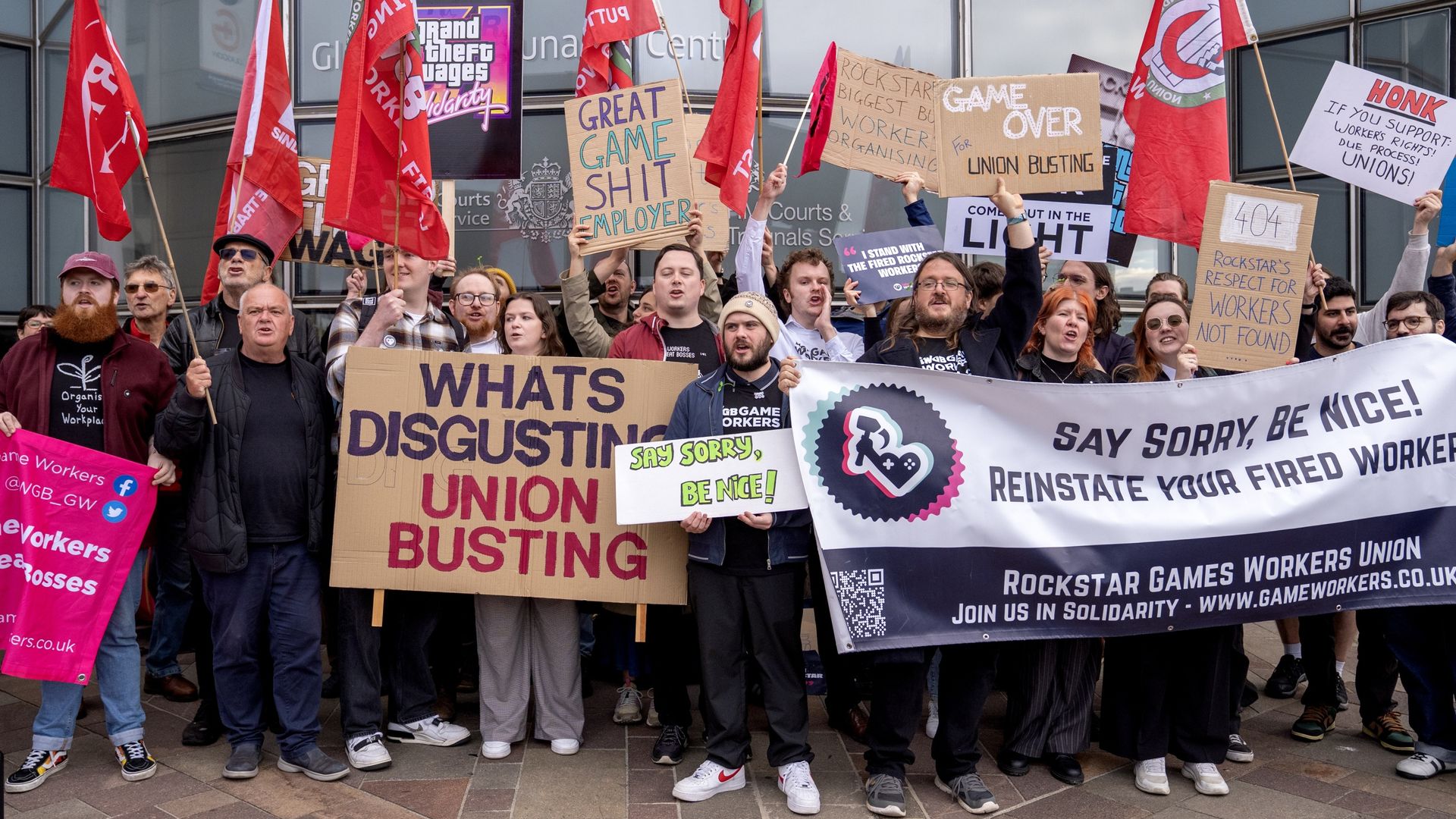
The employment tribunal unfolding at the Glasgow Tribunals Centre between Rockstar Games and twenty-three former developers represents a structural collision between corporate IP protection and organized labor rights. Represented by the Independent Workers Union of Great Britain, the claimants argue that their October dismissals constituted unlawful targeting for union activity. Conversely, parent company Take-Two Interactive and Rockstar maintain that the terminations were direct responses to gross misconduct involving the transmission of proprietary development data inside a private Discord channel. Dissecting this legal battle requires examining how software houses secure massive assets and how underground worker organization interfaces with corporate compliance.
The central mechanism of the dispute hinges on a digital channel designated as Room C. According to Rockstar’s legal filings presented to the tribunal, the studio discovered a Discord server hosting more than three hundred individuals, which included external competitors, former staff, and a journalist. The company asserts that the dismissed workers utilized this environment to broadcast internal development milestones, operational feedback, and specific game features tied to the upcoming release of Grand Theft Auto Six. In high-value software development, intellectual property hygiene operates on strict containment principles. When perimeter defenses fail via external communication apps rather than source code repositories, management typically invokes immediate containment protocols.
The economic stakes of Grand Theft Auto Six amplify every administrative decision made by its publisher. With pre-orders tracking into the hundreds of millions and a global launch scheduled for November, the marginal cost of a single security leak includes market volatility, competitive intelligence leakage, and investor anxiety. Rockstar’s operational posture during crunch periods is characterized by hyper-vigilance. The developer argued before the tribunal that the content within the chat room went beyond venting about management, crossing into explicit commentary on whether development schedules were tracking on time or falling behind.
From the labor perspective, the timing and execution of the firings point toward systemic union suppression. The Independent Workers Union of Great Britain asserts that thirty-four individuals across the United Kingdom and Canada were summarily stripped of access, terminated without standard progressive disciplinary pathways, and in one instance subjected to visa revocations. The union framework posits that management weaponized the discovery of the chat room as a pretext to dismantle an emerging collective bargaining unit inside Rockstar North. Under United Kingdom employment law, establishing automatic unfair dismissal based on trade union membership requires proving that the primary driver of termination was union activity rather than the stated conduct violation.
The evidentiary friction in Glasgow centers on distinguishing between protected workplace discourse and unprotected proprietary disclosure. Employees possess statutory rights to discuss compensation, management efficacy, and working conditions. However, those rights terminate at the boundary of trade secrets and non-disclosure agreements governing unreleased commercial software. The transcripts and message logs submitted into evidence reveal an environment where venting about corporate leadership intersected with structural commentary on game engine performance and production timelines. This intersection creates a dual-motive scenario that the tribunal must untangle. If workers organize via digital channels, the inclusion of administrative data within those same spaces invites corporate surveillance and subsequent enforcement actions.
The broader implications for the interactive entertainment sector depend entirely on how the tribunal rules on the burden of proof regarding gross misconduct versus anti-union animus. A ruling in favor of the claimants would establish Rockstar North as a recognized unionized studio under forced settlement or statutory mandate, fundamentally altering how AAA game developers manage remote and digital communication channels. Conversely, a complete vindication of Rockstar's gross misconduct defense would validate zero-tolerance containment policies, signaling to the industry that perimeter security supersedes internal labor organizing when proprietary assets are exposed on third-party networks.
Organizations facing similar scaling pressures must decouple the mechanics of internal dissent from the management of source material. Implementing clear telemetry for data egress while safeguarding channels for worker grievance prevents the structural overlap that triggers abrupt terminations. Software houses can mitigate these operational vulnerabilities by establishing transparent digital policies that explicitly separate protected organizational dialogue from intellectual property security parameters before a crisis forces legal intervention.


