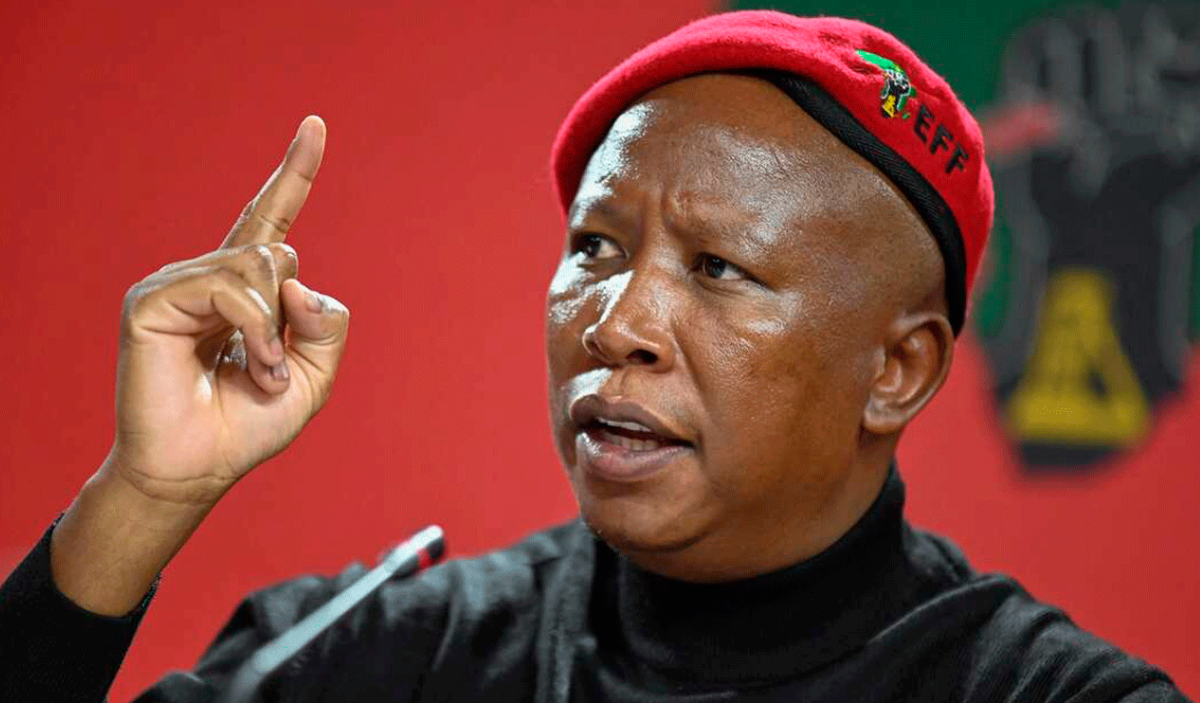
The sentencing of Economic Freedom Fighters (EFF) leader Julius Malema marks a critical inflection point in the intersection of South African constitutional law and populist political mobilization. While headlines focus on the immediate punitive outcomes, the underlying mechanics involve a complex friction between the Criminal Procedure Act and the eligibility requirements for National Assembly members under Section 47 of the Constitution. This development is not merely a legal event; it is a stress test for the principle of the rule of law in a landscape defined by high-stakes political theater.
The Triad of Legal Jeopardy
To analyze the impact of Malema’s sentencing, one must categorize the legal pressures into three distinct functional silos. Each silo carries different weight regarding his ability to hold office and lead the EFF.
- The Firearms and Public Order Silo: This involves the discharge of a firearm in public and contraventions of the Firearms Control Act. The core of the current legal friction stems from incidents where the state must prove intent and negligence within a high-profile public setting.
- The Insolvency and Financial Compliance Silo: Previous battles with the South African Revenue Service (SARS) established a precedent for using financial instruments to constrain political actors. While less visible currently, it remains the structural foundation for attacks on his eligibility based on financial fitness.
- The Incitement and Hate Speech Silo: This involves the "Kill the Boer" litigation and Equality Court rulings. These cases define the boundaries of political rhetoric versus criminal solicitation.
The current sentencing primarily engages the first silo, but its secondary effect is to activate the constitutional disqualification triggers that have remained dormant during the lengthy appeals processes.
Constitutional Disqualification Thresholds
South African law provides a specific mathematical and legal threshold for the removal of a Member of Parliament. Under Section 47(1)(e) of the Constitution, any person who is convicted of an offense and sentenced to more than 12 months’ imprisonment without the option of a fine is disqualified from being a member of the National Assembly.
The strategy employed by Malema’s legal team focuses on "sentence mitigation through optionality." By ensuring that any custodial sentence includes a fine as an alternative, or falls below the 12-month mark, the defense preserves his seat in the legislature. This creates a Legal Preservation Loop:
- Step A: Delay proceedings through interlocutory applications to push finality past election cycles.
- Step B: Contest the evidence of intent to reduce the severity of the charge from a felony-equivalent to a misdemeanor-equivalent.
- Step C: Negotiate a suspended sentence or a fine-inclusive sentence to bypass Section 47(1)(e).
If the court imposes a direct custodial sentence exceeding one year, the EFF faces a structural leadership vacuum. The party's central command is highly centralized around Malema’s persona; the removal of this core component would likely trigger an internal redistribution of power for which the party has no documented succession protocol.
The Mechanics of Political Victimization as Mobilization
The sentencing functions as a catalyst for a specific populist feedback loop. In the EFF’s operational framework, legal setbacks are converted into "political capital" through a three-stage transformation:
- The Narrative of Judicial Overreach: The judiciary is framed as a remnant of the "1994 compromise," suggesting that legal accountability is actually a targeted attempt by the establishment to stifle radical economic transformation.
- Mass Mobilization as a Defense Shield: Court appearances are utilized as logistics exercises. The party uses these dates to demonstrate its ability to mobilize thousands of supporters, effectively signaling to the state that a prison sentence for Malema would carry a high "social cost."
- The Martyrdom Variable: A jail sentence, rather than diminishing Malema’s influence, risks elevating him to a political martyr status. Historically, in South African politics, imprisonment has served as a validation of a leader's threat to the status quo.
Supply Chain of Evidence and Procedural Vulnerabilities
The prosecution’s success depends on the technical integrity of the evidence—specifically ballistic reports and video forensics in the firearms cases. The defense strategy exploits "procedural drift"—the gap between the event and the trial where witness memory fades and chain of custody for digital evidence can be questioned.
The state’s burden is to prove that the firearm used was a "lethal device" and that Malema was the individual operating it beyond a reasonable doubt. Any ambiguity in the video footage or the testimony of security personnel provides the necessary "legal friction" to stall the sentencing phase.
This creates a bottleneck for the National Prosecuting Authority (NPA). They must balance the need for a high-profile conviction to prove impartial law enforcement with the risk of a high-profile acquittal or a "slap on the wrist" sentence that would embolden the EFF's claims of invincibility.
The Economic Ripple Effect of Political Instability
The market reacts not to the sentencing itself, but to the potential for civil unrest following the verdict. South Africa’s sovereign risk premium is sensitive to "Rule of Law" indicators.
- Investor Sentiment: A perceived failure to hold high-ranking officials accountable signals institutional weakness.
- Currency Volatility: The Rand frequently fluctuates during periods of domestic political tension. A custodial sentence that triggers mass protests would lead to immediate capital flight as investors seek "safe-haven" assets.
- Structural Risks: The real risk lies in the potential for the EFF to shift from legislative participation to extra-parliamentary "direct action" if their leader is incapacitated. This creates an unpredictable environment for long-term infrastructure and mining investments.
The Strategic Path Forward for the Judiciary
The judiciary finds itself in a "Double-Bind Constraint." If they rule harshly, they risk being labeled partisan and inciting unrest. If they rule leniently, they risk eroding the deterrent power of the law.
The only viable path for the court is the Adherence to Technicality. By focusing strictly on the letter of the Firearms Control Act and avoiding any commentary on the political implications, the court maintains its institutional legitimacy. This means the sentencing will likely be a calculated compromise—punitive enough to acknowledge the crime, but structured to avoid triggering the Section 47 constitutional trap, thereby shifting the responsibility for Malema’s political future back to the voters rather than the bench.
The state must now prepare for the Appellate Marathons. Even with a sentence handed down, the South African legal system allows for multiple layers of appeal, including the Supreme Court of Appeal and the Constitutional Court. This ensures that the immediate political impact of the sentence is diluted over several years, effectively neutralizing the "jail sentence" as an immediate threat to the 2024-2026 political cycle. The strategic play for Malema remains the utilization of every procedural lever to ensure that the finality of the law never catches up with the speed of his political career.