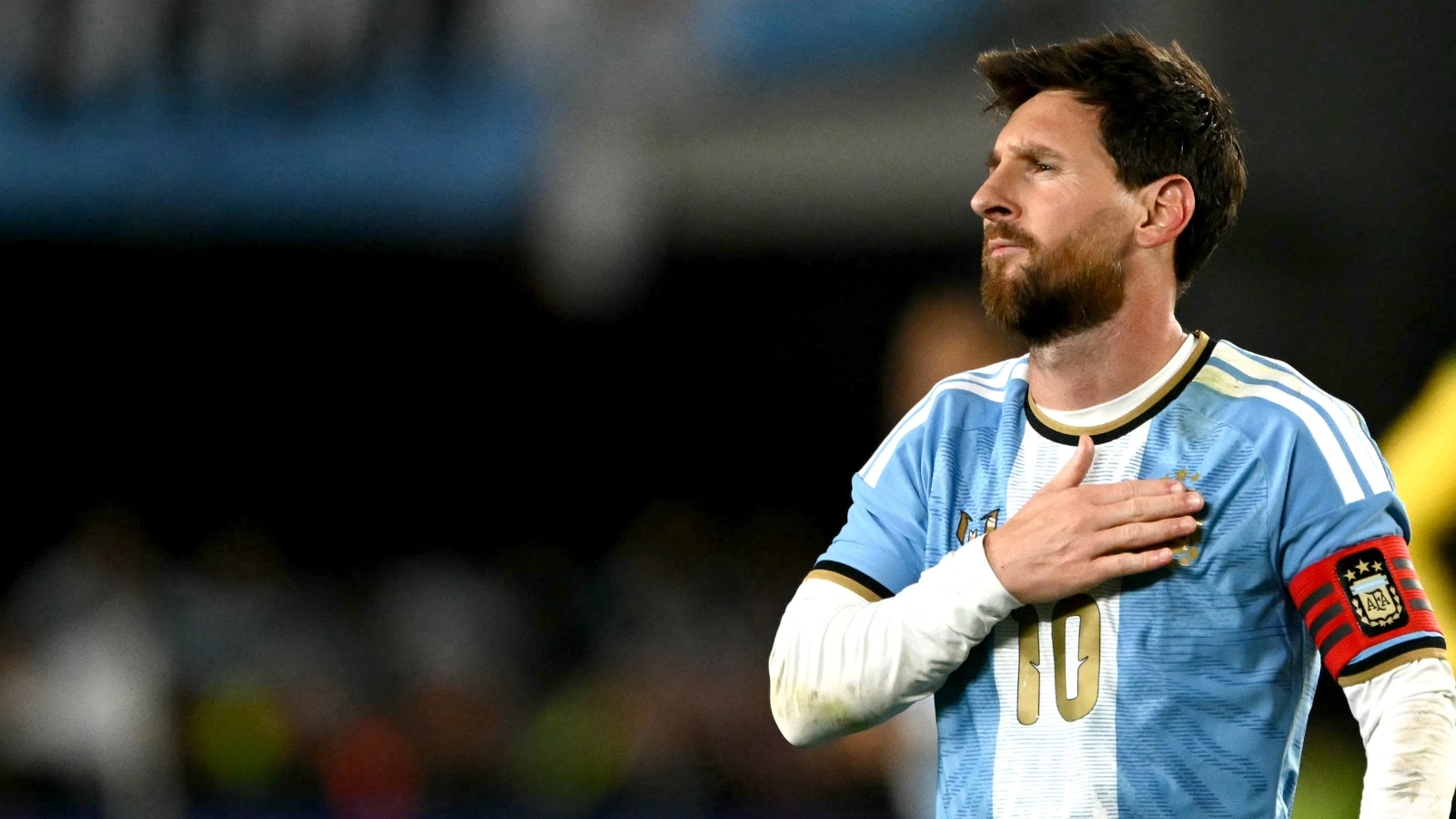
The boots always came off last.
While teammates stripped away their jerseys in the humid tunnel, throwing stained rags into green plastic bins, Lionel Messi would sit on the edge of the treatment table, untying his laces with a slow, deliberate patience. Twenty-one years of mud from Rosario to Buenos Aires, of turf from Madrid to Miami, of dust from deserts in Qatar and rain in Munich, packed into the leather grooves of those small white cleats. He knew the weight of them. He knew the precise moment the leather would give way at the heel, yielding to the shape of a foot that had carried an entire hemisphere’s worth of desperate prayers.
Then came the night the air finally went still.
Twenty-one years. One hundred and twenty-six goals. One golden trophy that took a lifetime of heartbreak to reach. And then, the sentence that fell like a heavy iron gate across a cathedral door: Not coming back anymore.
To understand why a nation of forty-five million people collectively held their breath when those words dropped, you have to understand the burden of being a savior in a country where football is not a pastime, but the primary language of survival.
Imagine standing in a packed kitchen in a barrio of Buenos Aires on a Tuesday night. The television is older than the teenager watching it, its screen flickering with static that smells faintly of ozone and old dust. Outside, the streetlights hum against the suffocating summer heat. A pot of water boils on a stove that has seen better decades. In Argentina, economy is a rolling storm, politics are a perpetual argument, and inflation is a shadow that shortens every dinner table. But when the national team plays, the storm clears. For ninety minutes, the chaotic, beautiful, fractured soul of the country narrows down to a patch of green grass and a left foot that moves like a pen writing poetry across water.
For two decades, Messi was the answer to every unanswered prayer whispered in those kitchens.
When he left home at thirteen, boarding a flight to Barcelona with a growth hormone deficiency and a dream too fragile to speak aloud, he was just a skinny kid from a steel town who dribbled as though the ball were glued to his toes by magic. He grew into a ghost who haunted defenders, a maestro who played the game three seconds ahead of everyone else on the pitch. Yet, back home, the relationship was fraught with a strange, possessive cruelty. They loved him, but they doubted him. They called him a mercenary because he won his trophies in Catalonia, not beneath the faded murals of Maradona. They watched him vomit on the pitch from the sheer, crushing anxiety of wearing the light-blue-and-white stripes, and instead of seeing a human being buckling under an impossible weight, some saw a lack of fire.
He lost four major finals. Four times, he walked past the gleaming gold trophy he had chased since boyhood, his eyes hollow, his shoulders slumped beneath an invisible mountain of salt. In 2014, in Rio de Janeiro, he stared at the World Cup trophy for a long, agonizing second before collecting his runner-up medal. The image became a modern pieta of sport: a genius standing in the shadow of the ultimate prize, denied by inches and bad luck.
Most men would have walked away. The criticism was a relentless, grinding noise. The media back home could be vicious, treating failure not as an athletic result, but as a personal betrayal.
Instead, he kept coming back.
Consider the quiet resilience required to board that plane time and time again, leaving behind the safety of European clubs where he was worshipped like a secular saint, returning to a federation plagued by administrative chaos, where the pitch might be bumpy, the travel grueling, and the expectations impossibly high. He kept coming back because he was tethered to a promise he had made to himself as a boy kicking a tattered ball against a corrugated tin wall in Grandoli.
The turning point was not aesthetic; it was emotional.
By the time Qatar arrived in 2022, the narrative had shifted from fierce demand to a collective, trembling vulnerability. The nation realized, with a sudden cold shock, that time was running out. The hair at his temples was graying. His pace had slowed, replaced by a preternatural stillness—a man who no longer ran to chase the game, but walked to let the game come to him, scanning the pitch like a grandmaster eyeing a chessboard.
When he lifted that golden globe in Lusail Stadium beneath a cloak of black and gold, the collective sigh of relief was felt across five continents. It was as if a decades-long thunderstorm had finally broken, washing away the ghosts of 1916, 1930, 1990, and 2014. In that single moment, the debt was paid. The ledger was balanced.
Yet, the hardest part of a legend’s journey is not the climb; it is the descent.
When an athlete of this magnitude announces the end, it feels less like a retirement and more like the shifting of tectonic plates. Younger players who grew up wearing his jersey with '10' scrawled in marker on the back now share the pitch with him. They look at him not just as a captain, but as a living monument. They are protective of him in a way the older generation never was. They run so he doesn't have to. They press so he can conserve his energy for that single, blinding flash of vision that can undo an entire defense with the flick of a toe.
The modern game is a relentless machine. It demands high-intensity sprints, biometric optimization, and mechanical perfection. But Messi played a different sport altogether—a sport of geometry, timing, and quiet geometry that defied the cold analytics of the modern playbook. While sports scientists measured his distance covered and pronounced him economical, anyone watching him knew the truth: he was conserving magic.
And now, the final chapter is closed.
No more long flights across the Atlantic to answer a call that demanded his youth. No more carrying the anxieties of forty-five million souls onto a rain-slicked pitch in South America. The cleats are unlaced. The locker room is quiet.
What remains is the legacy of a man who proved that genius does not have to be loud. In a world obsessed with noise, flash, and immediate gratification, Lionel Messi walked softly, spoke rarely, and let his left foot do the shouting.
The grass in Buenos Aires is still green. The children in the barrios are still kicking tattered balls against corrugated walls, painting imaginary numbers on their backs. But the ghost has finally found his rest, leaving behind a standard so impossibly high that it may take another generation—or a lifetime—before anyone dares to dream of matching it.