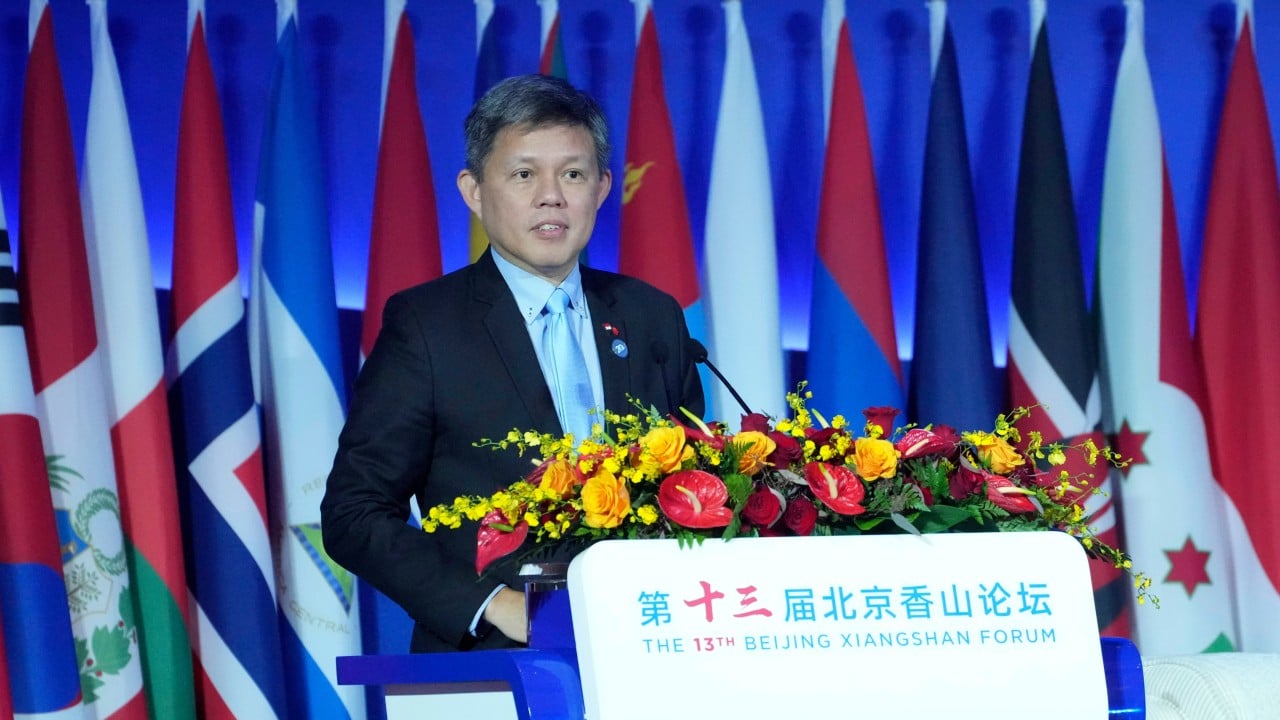
Geopolitical signaling relies on the calibration of linguistic medium and cultural reference to lower transaction costs in diplomatic engagement. When Singapore's Minister for Defence Chan Chun Sing delivered a targeted address entirely in Mandarin at the Xiangshan Forum in Beijing, observers categorized the move as mere cultural charm. A functional analysis reveals a deliberate structural maneuver designed to bypass traditional diplomatic friction, alter audience perception, and insert strategic messaging directly into domestic and regional information ecosystems.
The Protocol of Linguistic Code Switching
State actors operating within asymmetrical power dynamics face a constant transmission loss. When a small state addresses a major power in English, the dialogue defaults to international norms dictated by larger entities, introducing translation filters and psychological distance. Shifting the linguistic medium to the primary language of the host nation fundamentally alters the transaction economics of the exchange.
By utilizing Mandarin in a high-security multilateral setting, the speaker achieved three immediate objectives:
- Bypassing Translation Latency: Direct delivery eliminates the intermediary filter of live interpretation, allowing nuanced philosophical references to land without semantic degradation.
- Constructing Cultural Proximity: Invoking classical philosophical frameworks, such as the teachings of Mencius regarding state restraint and the security dilemma, signals a shared historical literacy that Western diplomatic vocabularies cannot capture.
- Domestic Resonance Amplification: Transmitting policy positions in fluent Mandarin optimizes the output for the host nation's digital and social media architecture, converting an elite geopolitical speech into a viral diplomatic asset.
The Three Pillars of Sovereign Restraint
The core content of the Beijing address moved beyond rhetorical flourish to establish a rigorous framework for managing great power competition. The architecture of this framework rests upon three distinct operational principles designed to mitigate structural friction between rising powers and smaller states.
1. Asymmetrical Perceptual Calibration
Great powers frequently misjudge how their internal security measures register across borders. Growth in national capability, driven by historical grievances or legitimate defensive needs, produces outward ripples of insecurity for smaller neighbors. The strategy mandates that major powers actively account for how shifts in relative power alter the threat perception of smaller actors. The burden of reassurance scales directly with national capacity.
2. The Mechanics of Strategic Patience
In periods of systemic transition, volatility increases the risk of accidental escalation. Strategic patience functions as an operational constraint against reactive posturing. As articulated in the address, the principle dictates that capabilities need not be advertised, advantages need not be pressed instantly, and provocations do not mandate immediate kinetic or verbal retaliation. This approach preserves optionality and prevents minor tactical friction from metastasizing into strategic crises.
3. Value Creation Over Zero Sum Competition
Cooperation cannot survive on shared ideological declarations; it requires continuous, verifiable value creation. Singapore’s historical posture toward China's economic integration—dating back to early support for multilateral trade frameworks in the 1980s—demonstrates that national interest is best secured by expanding the overlap of mutual economic and security utility.
The Cost Function of Trust
Trust in international relations is frequently mischaracterized as an emotional variable. From an institutional perspective, trust functions as a high-value currency with asymmetric accumulation and depletion rates.
$$\text{Cost of Trust Breach} \gg \text{Cost of Trust Formation}$$
Consistency over decades builds baseline institutional credibility, but a single miscalculation in physical domains (air and sea) or invisible domains (cyberspace) can liquidate accumulated capital instantly. In cyberspace and contested maritime zones, where attribution is complex and intentions remain ambiguous, institutional trust serves as the sole shock absorber against catastrophic escalation.
The Power of Example vs. The Example of Power
The ultimate security dilemma facing modern international systems involves the transition from deterrence models based on raw capacity to models based on systemic attraction. Outgunning or outlasting a rival produces diminishing returns in an interconnected global economy.
Small states survive and thrive not by matching the military outlays of regional hegemons, but by optimizing their utility as neutral, predictable nodes in global networks. The strategic imperative for any rising power is to demonstrate that its leadership model provides systemic stability rather than systemic coercion.
Strategic Execution Blueprint
To operationalize these principles in bilateral and multilateral engagements, state and corporate strategists operating in high-stakes environments must implement the following sequential execution steps:
- Audit Linguistic Interfaces: Identify where linguistic and cultural friction points cause policy misunderstandings, and deploy bilingual leadership capable of native-level conceptual translation.
- Separate Capability from Deployment: Maintain strategic deterrence capabilities while exercising absolute restraint in their public display, reserving operational deployment strictly for existential thresholds.
- Anchor Long-Term Alignment in Shared Utility: Tie bilateral stability to institutionalized economic and technological interdependence rather than transient political alignments.
- Institutionalize Redundancy in Crisis Channels: Establish quiet, low-friction communication lines capable of operating autonomously when public rhetoric spikes.
By shifting focus from reactive posturing to structured linguistic and strategic alignment, entities can navigate periods of systemic volatility without sacrificing operational autonomy.
This video provides contextual coverage of Singapore and China marking decades of diplomatic ties through cooperation over confrontation, mirroring the diplomatic tone analyzed above.



