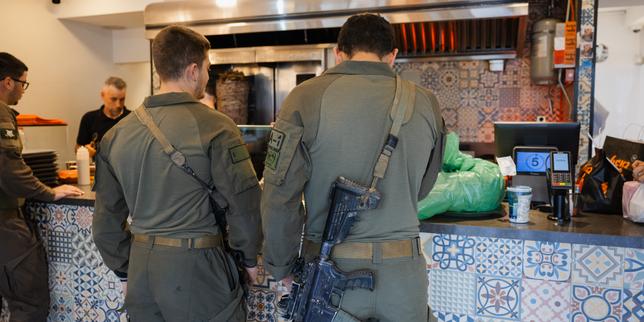
The streets of Kiryat Shmona aren't just empty. They're haunting. Walking through this northern Israeli city feels like navigating a ghost town where the ghosts are still very much alive, just hiding in hotels across the country. Since October 2023, the rhythm of life here has been replaced by the rhythmic thud of artillery and the shrill whine of Iron Dome interceptions. Most people who call this place home don't want to hear about a diplomatic solution or a shaky ceasefire. They want a decisive military victory that ensures they aren't moving back into a kill zone.
I’ve looked at the data and spoken to those who stayed. The sentiment is visceral. When you live a few kilometers from the Lebanese border, "stability" isn't a political buzzword. It's the difference between your kid sleeping in a bed or a bomb shelter. The current situation is untenable. Thousands of citizens remain displaced, scattered in temporary housing from Eilat to Tel Aviv, while Hezbollah’s Radwan forces loom just across the fence.
The failure of the 1701 status quo
We need to talk about UN Resolution 1701. It was supposed to keep Hezbollah north of the Litani River. It didn't. For years, the international community pretended the resolution worked while Hezbollah built tunnels, stockpiled over 150,000 rockets, and established observation posts disguised as environmental outposts.
Residents in Kiryat Shmona saw it happening. They watched through binoculars as militants moved closer. Now, that negligence has come home to roost. The people living in the north aren't interested in another piece of paper signed in New York. They know that if the Israel Defense Forces (IDF) don't push Hezbollah back physically and destroy their infrastructure, the "Red Line" will just keep moving south.
It’s about trust. The government failed to protect the south on October 7. The people of the Galilee are terrified of a "Northern October 7." They’ve seen the videos of Hezbollah training for a cross-border invasion. For them, the only way to restore a sense of safety is a fundamental change in the security reality. That doesn't happen with a handshake. It happens with boots on the ground and air superiority.
Why a ceasefire feels like a defeat
If you're sitting in a cafe in Paris or New York, a ceasefire sounds like the moral choice. In Kiryat Shmona, it sounds like a death sentence. A ceasefire that leaves Hezbollah on the border means the city stays empty. Who’s going to bring their toddlers back to a playground that’s within range of a Kornet anti-tank missile?
Nobody.
The economic heart of the Galilee is flatlining. Factories are closed. The high-tech hub that was supposed to transform the north is on life support. If the military "finishes the job," there’s a chance for a restart. If they stop now, Kiryat Shmona becomes a permanent buffer zone. That’s a win for Hassan Nasrallah.
The IDF has already taken out significant chunks of Hezbollah’s leadership and infrastructure. We’re seeing precise strikes on long-range missile launchers and command centers. But the rank-and-file militants are still there. They’re embedded in the villages of Southern Lebanon, using civilian homes as shields. Clearing those positions is a grueling, dangerous task. It's a task the residents here insist must be completed.
The psychological toll of the long wait
Living in limbo is a special kind of hell. It’s been months since the evacuation orders. Families are split. Elderly residents who refused to leave sit in their kitchens listening for the "Red Color" sirens. They’ve become experts at timing their walk to the shelter. Fifteen seconds. That’s all you get.
I spoke with a shop owner who returns every few days to check on his inventory. He told me he’d rather see his shop leveled in a final battle than see it slowly rot while he waits for a peace that won't last. That’s the prevailing mood. It’s a grim, determined realism.
The Israeli government faces immense pressure. There’s the hostage situation in Gaza, the international outcry over civilian casualties, and the looming threat of a wider regional war with Iran. But the "Home Front" in the north is reaching its breaking point. You can't ask 60,000 to 80,000 people to live as refugees in their own country indefinitely.
Hezbollah is not Hamas
One mistake people make is treating this like the conflict in Gaza. It isn't. Hezbollah is a state-level military force. They have better training, better tech, and a much deeper arsenal. A full-scale war in the north would be devastating for both sides. Lebanon would likely never recover. Northern Israel would see destruction on a scale it hasn't experienced in decades.
Despite this, the demand for action remains high. Why? Because the alternative is a slow bleed. It’s the realization that a massive explosion now might be better than a thousand small cuts over the next ten years. It’s a "now or never" moment for the Galilee.
What finishing the job actually looks like
"Finishing the job" is a vague phrase politicians love, but for the military, it has a concrete meaning. It means establishing a multi-layered security zone that Hezbollah cannot penetrate. It means destroying the tunnel networks that cross the border. It means ensuring that any movement of heavy weaponry south of the Litani is met with immediate, overwhelming force.
- Destruction of the Radwan Force capacity: These are the elite commandos trained for invasion. Their presence on the border is the primary psychological barrier to residents returning.
- Neutralizing anti-tank fire: Hezbollah has mastered the use of guided missiles against civilian homes. To stop this, the IDF needs to control the ridges and villages that overlook Israeli border towns.
- Permanent shift in Rules of Engagement: The days of "containing" small provocations are over. Any breach must be met with a response that makes the cost of aggression too high to bear.
The residents of Kiryat Shmona aren't warmongers. They’re parents, teachers, and business owners who want to go home. They’ve realized that in this part of the world, peace isn't something you find—it's something you enforce.
If the Israeli government decides to pivot toward a diplomatic fix without a massive military shift, they risk losing the north forever. People won't come back. The Galilee will become a wilderness. The demand for the military to finish the work isn't just about revenge or anger. It’s a demand for a future.
Watch the troop movements and the political rhetoric closely. The window for a "quiet" resolution is slamming shut. Either the military moves in to create a new reality, or the north of Israel remains a beautiful, mountainous cemetery for the Zionist dream of a safe home.
If you want to understand what's coming, don't look at the briefing rooms in Jerusalem. Look at the empty playgrounds in Kiryat Shmona. The silence there is the loudest thing in the country. It’s a silence that only a decisive victory can break.
Check the latest security briefings from the Northern Command and follow the displacement figures provided by the Ministry of the Interior. The numbers don't lie. A country that cannot protect its borders isn't a country for long. The residents of the north know this better than anyone else. They’re waiting for the government to show it knows it too.