The Momentum Deficit
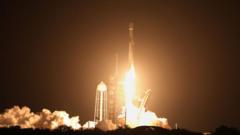
Space exploration treats orbital debris as a downstream externality, yet the intersection of spent launch vehicle stages and planetary surfaces represents a predictable physics problem. When an empty Falcon 9 second stage or a discarded Chinese Long March upper stage executes an uncontrolled trans-lunar trajectory, it possesses a measurable mass and a distinct velocity vector. The resulting kinetic energy transfer onto the lunar surface is not a random cataclysm; it is an unconstrained physical event governed by momentum conservation, material science, and cratering mechanics.
Most public discourse surrounding lunar rocket impacts reduces the phenomenon to a sensationalist collision narrative. Popular commentary focuses on the visual spectacle or the speculative contamination of pristine regolith, ignoring the underlying mechanical equations. To evaluate what happens when a multi-tonne metal cylinder strikes the Moon at orbital velocities, we must deconstruct the event into three distinct analytical variables: kinetic energy yield, subsurface stress propagation, and ephemeral ejecta dynamics. Discover more on a related issue: this related article.
The core operational reality is simple. The Moon lacks a dense atmosphere. Atmospheric drag provides zero deceleration for incoming space hardware. A discarded rocket stage traveling through cislunar space retains its terminal cruise velocity, entering the lunar gravitational well and accelerating until it hits the ground at speeds hovering between two and three kilometers per second.
The Energy Conversion Function
Quantifying a lunar impact requires moving away from qualitative descriptions and examining the energy conversion function. Kinetic energy scales linearly with mass and quadratically with velocity, expressed through the standard formula where energy equals one-half the mass multiplied by velocity squared. More analysis by MIT Technology Review highlights comparable perspectives on this issue.
Consider a typical spent upper stage. Dry masses range from three to four metric units, translating to roughly three to four thousand kilograms of structural aluminum-lithium alloys, stainless steel, and residual composite Overwrapped Pressure Vessels. When this mass impacts the lunar surface at an average velocity of 2.5 kilometers per second, the kinetic energy released is measured in gigajoules, roughly equivalent to the explosive yield of several tonnes of TNT.
This energy does not detonate like a chemical high explosive. Instead, it undergoes a rapid mechanical dissipation process. Upon contact with the surface, the leading edge of the rocket stage experiences a hypervelocity shock wave. The compressive strength of the structural metal is vastly exceeded by the contact pressure, causing the vehicle to transition instantly from a rigid structure into a high-density plasma and solid-fragment jet.
The energy transfers directly into the lunar regolith and underlying megaregolith, initiating a transient crater cavity. The efficiency of this cratering process depends entirely on the impact angle and the mechanical properties of the target material.
The Mechanics of Crater Formation
Lunar soil is not uniform dirt. It consists of a pulverized, highly porous surface layer called regolith, ranging from a few meters to tens of meters in depth, sitting atop fractured basaltic bedrock.
When a spent rocket stage strikes this medium at hypervelocity, the impact cratering sequence unfolds in three distinct phases: compression, excavation, and modification.
During the compression stage, lasting only a few milliseconds, shock waves radiate outward through the projectile and the target. The peak pressures reach gigapascal levels, instantly vaporizing a fraction of the projectile and melting the immediate impact zone. The target material is compressed, displaced, and driven downward and outward from the point of contact.
The excavation stage follows, driven by the expanding shock wave and the rarefaction waves that bounce back from the surface. Material is thrown outward, forming a parabolic ejecta curtain. Because the Moon has one-sixth of Earth's gravity, this ejecta travels much farther than it would under terrestrial conditions. Fragments of pulverized rock and shrapnel from the rocket stage can ballistic-arc for tens of kilometers, raining down across the surrounding mare or highlands.
The final phase, modification, involves gravity-driven collapse of the transient crater walls. Loose regolith slumps inward, widening the final depression and leaving a shallow, bowl-shaped crater typically ten to twenty times the diameter of the original projectile, depending on the impact angle. For a four-tonne cylinder, this results in a crater spanning fifteen to thirty meters across and several meters deep.
The Chemical and Material Trace
Beyond the physical crater, an artificial impact deposits foreign chemical signatures into the lunar geochemical baseline. Spent rocket stages are manufactured from aerospace-grade materials that leave distinct spectroscopic markers upon vaporization.
Aluminum-lithium alloys, titanium fasteners, residual propellant traces such as unburned hydrazine or nitrogen tetroxide, and fluoropolymer wire insulation are flash-heated during the impact event. A fraction of these elements vaporizes into the tenuous lunar exosphere, while the heavier metallic particles condense and settle into the newly formed ejecta blanket.
This creates a localized contamination zone. While planetary protection protocols heavily regulate missions designed to intentionally impact celestial bodies, uncontrolled derelict hardware bypasses these sterilization vectors. The introduction of terrestrial hydrocarbons and industrial metals into the lunar environment alters the local chemical composition of the regolith at the impact site. However, due to the vast surface area of the Moon, the volumetric dilution factor is astronomical, rendering the global impact negligible while creating localized anomalies for future lunar geologists.
Seismic Response and Interior Profiling
While physical destruction at the impact point is absolute for the projectile, the secondary effect provides unexpected utility. Every artificial impact acts as an active seismic source, sending acoustic waves propagating through the lunar crust.
The Apollo missions left behind a network of seismometers that successfully recorded artificial impacts, including the intentional crashing of Saturn V S-IVB third stages and Lunar Module ascent stages. These controlled impacts provided researchers with high-fidelity seismic data, revealing the layered structure of the lunar crust and upper mantle.
An uncontrolled rocket stage impact serves the exact same scientific function. By tracking the arrival times and dispersion of seismic waves across any operational lunar seismic sensors, geophysicists can map subsurface density anomalies, fault lines, and crustal thickness. The kinetic energy disaster of orbital debris translates directly into an acoustic probe of the lunar interior.
Mitigation and Orbital Geometry
The predictability of these impacts is a function of orbital mechanics and tracking fidelity. Spent upper stages left in eccentric Earth-Moon orbits or high Earth orbits do not remain stable indefinitely. Solar radiation pressure, Earth-Moon gravitational perturbations, and third-body effects from the Sun gradually alter their orbital parameters.
Over decades, these perturbations can lower the perigee or destabilize the resonant orbit, resulting in a progressive decay curve that eventually intersects the lunar surface. Unlike low Earth orbit debris, which experiences rapid atmospheric drag and burns up harmlessly, cislunar debris possesses long decay timescales and absolute surface survivability.
Preventing uncontrolled lunar impacts requires structural changes in mission architecture. Spacecraft operators must factor end-of-life disposal burns into their fuel budgets, ensuring that upper stages are directed away from intersecting lunar trajectories or guided into controlled heliocentric orbits where they pose no risk to planetary bodies.
The absence of a regulatory framework for cislunar space means that operators currently prioritize launch economics over orbital cleanup. As commercial traffic to the lunar vicinity accelerates, the frequency of uncontrolled hardware returns will increase, scaling the localized modification of the lunar surface.
Strategic Trajectory Accounting
The descent of an uncontrolled rocket stage onto the lunar surface is an inevitable consequence of unmitigated cislunar logistics. The mechanics are transparent: mass multiplied by velocity squared dictates the energy release, while regolith porosity and low gravity dictate the ejecta distribution. The event combines high-velocity material destruction with unintentional seismic sounding. Future lunar operations will require strict tracking and mandatory disposal burns to preserve the integrity of the lunar surface record and prevent avoidable operational hazards.