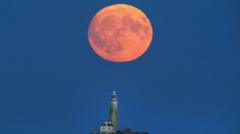
Step outside on a crisp July night, leave the hum of your living room TV behind, and look up.
Most nights, the moon is a familiar, silver coin—silent, distant, almost sterile. But every summer, there comes a single evening when it rises lower, larger, and painted in shades of warm amber. Native American traditions called it the Buck Moon, named for the time of year when young male deer push new, velvet-covered antlers from their brows. It marks a moment of intense growth in the natural world. Growth that is hard, sharp, and impossible to hide. Don't miss our earlier coverage on this related article.
Consider Sarah, a fictional graphic designer working in a high-rise downtown. She spends fifty hours a week staring at a glowing 27-inch monitor, tracking pixels, chasing deadlines, and living according to an artificial clock. On the night of the Buck Moon, her phone battery dies during her walk to the train station. Forced to look up from the glass rectangle in her palm, she stops dead in her tracks at the corner of 5th and Main. Framing the concrete canyon between two office towers is a staggering, copper-tinted orb.
For three seconds, Sarah forgets her train. She forgets her unread emails. She remembers that she lives on a rock floating through an endless dark, spinning alongside a massive celestial partner. If you want more about the context of this, ELLE provides an in-depth summary.
That shift in perspective is precisely why this annual lunar event matters. It shatters our routine.
The Science Behind the Glow
Why does the Buck Moon look so dramatically different from the pale orb of mid-winter? The answer lies in simple geometry and atmospheric physics.
During the height of summer in the Northern Hemisphere, the sun reaches its highest point in the daytime sky. Because the full moon sits directly opposite the sun in its orbit around Earth, a summer full moon must sit at its lowest point along the horizon.
When you look at a moon hanging low on the horizon, its light travels through a significantly thicker blanket of Earth's atmosphere than when it sits directly overhead. The atmosphere acts like a giant lens and filter combined. Short, blue wavelengths of light scatter in every direction—which is why the daytime sky looks blue. The longer, redder wavelengths of light pass straight through that dense air without scattering as much.
By the time the lunar light reaches your eyes, the blues have been stripped away, leaving behind a deep gold, warm orange, or dusty crimson hue.
It is an optical illusion, but the physical sensation of watching it unfold is entirely real.
A Marker of Season and Spirit
Long before atomic clocks, satellite navigation, and digital calendars, human beings tracked time through the sky. The names assigned to full moons were not mere poetic exercises; they were practical survival survival tools.
- The Buck Moon: Signaled a period of rapid change in local wildlife as antlers emerged and grew.
- The Thunder Moon: Warned early communities of severe summer storms born from intense heat.
- The Hay Moon: Marked the narrow window to harvest and dry feed before late-summer rains spoiled the crops.
These labels anchored human life to the rhythms of the earth. When early communities watched the Buck Moon climb over the treeline, they knew winter was still months away, but the peak of summer had officially arrived. It was time to prepare, to gather, and to acknowledge the passage of time.
Modern life has erased most of those natural markers. We buy strawberries in December. We work under fluorescent bulbs that ignore the setting sun. We adjust thermostats to keep our homes at a constant, artificial 72 degrees year-round. We have tamed our immediate environment, but in doing so, we have cut ourselves off from the grander cycle operating just above our roofs.
How to Catch the View
Catching the full impact of the Buck Moon requires very little equipment, but it does demand a deliberate choice to slow down.
First, check your local moonrise times. The most breathtaking view does not happen at midnight when the moon is high and pale; it happens during the twenty minutes immediately following moonrise. This is when the atmospheric filtering is strongest, and when an optical phenomenon known as the "moon illusion" makes the celestial body appear impossibly vast against trees, buildings, and hills on the horizon.
Second, escape the glare. Step away from bright streetlights and turn off your porch lights. Give your eyes at least ten minutes to adjust to the twilight.
Finally, leave the camera in your pocket. Modern smartphone sensors struggle with extreme low-light high-contrast scenes, often reducing a magnificent amber horizon to a blurry white dot. Instead of trying to capture a mediocre photograph to post online, allow your own eyes to record the moment.
The amber glow lasts only a short while before the moon climbs higher, shedding its copper coat for its standard winter-white armor. But those few minutes spent standing under the open sky, feeling tiny beneath an ancient cycle, have a way of clearing the noise of modern life.
The moon will rise tonight whether you step outside to see it or not. The sky does not need an audience. But every now and then, we desperately need the sky.