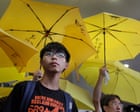
Every mainstream headline surrounding Joshua Wong operates under a comforting, lazy delusion. The narrative is always identical. A heroic young activist, crushed by an authoritarian machine, bowing to inevitable pressure in a rigged courtroom. It makes for incredible cable news segments and comfortable dinner table outrage in London and Washington.
It is also completely wrong.
When Wong entered his guilty plea under the national security law, the Western press treated it as a tragedy of silenced dissent. They missed the structural reality of what actually happened. They missed the calculation, the legal mechanics, and the grim pragmatism of modern political gravity.
Stop reading the headlines. Let us look at what is actually occurring.
The Comforting Fiction of Judicial Martyrdom
Western commentators love a clean binary. Good versus evil. Freedom versus oppression. When a high-profile defendant pleads guilty in a high-stakes political trial, the outside observer assumes coercion or broken spirit.
That interpretation ignores how legal systems operate when the state holds a near-monopoly on institutional power.
Under the sweeping architecture of the national security law enacted in mid-2020, conviction rates in these specific courts are not just high; they are a statistical certainty. Prosecutors do not bring these charges to trial to test hypotheses. They bring them when the verdict has already been written by the statutory framework itself.
Imagine a scenario where a poker player holds a hand where every single card is face-downed, stacked, and controlled by the house. Continuing to play out a multi-week trial where the outcome is mathematically predetermined is not bravery. It is performance art.
Wong understood the math. By entering a guilty plea, defendants under this specific jurisdiction secure a statutory discount on their eventual sentencing—usually a reduction of up to one-third. In an environment where decades of imprisonment are locked behind a door of absolute statutory minimums, trading performance for time is the only rational move left on the board.
The Western media calls it a surrender. Realists call it damage control.
The Myth of International Rescue
For years, the core strategic error of the local opposition movement was an over-reliance on external salvation. Activists genuinely believed that foreign condemnation, economic sanctions from Washington, and moral pressure from European parliaments would alter Beijing's foundational security calculus.
That belief was a catastrophic miscalculation.
Geopolitics does not run on moral enthusiasm. Sovereignty is maintained by the entity holding physical jurisdiction, police power, and administrative dominance on the ground. When the National Security Law dropped, it was designed precisely to sever the nerve endings connecting domestic agitation to foreign patronage.
Foreign governments issued statements of deep concern. They offered expedited visa pathways. They hosted panels. And then, quietly, they moved on to the next global crisis.
Wong’s guilty plea is the administrative punctuation mark at the end of that failed theory. The international community could write checks with their rhetoric, but they could never cash them with physical enforcement inside the territory. Relying on external saviors is not a strategy; it is a prayer. And praying does not hold up against an advancing security apparatus.
The Economics of Compliance
We must address the structural shift that happened behind the political noise. Markets do not care about democracy banners; they care about predictability.
Critics abroad waail about the death of financial autonomy in the territory. Yet, look at the capital flows, the banking reserves, and the continued operation of multinational corporate hubs. The administrative transition streamlined the governance model from a messy common-law hybrid into a tightly controlled vertical structure.
To the governing authorities, this was never about suppressing individuals for the sake of cruelty. It was about risk elimination. From their perspective, the 2019 unrest threatened systemic stability, property, and continuity. Once that threat was neutralized through sweeping legislative fiat, individual trials became mere administrative clean-up operations.
Wong's plea is processed not as a dramatic moral struggle, but as a judicial filing. The machine does not hate him; it simply processes him according to code.
The Dangerous Nostalgia for 2019
The reason this narrative persists in Western newsrooms is simple: commentators are addicted to the aesthetics of the 2019 protests. They remember the sea of umbrellas, the dramatic university campus standoffs, and the viral social media footage.
That world is gone. It is not coming back. Clinging to the illusion that underground resistance will magically resurrect that exact moment is a form of political escapism.
True analysis requires looking at power as it is, not as we wish it to be. Wong recognized the brutal arithmetic of his situation long before his lawyers submitted the paperwork. The tragedy is not that he pleaded guilty. The tragedy is that anyone ever convinced a generation of young people that moral posturing alone could defeat a sovereign state determined to rewrite the rules of the game.
History belongs to the side holding the keys to the cell block.