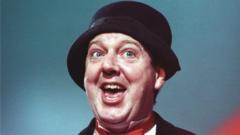
The heavy wool of the academic comedy circuit has long dismissed pure silliness as an inferior theatrical mode. When veteran entertainer Jimmy Cricket passed away at the age of eighty, the cultural obituaries rushed to frame him through the cozy, comforting lens of nostalgia. They remembered the cut-off evening dress trousers, the fedora perched at a jaunty angle, and the wellington boots marked with an L and an R. They quoted his timeless catchphrase. They painted him as a harmless relic of a vanished era when television light entertainment bound families together on a Saturday night.
That framing misses the harder, sharper reality of what Jimmy Cricket actually achieved. Born James Joseph Mulgrew in County Tyrone, he was not merely a passive artifact of mid-century variety television. He was an uncompromising practitioner of a specialized craft that modern comedy abandoned long ago: total, unironic innocence. In an industry where contemporary stand-up scales heights by tearing things down, Cricket built an entire career out of standing completely still and refusing to be cynical.
The Mechanics of Clean Mirth
To understand why figures like Cricket occupied a unique structural pillar in British entertainment, one must examine the mechanics of his act. Modern stand-up relies heavily on the confessional, the grievance, or the political jab. It operates on an adversarial contract between the performer and the room. The comedian points out an absurdity, the audience winces in recognition, and the bond is forged through shared exhaustion with modern life.
Cricket rejected this contract entirely. His humor was structural slapstick married to vaudevillian timing, rooted deeply in the tradition of the holiday camp Redcoat. He did not mine contemporary misery for material. Instead, he treated the stage as a neutral zone where logic was politely suspended. When he stepped up to the microphone with a letter clutched in his hand—his famous, rambling missives from his "mammy"—the humor derived precisely from its total detachment from geopolitical anxiety or social critique.
This brand of performance required an ironclad constitution. Critics who mistook his gentle exterior for simple-mindedness failed to recognize the precise athletic timing required to sustain physical comedy for decades. He worked the miners' welfares, the summer seasons, and the regional theatres with the exact same ballistic commitment he brought to his 1981 appearance on ITV's Search for a Star or his subsequent Central Television series And There's More. He never looked down on his audience, and crucially, he never looked down on his material.
The Cost of Staying Earnest
The entertainment landscape changed rapidly around performers like Cricket during the final decades of the twentieth century. Alternative comedy arrived with a wrecking ball in the late seventies and eighties, rebranding traditional variety as square, out-of-touch, and intellectually vacant. Performers who relied on physical props, catchphrases, and clean gags were systematically pushed to the cultural margins, relegated to Panto season and regional piers.
Yet Cricket outlived the cyclical fashions of cool. While other traditional acts grew bitter or attempted forced, awkward pivots into edgy adult territory to court metropolitan approval, Cricket remained entirely static. He stayed inside his lane because he understood something vital about human psychology. People do not always want to see their anxieties reflected back at them with dark irony. Sometimes, they require a safety valve. They require a performer willing to look ridiculous so that they might feel, for one hour, unburdened.
His private life mirrored his public persistence. A devoted family man married for over five decades, a Papal Knight of the Catholic Church, and a tireless charity fundraiser, his professional persona was not an ironic mask concealing a cynical interior. The warmth was structural. Colleagues like Tim Vine and Toby Hadoke noted that the man off-stage was identical to the man on it—obsessively kind, endlessly supportive of younger acts, and constitutionally incapable of cruelty. In a notoriously predatory industry, maintaining that level of baseline decency for sixty years is an act of quiet rebellion.
The Final Punchline
When his family released their statement detailing his final days—noting that he was cracking jokes to National Health Service nurses right up to the end—they deliberately subverted his most famous sign-off. Instead of his signature phrase pointing toward the exit, they noted his deep faith and looked toward eternity.
The passing of Jimmy Cricket marks the final closing of a curtain on an entire ecosystem of British performance. The commercial pressures of modern television mean that networks no longer incubate family-friendly physical comedians who can play successfully to a room containing both seven-year-olds and septuagenarians. The cross-generational appeal has been fragmented into hyper-targeted niche markets.
We are left with a culture saturated in knowing winks and defensive irony. We have plenty of comics who can deconstruct the misery of the world with surgical precision. What we have lost, and what Jimmy Cricket preserved until his final breath, is the courage to stand under the harsh lights, put on a pair of oversized boots on the wrong feet, and simply choose to make strangers laugh without a single safety net of cynicism