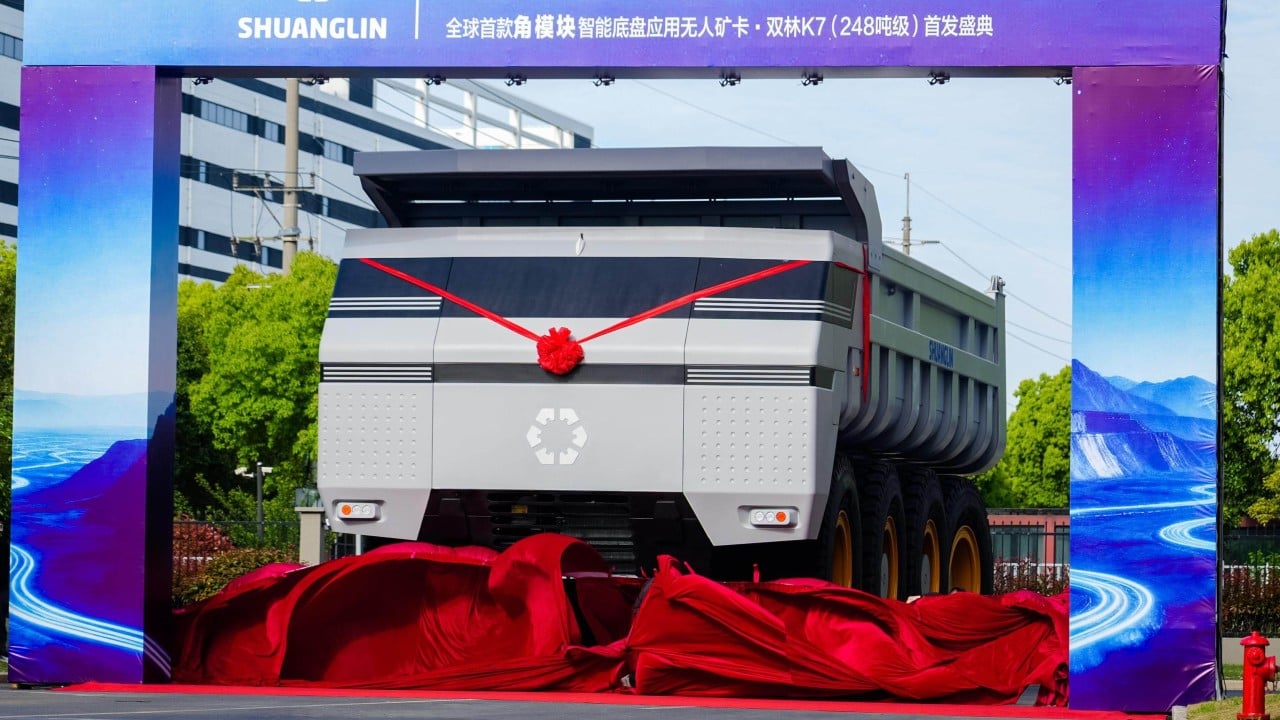
The dust in an open-pit mine doesn’t just sit on the ground. It hangs in the air like a thick, gritty curtain, tasting of iron and ancient stone. For decades, this was the office for thousands of drivers. They sat in cabs the size of small apartments, perched atop tires taller than a professional basketball player, wrestling with steering wheels that fought back against every rut and ravine. It was a life of vibration, kidney-rattling jolts, and the constant, low-level hum of danger.
That world is beginning to go silent.
In a remote corner of northern China, a new kind of beast has emerged from the haze. It doesn't have a seat. It doesn't have a steering wheel. It doesn't even have a windshield, because there is no one inside to look through it. This is the E-Tug, a 136-ton driverless electric mining truck developed by Aerospace Heavy Industry. While the "driverless" label is enough to make headlines, the true magic of this machine isn't just that it thinks for itself—it’s how it moves.
The Geometry of Survival
Traditional trucks are clumsy. They operate on a simple, rigid geometry: front wheels turn, back wheels follow. In the tight, treacherous spirals of a deep-pit mine, this is a liability. A standard haul truck needs a massive radius to turn around. It wastes time, burns fuel, and requires wide, expensive roads carved into the side of the earth.
The E-Tug throws that geometry away.
Equipped with an independent all-wheel steering system, it can perform a maneuver known as "crab-walking." Imagine a massive, steel-plated predator moving diagonally across a slope without ever turning its nose. It can slide sideways into a loading zone. It can rotate on its own axis. By moving like a crustacean rather than a car, it shrinks the physical footprint required for a mine to function.
Consider the "dead time" in a typical mining shift. A human driver spends a significant portion of their day backing up, three-point turning, and lining up under the maw of a giant excavator. It is a slow, methodical dance. The E-Tug replaces that dance with a series of sharp, mechanical pivots. It doesn't get tired. It doesn't lose depth perception in a midnight fog. It simply slides into place, receives its load, and hums away.
The Invisible Stakes of the Deep Pit
To understand why a truck that walks sideways matters, you have to look at the economics of the earth itself. Mining is a game of margins played with millions of tons of rock. The deeper you go, the more expensive it becomes to bring the ore to the surface.
Every extra meter of road width you have to carve into a pit wall is a meter of "overburden"—worthless rock—that you have to move before you get to the profit. By using trucks that can navigate narrower paths and turn in their own length, mining companies can design steeper, tighter pits. We are talking about saving billions of dollars over the life of a single site.
But the stakes aren't just financial. They are deeply, uncomfortably human.
Mining is one of the most hazardous professions on the planet. Even with the best safety protocols, putting a human being behind the wheel of a multi-ton kinetic weapon for twelve hours at a time is a risk. Fatigue is a silent killer. A momentary lapse in judgment on a rain-slicked haul road can result in a catastrophe that closes a site for weeks.
Removing the cab isn't just a design choice; it's a declaration. It admits that some environments are simply too hostile for the human body to occupy. The E-Tug operates via a combination of LiDAR, radar, and a 5G-enabled "brain" that sees through dust and darkness with a clarity no human eye could hope to achieve.
The Electric Pulse
Underneath its yellow armor, the E-Tug is a titan of efficiency. It is fully electric, powered by a massive battery array that swaps out the roar of a diesel engine for the high-pitched whine of an electric motor.
There is a beautiful irony in this: we are using electric machines to mine the very minerals required to build more electric machines. The lithium, the copper, and the rare earth elements that power our smartphones and our Teslas are being pulled from the ground by their own mechanical cousins.
This creates a closed loop of sustainability that the industry has craved for years. Diesel consumption in a large-scale mine is staggering—thousands of gallons an hour. By switching to an autonomous electric fleet, a mine can cut its carbon footprint by a margin that seemed impossible a decade ago.
The Ghost in the Machine
It is easy to look at a driverless truck and see a threat to labor. It’s a valid fear. When the cab disappears, the job of the driver disappears with it. But if you talk to the engineers on the ground, they describe a shift rather than an erasure.
The "driver" of the future doesn't sit in a vibrating seat in the middle of a dust storm. They sit in a climate-controlled command center miles away, or perhaps in a different city entirely. They monitor a fleet of ten trucks from a bank of monitors, stepping in only when the AI encounters a problem it can't solve. It is the transition from manual labor to systems management.
It is a cleaner job. A safer job. But it is also a different kind of life.
The E-Tug represents the moment where the "uncanny valley" meets heavy industry. There is something profoundly strange about watching a 130-ton vehicle navigate a complex obstacle course with the grace of a ballet dancer, completely empty of life. It moves with a terrifying, silent precision. It doesn't hesitate. It doesn't second-guess.
The New Architecture of the Earth
We are moving toward a world where the surface of the planet is reshaped by entities that don't breathe. The crab-walking truck is the first architect of this new era.
Because it can move in ways we cannot, it allows us to build in ways we never would have dared. Tunnels can be smaller. Grades can be steeper. The very layout of our industrial world is being rewritten to accommodate the specific strengths of the machine.
We used to build tools that fit our hands. Now, we are building worlds that fit our algorithms.
The E-Tug is a marvel of engineering, a feat of 5G integration, and a masterclass in autonomous navigation. But more than that, it is a mirror. It reflects our desire to reach deeper into the earth while keeping our own skin out of the game. It is the sound of a silent revolution, one that slides sideways through the dust, moving toward a future where the heavy lifting is done by ghosts.
The dust still hangs in the air at the mine site, thick and iron-tasting. But the curtain is rising on a different stage. The trucks are walking, and they don't need us to lead the way.