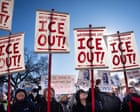
The coffee in the paper cup grows cold. It turns bitter. Across the concrete plaza, a megaphone crackles to life, spitting out words that dissolve into the damp morning air before they can even form full sentences. Signs bob on wooden poles. Cardboard. Sharpie ink. Hands wrapped tight against the chill.
You stand among them. Or perhaps you just walk past them on your way to the subway, a commuter glancing sideways at the cluster of citizens shouting about immigration enforcement, about borders, about humanity. It feels ordinary. It feels like a Tuesday in a modern democracy.
Except you are not alone.
Beneath the heavy coats and sensible shoes, hidden within the rustle of down jackets and the chatter of smartphone screens, eyes are watching. Not just human eyes. Digital eyes. Silent, methodical, and relentless.
Court documents recently pried open by legal challenges reveal a quiet machinery that most citizens assume only exists in spy thrillers. Federal agents tracking anti-ICE protests. Logging faces. Pinning license plates to databases. Archiving the movements of people whose only crime, at least in that moment, was holding a sign that displeased the state.
This is the reality of modern civic dissent. It is observed. It is cataloged.
I remember the first time I realized someone was keeping a file. It wasn't dramatic. No trench coats. No smokey alleyways. Just a routine records request returned with thick black redactions, a digital signature, and the cold realization that my afternoon spent standing in the rain had been reduced to a spreadsheet row. A metadata point.
When federal law enforcement agencies turn their surveillance apparatus inward, toward the very population they swore to protect, the definition of security shifts. It bends. It snaps.
Consider what happens next. You march. You chant. You go home, wash the coffee cup, and forget about it. But the servers do not forget. The automated license plate readers lining the avenue captured your sedan at 8:14 AM and 5:32 PM. Facial recognition software, running quietly in the background of street-corner traffic cameras, indexed the geometry of your cheekbones.
This is not about immigration policy alone. This is about the architecture of observation.
When a government invests heavily in monitoring political dissent, the chilling effect is rarely loud. It does not arrive with a heavy boot kicking down your front door at midnight. It arrives as hesitation. It is the second-guessing before you type a post on social media. It is the friend who decides not to attend the rally because they are applying for a federal job, or a mortgage, or a security clearance, and they have heard the whispers about watchlists.
Paranoia becomes a civic tax.
History shows us this pattern on a loop. Whenever institutional power feels threatened by popular friction, its first instinct is to illuminate the dark corners where dissent breeds. But democracy is supposed to be messy. It is supposed to involve people standing on pavement, yelling until their throats are raw, demanding change from leaders who would rather look away.
When the state uses its vast technological arsenal to watch the protesters, the balance of power tilts.
Imagine, for a moment, a citizen named Sarah. (Note: Sarah is a hypothetical composite based on real legal disclosures, designed to illustrate a documented investigative pattern.) Sarah is twenty-six. She works in accounting. She has never been arrested in her life. She cares deeply about migrant rights, so she spends her Saturday afternoon standing outside a federal building, holding a sign that quotes Emma Lazarus.
To Sarah, she is exercising a constitutional birthright.
To the Department of Homeland Security or the FBI field office monitoring the perimeter, Sarah is an intelligence asset. Or rather, her data is. Her face is captured on a high-definition pan-tilt-zoom camera mounted discreetly on a nearby light pole. Her cell phone's unique hardware identifier—its digital fingerprint—pings a stingray device or is harvested through commercial location data brokers.
Sarah goes home. She eats dinner.
Meanwhile, her digital ghost is filed away in a database. It is shared across inter-agency fusion centers. It sits there, waiting for an algorithm to flag a pattern, waiting for a threshold to be met, waiting to be pulled up during a routine background check five years down the road.
Why? Because the machinery of surveillance, once built, demands to be fed.
We are told this is about safety. We are told that keeping tabs on anti-ICE demonstrations, environmental blockades, and civil rights marches is merely proactive threat mitigation. Law enforcement agencies argue that they must monitor crowds to prevent violence, to protect federal property, to maintain public order.
The justification sounds reasonable in a boardroom. It falls apart on the asphalt.
Because the vast majority of people standing in those crowds are not violent extremists. They are teachers, nurses, students, and retirees. When their movements are vacuumed up alongside the fringe minority, the net is cast so wide that it catches the entire ocean.
The Fourth Amendment was written by men who understood human nature. They knew that power accumulates, and that unchecked power inevitably turns its gaze toward its critics. They designed a constitutional shield requiring probable cause, warrants, and judicial oversight precisely to prevent the state from building dossier empires on ordinary citizens.
Yet, digital surveillance has outpaced constitutional jurisprudence.
Agencies bypass traditional warrant requirements by simply buying data from commercial brokers. If a private company can legally harvest your location history from the weather app on your phone, federal agents can legally purchase that exact same data stream without ever knocking on a judge's door. It is an end-run around the Bill of Rights. A loophole wide enough to drive a surveillance van through.
The court files that expose these practices are usually dragged into the light by civil liberties organizations through agonizing Freedom of Information Act lawsuits. Years of stonewalling. Heavily redacted pages. Legal battles that stretch across presidential administrations, proving that the appetite for domestic intelligence gathering is bipartisan and institutional, transcending political parties.
The machinery runs itself.
Consider the chilling reality of what happens when dissent is treated as a security anomaly. It alters the DNA of public life. People stop showing up. Not because they stopped caring, but because the cost-benefit analysis of civic participation has been quietly rewritten by invisible hands.
That is the true objective of mass monitoring. It doesn't always need to arrest you to win. It just needs you to stay home.
The coffee is cold now. The plaza is emptying out. The protesters have packed their cardboard signs into the trunks of their cars, unaware of the digital breadcrumbs left behind on the tarmac and in the cloud.
We live in a glass house, and the architects of the house are holding the blueprints while we stumble around in the dark.
The silence that follows a protest is never truly empty. It hums with the quiet transfer of packets, the hum of servers cooling in windowless rooms, and the steady, unblinking stare of an eye that never closes.