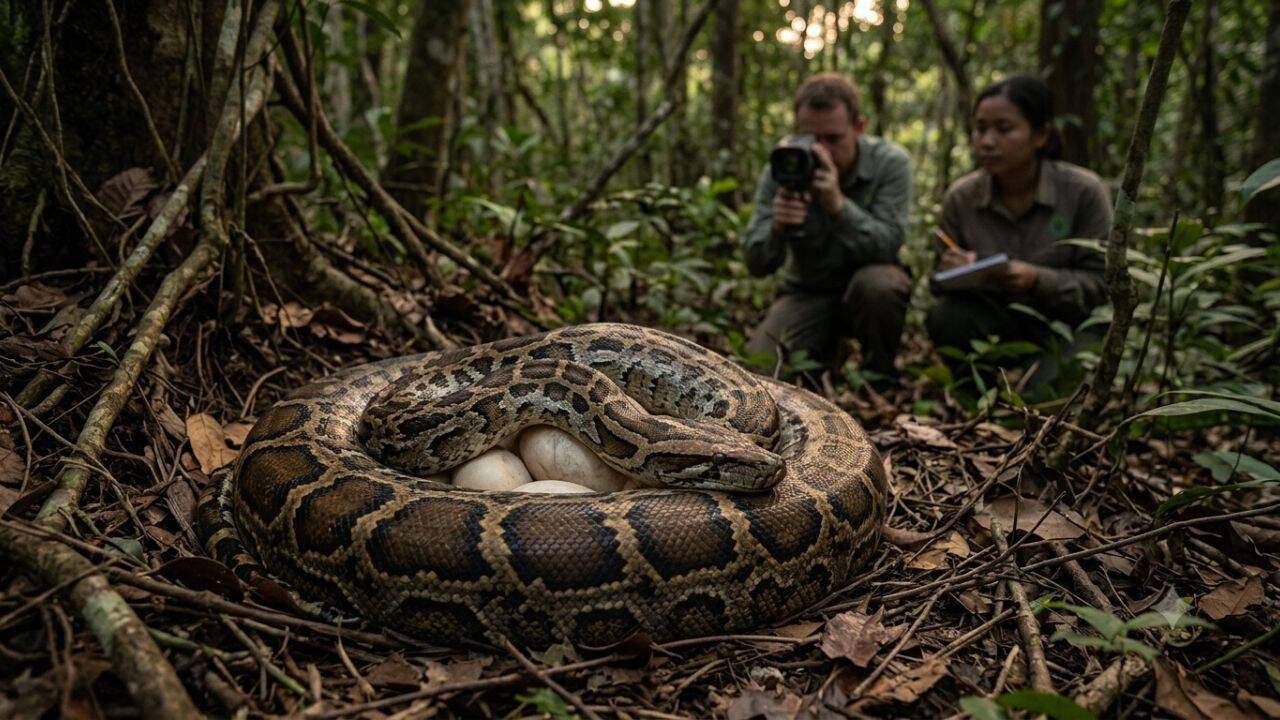
The Florida Everglades is witnessing an evolutionary masterclass that defies conventional wisdom about cold-blooded predators. Deep within the sawgrass marshes and abandoned infrastructure of southern Florida, invasive female Burmese pythons are exhibiting a specialized physiological response previously thought rare or isolated in wild North American environments: shivering thermogenesis.
When a female Burmese python coils around her clutch of dozens of eggs, she is not merely standing guard against opportunistic predators like raccoons or opossums. She is actively operating as a biological furnace. Through rhythmic, involuntary muscle contractions, these massive constrictors elevate their internal metabolic rates, pumping precious body heat directly into the developing embryos.
This isn't an accidental byproduct of digestion. It is a calculated, energy-intensive maternal investment that underscores how effectively this invasive apex predator is adapting to its adopted subtropical home.
The Mechanics of Reptilian Shivering
For decades, standard ecological models categorized reptiles as strictly ectothermic—creatures entirely dependent on external thermal sources like ambient air and direct sunlight to regulate body temperature. Snakes lay eggs and typically leave them to the whims of environmental conditions, trusting that warm soil or rotting vegetation will suffice.
The Burmese python shatters this textbook generalization.
When ambient temperatures drop below specific physiological thresholds, the female's muscular system begins a series of rapid, spasmodic contractions. This deliberate shivering increases her oxygen consumption and metabolic output exponentially, generating tangible thermal energy. Field studies tracking wild nesting females in the Greater Everglades Ecosystem have documented these snakes maintaining nest temperatures significantly higher than the surrounding ambient air.
The cost of this maternal dedication is astronomical. Producing a massive clutch—sometimes numbering nearly a hundred eggs—combined with weeks of continuous muscle twitching and fasting drains the female's physical reserves. Field data shows that brooding females can lose close to thirty percent of their total body mass during a single reproductive cycle.
Yet, the evolutionary payoff for the species is immense. By keeping the eggs within a tighter, optimal thermal window, the mother shortens developmental irregularities, increases hatchling viability, and gives her offspring a distinct survival advantage upon emergence.
Infrastructure as an Incubation Chamber
The setting of these biological events reveals another layer of adaptability. While native habitats in Southeast Asia provide natural cavities, hollow trees, and forest debris for nesting, the altered landscape of South Florida offers artificial alternatives.
Research into wild nests has documented females utilizing human-made structures, such as abandoned concrete culvert pipes, as subterranean nurseries. These industrial relics provide structural stability, protection from heavy seasonal downpours, and thermal mass that buffers against extreme temperature swings. A massive female python draped inside a concrete drainpipe, shivering away unseen while guarding a massive cluster of leathery eggs, represents a collision between invasive biology and human infrastructure.
This behavior complicates the already formidable challenge of python management in Florida. Wildlife management agencies have historically relied on removal programs, public hunts, and tracking sentinel snakes to locate breeding populations. However, understanding that females actively invest energy into incubation means that nest sites function as localized production hubs of high efficiency.
Every successful clutch that survives the brooding period introduces dozens of apex predators into an ecosystem that has already suffered catastrophic declines in native mammal populations. Raccoons, bobcats, marsh rabbits, and opossums find themselves competing with or falling prey to an invasive lineage that possesses not just physical strength, but sophisticated reproductive resilience.
The Cost of Adaptation
The success of Python bivittatus in the American subtropics is a stark reminder of biological plasticity. An animal torn from its native range, liberated by the exotic pet trade, and thrust into an alien environment did not merely survive; it co-opted the ecosystem's thermal and physical resources.
The image of a shivering python mother wrapped tightly around her eggs in a dark, concrete pipe strips away any lingering illusion that these reptiles are simple, unthinking automata. They are complex biological actors capable of facultative endothermy when the survival of their genetic lineage demands it.
As field biologists continue to map the reproductive habits of these invasive giants, the margin for error in controlling their spread narrows. The furnace is lit in the marsh, and the output scales upward with every season.