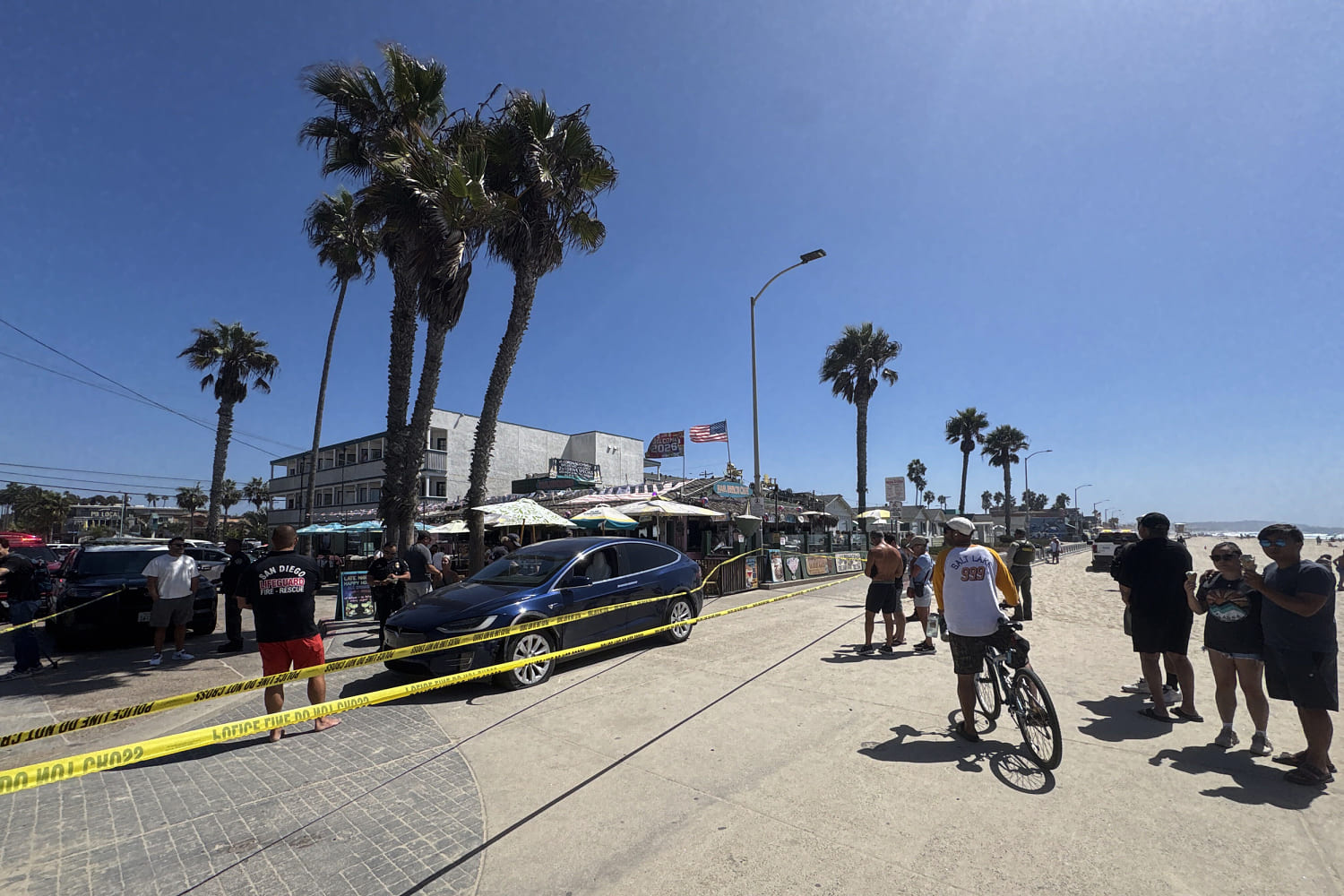
Public infrastructure designed for leisure operates on an implicit social contract of predictable civil behavior. When that contract breaks down through vehicular weaponization in densely populated corridors like the San Diego boardwalk, the resulting crisis exposes the mechanical limits of emergency response times and the structural dependency on immediate civilian counter-action. Analyzing the mechanics of the Mission Beach incident where bystanders interdicted a driver accused of striking a pedestrian with a stolen automobile reveals critical parameters regarding spatial risk, kinetic threat mitigation, and the friction between civic safety models and open pedestrian zones.
The Vector of Vulnerability in Open-Access Corridors
Shared pedestrian zones, promenades, and boardwalks present a unique spatial challenge for municipal safety design. These environments maximize economic and recreational utility by removing physical barriers, bollards, and vehicular access restrictions to maintain fluid foot traffic. Yet, this same openness creates a catastrophic vulnerability profile.
When a motor vehicle enters a pedestrian-exclusive corridor, the velocity vector combined with high-density foot traffic generates an extreme imbalance of kinetic force versus human reaction windows. Traditional municipal response models rely on delayed intervention: an emergency call is placed, dispatch routes resources, and law enforcement units navigate congested urban grids to reach the perimeter. During the critical window between vehicle intrusion and official arrival, the survival probability of targeted individuals depends entirely on local kinetic interruption.
[Vehicle Intrusion] ---> [Spatial Vulnerability] ---> [Delayed Municipal Response] ---> [Civilian Interdiction Mandate]
This structural reality shifts the initial burden of crisis management from professional security infrastructure to ad-hoc civilian collectives. The San Diego boardwalk episode illustrates how high-density public spaces function as decentralized security ecosystems where the speed of threat neutralization is inversely proportional to the distance from stationary law enforcement assets.
The Cost Function of Civilian Intervention
When untrained individuals elect to pursue, confront, and physically detain an active vehicular assailant, they operate under a distinct set of tactical constraints and physiological stressors. Decision-making under high-arousal conditions narrows focus, degrading fine motor skills and spatial awareness while amplifying baseline aggression or protective instincts.
The operational variables governing successful bystander interdiction can be modeled across three primary dimensions:
- Spatial Containment Efficiency: The physical geometry of a boardwalk—bounded by physical structures on one side and open terrain on the other—limits escape vectors for a vehicle, inadvertently compressing the operational zone and increasing collision probability with secondary bystanders.
- Kinetic Disruption Timing: The effectiveness of intervention decays exponentially relative to the duration of the assault. Early interdiction prevents the escalation from isolated impact to multi-target vehicular ramming.
- Collective Action Coordination: Unorganized crowds exhibit high variance in tactical response. Without a designated leader or communication protocol, bystander intervention risks cascading into secondary injuries, collateral property damage, or the accidental shielding of the suspect's escape path.
+---------------------------+-----------------------------------------------+
| Strategic Variable        | Operational Impact on Public Safety           |
+---------------------------+-----------------------------------------------+
| Perimeter Permeability    | Accelerates vehicle entry; removes warning lag |
| Citizen Response Latency  | Fills the gap between incident and police arrival |
| Spatial Compression       | Narrows escape options for pedestrians        |
+---------------------------+-----------------------------------------------+
Systemic Flaws in Urban Promenade Architecture
The reliance on civilian intervention to resolve kinetic threats on pedestrian thoroughfares highlights systemic architectural deficiencies in modern urban planning. Designing spaces for maximum aesthetic openness without incorporating passive physical hardening measures creates an unacceptable variance in public safety outcomes.
Fixed bollards, retractable barriers, and strategic landscape grading can eliminate vehicular access points without degrading the pedestrian experience. However, municipalities frequently balance the capital cost of infrastructure hardening against the statistical rarity of vehicular ramming events. This risk-management calculation ignores the severe downstream psychological and physical costs borne by the public when an unhindered vehicle penetrates a crowded corridor.
Furthermore, relying on rapid civilian mobilization introduces severe liability and safety hazards. Bystanders lack tactical gear, communication channels with emergency dispatchers, and standardized protocols for kinetic containment. Expecting citizens to act as an impromptu tactical force creates a moral hazard for municipal governance, shifting the cost of infrastructure protection onto the civilian populace.
Tactical Realignment for High-Density Public Corridors
To mitigate reliance on ad-hoc civilian interdiction, municipal risk management frameworks must shift from reactive post-incident enforcement to proactive spatial fortification. The structural vulnerabilities exposed on coastal promenades demand an operational overhaul across three vectors:
- Passive Hardening Integration: Deploying architectural deterrents capable of arresting vehicle momentum without obstructing pedestrian flow or emergency vehicle access.
- Early Warning Telemetry: Installing automated optical and acoustic sensors capable of detecting unauthorized vehicular entry into pedestrian zones and instantly triggering localized warning systems or automated physical barriers.
- Decentralized Security Presence: Replacing distant patrol models with high-visibility, mobile tactical units stationed directly within high-density recreational zones during peak utilization windows.
Until structural architectural changes match the real-world threat profile of open-access pedestrian corridors, public safety will remain precariously tethered to the spontaneous courage and tactical improvisation of those standing nearest the point of impact.