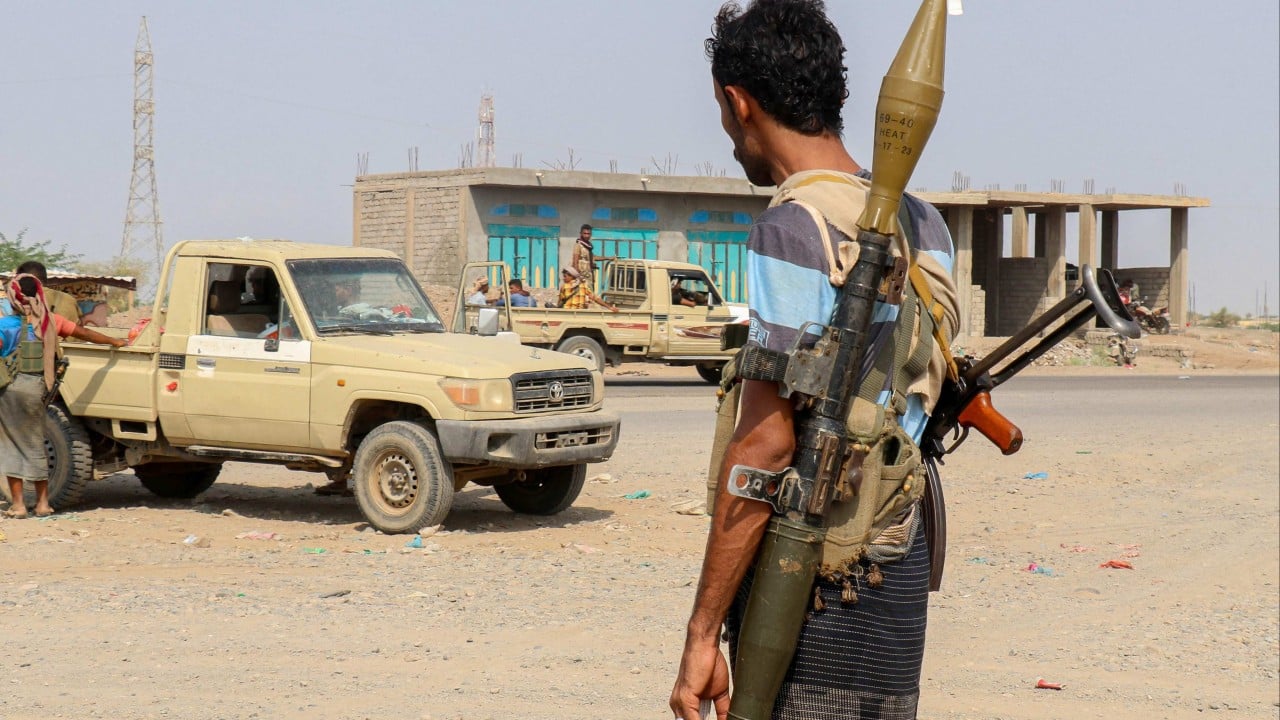
More than three hundred combatants and civilians have been killed in Yemen during a ferocious surge of violence that marks the deadliest fighting since the 2022 truce finally dissolved. Houthi forces launched a sweeping offensive aimed directly at severing the vital supply arteries connecting Taiz to the strategic Red Sea port city of Mokha. This kinetic escalation shatters years of relative, uneasy stagnation, dragging the southern coast back into a state of total war. The offensive concentrates heavily on the doorsteps of the Bab al-Mandab Strait, threatening international maritime choke points just as regional pressures reach a boiling point.
The military mechanics of this sudden offensive reveal an operational shift by the Houthi movement. Rather than maintaining defensive postures along static lines, field commanders executed a synchronized push utilizing ground assaults, ballistic assets, and drone saturation to overwhelm government-held redoubts in western Taiz and southern Hodeidah. Medical and military tallies from both factions confirm that casualties mounted rapidly as defensive positions in Jabal Habashi and Maqbanah collapsed under coordinated mortar and rocket barrages. Displaced families packed onto pickup trucks, abandoning makeshift desert camps to escape the crossfire, fleeing deeper into arid scrublands devoid of basic infrastructure or shade.
The Anatomy of a Broken Ceasefire
Peace in Yemen has always been an illusion propped up by international fatigue rather than genuine reconciliation. The formal 2022 truce provided a convenient diplomatic fiction, allowing foreign capitals to pretend the humanitarian catastrophe was managed while domestic actors simply rearmed. When that arrangement began to fray earlier this year, it did not happen in a vacuum. It was systematically eroded by macroeconomic collapse, localized factional infighting in the south between the internationally recognized government and secessionist southern militias, and the wider regional spillover linked to the Middle East conflict.
When supply lines snap, human misery follows with mathematical precision. The closure of the primary road linking Taiz to Mokha cuts off thousands of households from commercial goods, medical supplies, and humanitarian relief. Humanitarian agencies operating on the ground face an impossible operational landscape. Funding appeals for Yemen remain severely under-written, and major international organizations have repeatedly scaled back life-saving interventions due to bureaucratic obstruction and security risks in northern zones. The current ground offensive compounds these structural vulnerabilities, shoving millions of already malnourished citizens closer to outright starvation during the peak lean season.
Strategic Calculations Along the Red Sea Choke Point
Control of the Red Sea gateway dictates the economic and military posture of every faction involved in this decade-long tragedy. By pushing toward the Bab al-Mandab Strait, Houthi forces are positioning themselves to project power over one of the busiest maritime commercial corridors on Earth. Every container ship, oil tanker, and bulk carrier transiting between Europe and Asia through the Suez Canal passes within visual range of these contested coastal cliffs.
The internationally recognized government, fractured by internal rivalries and competing regional patrons, struggles to mount a cohesive defense. Saudi Arabia and its allies find themselves constrained by diplomatic weariness and an intense desire to disentangle their military footprints from a quagmire that has bled state coffers for a decade. Meanwhile, external actors maintain their proxy investments, ensuring that neither side possesses the absolute dominance required for a military victory, nor the incentive to negotiate in good faith.
Civilians bear the ultimate cost of this geopolitical stalemate. Thousands of families displaced by the latest round of fighting now inhabit sun-scorched tent settlements where clean water is scarce and sanitation non-existent. As front lines shift through agricultural fields and residential outskirts, infrastructure collapses under sustained artillery duels. Schools, clinics, and electrical grids take direct hits, turning habitable districts into ghost towns.
There is no diplomatic off-ramp currently visible on the horizon. International envoys issue routine condemnations, appealing for restraint to deaf ears in Sanaa and Aden alike. As long as regional actors continue to use Yemeni soil as a chessboard and domestic factions prioritize territorial aggrandizement over institutional survival, the death toll will continue to climb. The bodies piling up in front-line makeshift morgues are not anomalies; they are the predictable output of a war machine that has never truly stopped turning.