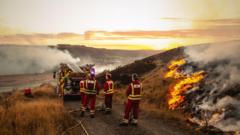
The smoke clears, politicians step before television cameras, and the script unfurls with predictable fatigue. Officials express solemn regret, admit that public safety protocols failed to match the velocity of modern flame fronts, and promise that lessons must be learned from devastating wildfires. Then the funding committees reconvene, the news cycle drifts toward safer terrain, and the underlying structural vulnerabilities remain completely untouched until the next dry season triggers identical devastation.
Emergency management ministers talk endlessly about an unprecedented new normal, but the real crisis is not meteorological. It is an institutional failure of imagination. Governments across the globe treat catastrophic wildfires as sudden acts of God rather than predictable outcomes of decades-long policy inertia, outdated zoning laws, and a total disconnect between municipal planners and wildland fire scientists. If you liked this post, you might want to check out: this related article.
The Architecture of Failure
When a crown fire races through a wildland-urban interface at speeds exceeding thirty kilometers per hour, it does not care about administrative boundaries or bureaucratic jurisdictional disputes. Yet, response frameworks remain rigidly fragmented.
Consider how regional authorities handle vegetation management. Local municipalities control property taxes and approve suburban housing expansions directly adjacent to volatile brushlands, while provincial or national forestry departments manage the surrounding timber. These two entities rarely share synchronized mapping data or unified budgetary priorities. For another perspective on this story, refer to the recent coverage from Associated Press.
A housing subdivision is approved with ornamental cedar landscaping and narrow access roads, creating a localized death trap. When disaster strikes, fire crews find themselves protecting structures that never should have been permitted in that exact configuration.
This institutional blindness extends directly into evacuation protocols. Traditional emergency planning assumes citizens receive warnings hours in advance via television broadcasts or automated telephone calls. Modern high-intensity fire behavior destroys electrical grids and cellular towers within minutes.
When power fails instantly, sirens and digital alerts do not reach populations trapped on single-access suburban arteries. Admitting that lessons must be learned offers cold comfort to families who discover that evacuation routes are bottlenecked by burning utility poles and gridlocked traffic.
Beyond the Rhetoric of Resilience
True preparation requires moving past comfortable euphemisms about community resilience and confronting hard operational realities. For instance, consider a hypothetical municipality situated in a high-risk dry zone. Building codes in this zone currently permit standard wood-shingle roofing and combustible deck attachments to appease real estate developers concerned with construction costs.
If municipal leaders refuse to mandate non-combustible building envelopes, defensive ember-resistant venting, and mandatory defensible space clearances of at least thirty meters around every residential structure, then any post-disaster ministerial apology is merely performative theater.
Insurance markets have begun recognizing this reality faster than elected officials. Private insurers are quietly retreating from high-risk wildfire zones, leaving homeowners exposed or entirely uninsurable. This financial withdrawal functions as an unacknowledged regulatory correction. When the free market refuses to underwrite poor land-use planning, governments often step in with taxpayer-funded backstops, subsidizing the very behavior that put communities in jeopardy in the initial phase.
This moral hazard prevents real adaptation. As long as property owners believe the state will rebuild their homes in the exact same vulnerable location after every disaster, behavioral patterns will not shift.
Re-Engineering Emergency Response
Fixing this trajectory demands structural changes that politicians routinely avoid because they alienate influential voter blocs and powerful commercial interests. First, zoning authority must be decoupled from municipal councils that face short-term pressures to expand tax bases through development in high-risk zones. Independent regional land-use boards, staffed by fire ecologists and hydrologists, must possess veto power over any construction project that compromises regional evacuation capacity or firefighter safety.
Second, communication infrastructure must be overhauled to operate completely off the grid. Relying on centralized cellular networks during a climate-driven emergency is a catastrophic design flaw. Decentralized, mesh-networked warning systems powered by independent solar arrays and satellite uplinks must become the mandatory baseline for any community designated as a high-risk interface zone.
The admission that lessons must be learned has transformed into a meaningless rhetorical shield. Every cycle of ash and ruin exposes the same administrative cowardice, the same refusal to confront developers, and the same reluctance to invest heavily in pre-disaster mitigation rather than post-disaster recovery. Until governments penalize poor planning with the same urgency they apply to putting out the flames, the smoke will simply return next summer.