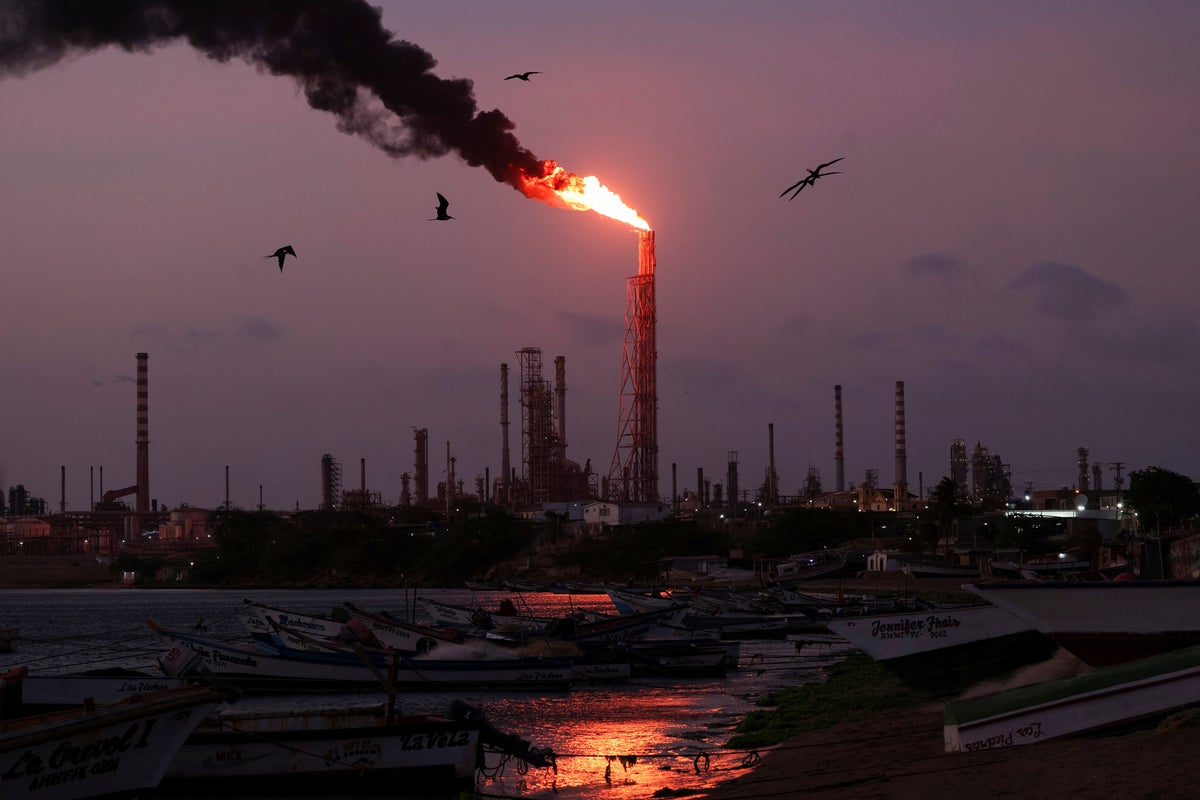
Realizing the grand vision of a massive, Washington-backed energy revival in South America requires confronting an unforgiving physical reality. Decades of systemic looting, chronic underinvestment, and catastrophic fires have left Venezuela's petroleum infrastructure in an advanced state of decay. When political shifts prompt vows of a hundred-billion-dollar injection from foreign oil majors, the numbers sound transformative. Yet heavy metal, corroded pipes, and paralyzed fractionating towers do not care about political rhetoric. They require an immense, multi-year engineering miracle that money alone cannot instantly buy.
The Chemistry of Collapse
To understand why the Paraguana Refining Center and other vital domestic processing facilities remain broken shells, one must look past the headlines and examine crude viscosity. Venezuela sits atop the world's largest deposits of extra-heavy oil, a dense, asphalt-like bitumen found primarily in the Orinoco Belt. Raw bitumen cannot simply be pumped out of the ground and piped into a standard facility. It requires specialized upgraders to break down heavy molecules, alongside continuous imports of lighter chemical solvents known as diluents to thin the sludge enough for transit.
Right now, most of those chemical upgraders sit completely paralyzed. Without functional upgraders and steady shipments of foreign cutter stocks, heavy crude clogs the entire supply chain. The domestic refining network, built decades ago to handle these specific streams, has been scavenged for spare parts. Technicians have been forced to cannibalize dead units just to keep a single distillation column wheezing along at ten percent of its designed capacity.
Where the Money Will Not Go
Corporate boardrooms in Houston and London are evaluating risk through a lens of cold financial calculation. Pumping capital into a foreign nation requires verifiable legal protections, predictable tax structures, and absolute certainty that contracts will be honored. Billions of dollars in unliquidated arbitration claims from past nationalizations still hang over Caracas like a specter. Until those foundational legal disputes find resolution, major international operators will hold their checkbooks tight.
More importantly, rational capital allocators prioritize exportable crude over domestic fuel production. Refineries inside Venezuela primarily supply local gasoline heavily subsidized by the state. Operating those plants means producing fuel that is sold domestically at a steep financial loss. Foreign corporations chasing returns for their shareholders will direct their initial cash flows toward upstream extraction wells and export terminals capable of generating hard foreign currency. Refineries that feed local pumps will remain at the bottom of the priority list.
The Talent Vacuum
Physical rust is only half the crisis. The human capital drain represents an equally severe barrier to recovery. Over the past twenty years, thousands of seasoned petroleum engineers, specialized geologists, and experienced plant operators fled state-run Petróleos de Venezuela. They found employment across the Middle East, the United States, and the North Sea.
Replacing rusted control panels takes months. Replacing decades of lost institutional knowledge takes generations. Bringing modern digital automation and safety systems to a facility that has relied on manual, jury-rigged fixes since the early 2000s demands an army of skilled expatriate labor. Safety protocols cannot simply be decreed from a corporate headquarters; they must be drilled into a workforce operating complex, hazardous pressure vessels handling volatile hydrocarbons under extreme thermal stress.
Beyond the Short-Term Gamble
The gap between political timelines and engineering reality remains staggering. Promising complete operational restoration within eighteen months ignores the baseline physics of heavy oil field development. Upstream production might eke out minor gains through emergency wellhead interventions, but transforming fractured assets into modern, efficient energy hubs is a decade-long endeavor.
The machinery of extraction demands stable power grids, secure pipelines, and uncorrupted logistics chains. Until the foundational rot inside the administrative and physical architecture is completely excised, every billion-dollar pledge remains nothing more than a down payment on an uphill battle against time and entropy