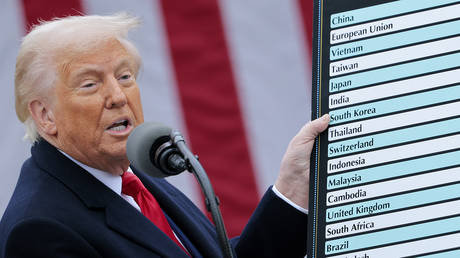
Donald Trump has declared a Section 301 trade investigation against the European Union, threatening sweeping retaliatory tariffs after Brussels slapped Google with a $1 billion antitrust fine under the Digital Markets Act. Accusing European regulators of treating American technology firms as a financial resource, the White House is turning antitrust enforcement into an international tariff conflict. The move escalates a long-running dispute over how foreign governments police dominant digital platforms.
The immediate trigger was a combined €890 million penalty levied by European Commission regulators against Google for self-preferencing its travel booking services and restricting app marketplace alternatives. Yet the anger brewing in Washington extends far beyond a single corporate fine. Over the past decade, European regulators have extracted tens of billions of dollars in fines and back taxes from Apple, Meta, Amazon, and Alphabet. From the perspective of the White House, these enforcement actions represent a calculated, non-tariff barrier designed to penalize American innovation where European firms have consistently failed to compete.
The conflict marks a fundamental shift in how trade disputes are fought. Rather than fighting over steel, agriculture, or automobiles, the world's two largest economic blocs are now weaponizing trade policy over algorithm design, app store fees, and digital sovereignty.
The Section 301 Weapon Re-Emerges
Washington is reaching for its heaviest economic hammer. By directing the United States Trade Representative to launch an investigation under Section 301 of the Trade Act of 1974, the administration is laying the legal groundwork to bypass multilateral arbitration entirely.
Section 301 gives the executive branch broad authority to investigate and retaliate against foreign government practices deemed unreasonable, unjust, or discriminatory against American commerce. The law was famously deployed in the 1980s against Japanese semiconductor manufacturers and reinstated during Trump's first term to impose tariffs on Chinese imports. Applying it to European regulatory policy sets a startling precedent. It frames sovereign legal enforcement as an unfair trade practice.
The legal theory pushed by administration officials relies on a straightforward argument. If a foreign regulator systematically directs its heaviest financial penalties at foreign corporations while exempting domestic or regional alternatives, that enforcement acts as a de facto import duty. White House officials point out that the Digital Markets Act explicitly targets companies meeting specific market capitalization and user thresholds, criteria that almost exclusively ensnare American firms like Google, Apple, Meta, Amazon, and Microsoft.
Brussels vehemently rejects this framing. European Commission officials maintain that the regulations apply strictly based on market power, not national origin. To European regulators, the laws protect European consumers from monopolistic rent-seeking and preserve open digital markets. But in Washington, the math tells a different story. American executives and trade negotiators view the European Commission as a regulatory body acting as a revenue collection agency for a continent without its own tech giants.
Anatomy of a Thirty Billion Dollar Regulatory Ledger
The financial scale of European enforcement against Big Tech is staggering. A look at the balance sheet explains why tension reached a boiling point.
Apple was ordered to pay €13 billion in back taxes to Ireland after European courts ruled that selective tax arrangements constituted illegal state aid, alongside a separate €1.8 billion fine over music streaming competition rules. Google has accumulated over €8 billion in European antitrust penalties over the past decade, culminating in the latest $1 billion sanction. Meta faced a record €1.2 billion privacy fine over transatlantic data transfers, coupled with ongoing scrutiny over its bundled advertising model. Amazon reached settlements to avoid massive fines regarding its use of third-party seller data, yet remains under constant regulatory oversight.
Cumulative European Fines on Major U.S. Tech Platforms
| Company | Major Regulatory Focus | Estimated Total Fines and Demands |
|---|---|---|
| Alphabet (Google) | Search Preferencing, Android, AdTech | ~$9.8 Billion |
| Apple | State Aid Tax Rulings, App Store Rules | ~$16.2 Billion |
| Meta | Cross-Border Data Transfers, Ad Bundling | ~$3.2 Billion |
| Amazon | Marketplace Data Usage, Buy Box Rules | ~$2.7 Billion |
These numbers represent direct capital extraction from American balance sheets. For years, American tech executives lobbied the State Department and U.S. Trade Representative behind closed doors, pleading for intervention. The argument was simple. Allowing European regulators to continuously fine American platforms creates a regulatory blueprint that other regions, including Latin America and Southeast Asia, will eagerly copy to extract value from American corporate treasuries.
The White House has now transformed those corporate grievances into official state policy. By explicitly linking antitrust fines to import duties on European consumer goods, Washington is asserting that no foreign body can penalize an American enterprise without facing an equal financial penalty on its own export market.
Industrial Failure Masked as Consumer Protection
Why has Europe become the global epicenter of digital regulation? The answer lies in economic divergence.
While Silicon Valley spent the last two decades building global platforms in search, social networking, cloud computing, and smartphone operating systems, Europe created virtually no comparative digital giants. The European economy excels in heavy manufacturing, automotive engineering, luxury consumer goods, and chemical production. But in the digital space, European consumers and enterprises rely almost entirely on American infrastructure.
This imbalance created a distinct political dynamic in Brussels. Without native tech champions to protect from regulatory collateral damage, European policymakers faced no internal economic penalty for passing stringent digital regulations. Rules like the General Data Protection Regulation, the Digital Services Act, and the Digital Markets Act were crafted under the banner of privacy and fair competition.
However, the structural reality of these laws is stark. They impose immense compliance burdens that smaller startups cannot afford, while hitting dominant American firms with fines tied to their global turnover. Under the Digital Markets Act, penalties can reach up to 10 percent of a company's worldwide annual revenue, with repeat violations climbing to 20 percent.
Consider a hypothetical scenario to understand the scale of this exposure. If a technology platform generates $300 billion in global revenue, a maximum fine under the European framework could reach $30 billion for a single systemic infraction. That single penalty would dwarf the annual operational budget of entire European ministries.
To American trade officials, this mechanism operates less like consumer protection and more like a permanent tariff on American intellectual property. Washington argues that European authorities are using structural fines to fund public balance sheets and shield domestic digital startups from market realities.
The Tariff Trap and Corporate Collateral Damage
Threatening retaliatory tariffs sounds like a straightforward defense of domestic industry. The operational reality is far more dangerous.
Tariffs are indiscriminate weapons. If the United States imposes sweeping duties on European automotive exports, industrial machinery, wines, and luxury goods, the immediate burden falls on import supply chains and American consumers. A 20 percent tariff on European industrial component imports increases production costs for manufacturing plants in the American Midwest.
Furthermore, the European Union possesses its own retaliation apparatus. Should Washington impose duties following the Section 301 investigation, Brussels will inevitably hit back with targeted tariffs on American agricultural exports, aerospace equipment, and spirit exports. American farmers and specialized manufacturers become collateral damage in a fight sparked by Silicon Valley platform rules.
There is also an uncomfortable paradox inside Silicon Valley executive suites. Publicly, tech executives welcome White House resistance against aggressive European enforcement. Privately, many corporate risk officers view an escalating trade war with terror.
Big Tech platforms rely on seamless global operations. They need transatlantic data transfer agreements to function. They require predictable regulatory environments to sell enterprise software and cloud infrastructure to European corporations. If transatlantic trade dissolves into open conflict, European regulators can retaliate through non-tariff mechanisms that hit Silicon Valley far harder than financial fines.
Brussels could suspend cross-border data flows entirely on privacy grounds. It could mandate strict interoperability requirements that force American platforms to expose proprietary source code. It could accelerate the adoption of national digital services taxes across individual member states.
A full-scale trade war does not solve the regulatory compliance challenge for American tech firms. It doubles their operational risk.
The Fragmented Sovereign Internet
The escalation between Washington and Brussels accelerates a much broader structural shift in the global economy: the end of an open, borderless internet.
For three decades, the global digital economy operated on the assumption that software built in California could be deployed globally with minimal localized friction. That era is over. What was once a unified global market is fracturing into distinct digital jurisdictions governed by incompatible legal systems.
China established its national firewall decades ago, substituting foreign platforms with state-monitored domestic equivalents. Europe chosen a model of heavy regulatory intervention, asserting sovereign authority over how algorithms process data, present choices, and moderate speech within its borders. The United States is now responding with economic nationalism, using trade threats to defend its commercial dominance.
This tri-polar dynamic forces technology companies to build localized infrastructure and custom software stacks for every major trading bloc. An app store running in Munich will no longer look or function like an app store running in Ohio. Algorithmic ranking systems for search and social media will have to be hardcoded to comply with local executive decrees and court mandates.
The financial cost of maintaining these fragmented systems is immense. Smaller tech companies and emerging AI startups will find international expansion prohibitively expensive, effectively cementing the market position of the very incumbents that regulators aimed to curb.
The Limits of Economic Coercion
The White House is gambling that European leaders will back down when faced with the threat of severe export tariffs. There is precedent for this strategy. When Canada attempted to implement a national digital services tax, explicit tariff threats forced Ottawa to pause the initiative.
However, the European Union is not a single domestic government facing an election cycle. It is a 27-nation trading bloc built around a complex bureaucracy that views its regulatory power as its primary source of global geopolitical leverage. The European Commission derives its institutional identity from setting global compliance standards—a phenomenon political scientists refer to as the "Brussels Effect."
If Brussels yields to White House threats and waives antitrust enforcement for American corporations, it effectively surrenders its regulatory sovereignty. That is an outcome European leadership cannot accept without triggering massive political domestic backlash across key member states like France and Germany.
Instead, Europe is likely to double down. Officials in Brussels are already preparing legal counter-measures under the World Trade Organization framework and drafting retaliatory tariff lists targeting key political constituencies in the United States.
The conflict now moves into a dangerous phase where neither side can easily retreat. Washington cannot back off its tariff threats without signaling that foreign nations can fine American corporations with impunity. Brussels cannot pause its regulatory enforcement without admitting that its laws are subject to White House veto power.
In this game of economic chicken, the illusion of a friction-free global digital economy is the first definitive casualty. As trade negotiations stall and Section 301 timelines tick forward, multinational corporations are coming to a stark realization. The borderless internet was a temporary anomaly, and the era of sovereign economic warfare over code has permanently begun.