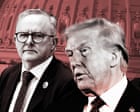
Big Tech has found its ultimate shield against domestic regulation, and it looks exactly like a Washington trade war. In Canberra, the center-left Albanese government is attempting to patch a leaky hull in its media policy by introducing the News Media Bargaining Incentive (NBI). The draft legislation seeks to impose a 2.25% revenue levy on tech firms unless they sign private funding deals with domestic newsrooms. Rather than arguing the economic merits of the bill, Silicon Valley lobby groups and executives from Meta and Google have bypassed local treasury officials entirely. They are actively whispering a warning into the ears of Australian lawmakers: Pass this law, and we will let Donald Trump destroy your economy.
This is no longer a localized corporate dispute over copyright or link-sharing. It is an active demonstration of structural leverage where multi-billion-dollar American platforms weaponize the unpredictable foreign policy of a volatile US administration to bully middle-power democracies into regulatory submission.
The Architecture of the Free Trade Threat
The core of the strategy relies on a highly calculated legal reading of the Australia-United States Free Trade Agreement (AUSFTA). In formal submissions dropped by Meta and organizations like the National Foreign Trade Council, the corporate argument has been stripped of its usual public relations veneer. The tech companies are framing the NBI as a "discriminatory, retroactive tax" that specifically targets foreign enterprises while leaving domestic competitors untouched.
The legal mechanics are straightforward. Under the proposed rules, platforms with minimum local revenues of $250 million and more than 5 million local users face the levy. Because these metrics conveniently capture Meta, Alphabet, and ByteDance, while ignoring domestic digital conglomerates or emergent AI entities, the tech lobby claims the law treats American companies worse than local ones.
By officially labeling the policy "foreign extortion," these companies are intentionally flashing a green light to trade hawks in Washington. They know that the current administration views any asymmetrical tax on American intellectual property or digital services as an act of economic warfare. The subtext of the tech submissions is clear. If Canberra goes through with this, the corporate suites will successfully lobby the White House to trigger retaliatory tariffs under the guise of protecting American commerce.
Why the Old Model Broke
To understand why the government is resorting to a blunt revenue levy, one has to examine the systemic collapse of the original 2021 News Media Bargaining Code. That initial policy allowed the government to "designate" specific platforms, forcing them into arbitration with media companies to determine payment for news links.
It worked, but only for a brief moment. Meta and Google signed deals worth roughly $200 million annually to avoid being officially designated. But the law contained a catastrophic structural flaw: it depended on the platforms actually wanting to host news.
When those multi-year deals expired, the corporate strategy shifted from negotiation to total evasion. Meta simply announced it would not renew the contracts and began systematically stripping news tabs and journalistic content from Facebook and Instagram feeds globally. They realized that news accounted for less than 3% of what people consumed on their feeds. The corporate calculation concluded that losing journalism was cheaper than paying a permanent subsidy to legacy media moguls.
The new 2.25% levy is a desperate attempt to close that exit door. It shifts the trigger from hosting news to earning revenue within the jurisdiction. If a company makes money in Australia, it pays the tax, regardless of whether it bans news links entirely.
The Asymmetry of Modern Regulation
The tech giants are pointing out genuine structural hypocrisy in the bill, even if their motives are purely defensive. By pegging the levy to traditional user counts and legacy digital ad revenue, the legislation completely ignores the fundamental shift occurring in digital consumption.
Platforms like OpenAI or Anthropic are currently scraping massive quantities of journalistic data to train large language models and serve direct answers to users, completely bypassing the traditional link-economy. Yet, under the current definitions, these AI developers face zero obligations under the NBI. Meta argues this dynamic distorts the market. They are correct. The law protects an old media ecosystem by taxing an old digital ecosystem, completely blind to the infrastructural reality of how information moves today.
Yet, pointing out bad legislative design is different from using foreign executive power to veto it. By aligning their corporate interests with the tariff-heavy instincts of the US administration, tech companies are establishing a dangerous precedent. They are demonstrating that whenever a sovereign nation attempts to regulate algorithmic distribution or platform monetization, the platforms can simply call in a geopolitical airstrike from Washington.
Middle powers like Australia, Canada, and various European nations are finding themselves profoundly outmatched in this dynamic. Their domestic legislative processes are being short-circuited by global trade mechanisms that were drawn up decades before social media platforms became the primary gatekeepers of public discourse.
The Albanese government now faces a brutal choice. Pressing ahead with the winter parliamentary sittings means risking a direct trade confrontation with an American administration that is already looking for excuses to erect protectionist barriers. Backing down means admitting that domestic media policy is no longer decided in Canberra, but is instead subject to a permanent corporate veto backed by the threat of foreign economic retaliation. The policy is no longer about saving journalism. It is an active, unresolved test of whether medium-sized democracies retain the sovereign right to tax global tech monopolies at all.
Inside the broligarchy: Is big tech running US politics? Carole Cadwalladr talks to DW News
This investigative report explores the deep political influence of tech billionaires and how corporate power increasingly dictates state policy and media survival.