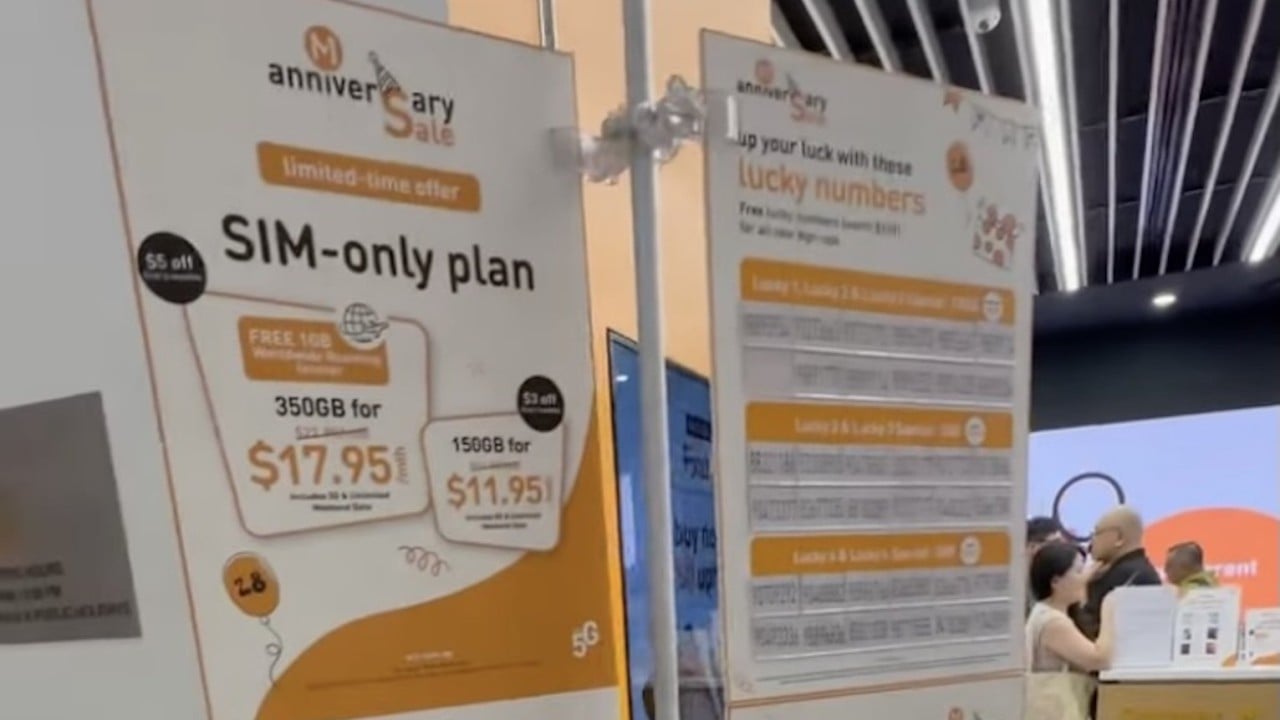
The collapse of the 1.43 billion Singapore dollar merger between M1 and Simba Telecom on May 21, 2026, has permanently broken the industry’s hope for relief from its decade-long, margin-shredding price war. Investors and consumers expected a neat consolidation to shrink the market from four players to three, stabilizing nose-diving average revenue per user. Instead, an unprecedented regulatory investigation by the Infocomm Media Development Authority into Simba's alleged unauthorized use of spectrum killed the deal at the finish line. This failure leaves Singapore’s telecommunications market deeply fragmented, financially depleted, and trapped in a race to the bottom that threatens the long-term quality of the country's digital infrastructure.
To understand why this merger disintegrated, one must look past standard corporate PR. This was not a routine disagreement over valuation or governance. It was a structural collision between an asset manager trying to dump a legacy business, an aggressive challenger running out of network capacity, and a regulator enforcing an unforgiving legal line.
The Spectrum Snag That Broke a Billion Dollar Deal
The transaction died because Simba ran into an invisible wall: airwaves. On May 18, just three days before the contractual long-stop date of the deal, the IMDA abruptly suspended its review. The regulator revealed it was investigating whether Simba had been utilizing unassigned radio frequency bands to provide its mobile services.
Under the Telecommunications Act 1999, operating on unauthorized spectrum is a severe breach. For a carrier, spectrum is lifeblood; it dictates how many users can connect and how fast data moves. This specific regulatory hurdle was entirely unprecedented in Singapore's highly disciplined corporate history.
Simba’s parent company, Australia-listed Tuas Limited, saw its shares plunge over 60% immediately following the news. The contractual deadline passed on May 21 without regulatory clearance, rendering the sale and purchase agreement null and void. While Simba continues to cooperate with the ongoing investigation, the structural reality is grim.
The Airwave Bottleneck Explained
To understand Simba’s desperate hunger for M1, one must look at the 2020 5G spectrum allocation. Singtel walked away with the lion's share of the premium 3.5GHz band, while StarHub and M1 joint-ventured to secure the rest. Simba was completely shut out of these premium airwaves.
As Simba aggressively picked up over a million price-sensitive subscribers with its rock-bottom rates, its network began to bottleneck. Customers frequently observe full signal bars on a crowded MRT train during peak hours yet experience grindingly slow load times. Without premium spectrum, the network lacks the capacity to back up its raw speed promises. Buying M1 was never just about acquiring its 2.29 million subscribers; it was a desperate bid to inherit M1's premium 5G airwave rights.
Now that the deal is dead, Simba faces two incredibly expensive choices:
- Pay exorbitant fees to convert its existing 4G airwaves for heavy-duty 5G deployment.
- Build out massive quantities of new physical base stations to boost capacity via less efficient, alternative frequencies.
Neither option bodes well for a company whose entire brand identity is built on thin margins and cheap consumer plans.
Keppel’s Panic and the AI Strip Mining of M1
For M1’s parent company, the global asset manager Keppel, the collapse is a massive strategic failure. Keppel has been executing an asset-light transformation strategy, intending to divest non-core industrial assets to unlock cash. Selling M1 was supposed to immediately yield 1 billion Singapore dollars in net cash, fueling special dividends and capital recycling.
With the deal dead, Keppel has pulled M1 from its 2025 monetization schedule. The asset manager is now forced to hold onto an underperforming telco in a brutal market.
Keppel's immediate response has been swift and unforgiving. It launched an aggressive 90-day efficiency plan designed to aggressively cut costs and automate operations to preserve whatever margin remains.
Keppel's 90-Day M1 Survival Strategy:
[Stop Divestment Plans] -> [Launch 90-Day Efficiency Campaign] -> [Replace CRM Tools with AI Agents] -> [Cut Operational Costs] -> [Look for New Suitors]
The telco is drastically scaling back human elements. Expensive legacy customer relationship management tools are being systematically replaced by autonomous AI agents that operate at half the cost. Advertising campaigns are being generated programmatically.
While this might appease institutional analysts on quarterly earnings calls, it presents a massive risk to consumer satisfaction. If a subscriber experiences a complex billing issue or a localized network outage, their ability to reach a human technician will be severely restricted.
Why a Prolonged Price War Benefits No One
The broader Singapore telecom market is fundamentally broken. A country of less than six million people cannot healthily sustain four full-scale facilities-based operators alongside a flood of Mobile Virtual Network Operators.
The industry is currently suffering from high single-digit to double-digit revenue declines. The continued existence of four distinct networks guarantees that capital expenditure is duplicated inefficiently while pricing power remains non-existent.
| Telco Operator | Market Position / Strategy Post-Collapse |
|---|---|
| Singtel | Dominant market leader; seeing domestic margins soften under weight of relentless discount competition. |
| StarHub | Mid-tier incumbent; actively cutting costs while assessing potential long-term consolidation options. |
| M1 | Stranded under Keppel ownership; undergoing aggressive corporate trimming and automated restructuring. |
| Simba | High-growth, low-margin disruptor; facing serious regulatory investigations and severe capacity limits. |
StarHub’s executive leadership has repeatedly warned that an artificial, prolonged price war prevents operators from investing in critical areas like advanced cybersecurity, network resilience, and genuine infrastructure innovation. When companies fight purely on price, capital expenditure on long-term safety and stability is always the first item cut from the ledger.
Singtel’s domestic stock performance has already reflected these structural worries, sliding as investors realize that the domestic market will offer zero profit growth for the foreseeable future.
The Next Consolidation Battleground
The Simba-M1 deal is dead, but the economic gravity demanding consolidation has not changed. Keppel has explicitly stated it remains open to selling M1. The company confirmed it has already engaged in serious alternative discussions with at least two other bidders.
The logical, ultimate play for the Singapore market is a defensive merger between StarHub and M1.
A combined StarHub-M1 entity would create a formidable counterweight to Singtel's dominance, cleaning up infrastructure redundancies overnight. However, such a move would isolate Simba entirely.
If StarHub and M1 merge, Simba’s sub-scale market share would be completely dwarfed by two massive incumbents. Blocked from expansion, starved of premium spectrum, and under the microscope of a strict state regulator, the challenger that triggered Singapore's price war may find itself without a viable path forward. The price war will continue for now, but the financial toll means the status quo is entirely unsustainable. Underneath the cheap data plans enjoyed by consumers lies an industry running dangerously on empty.