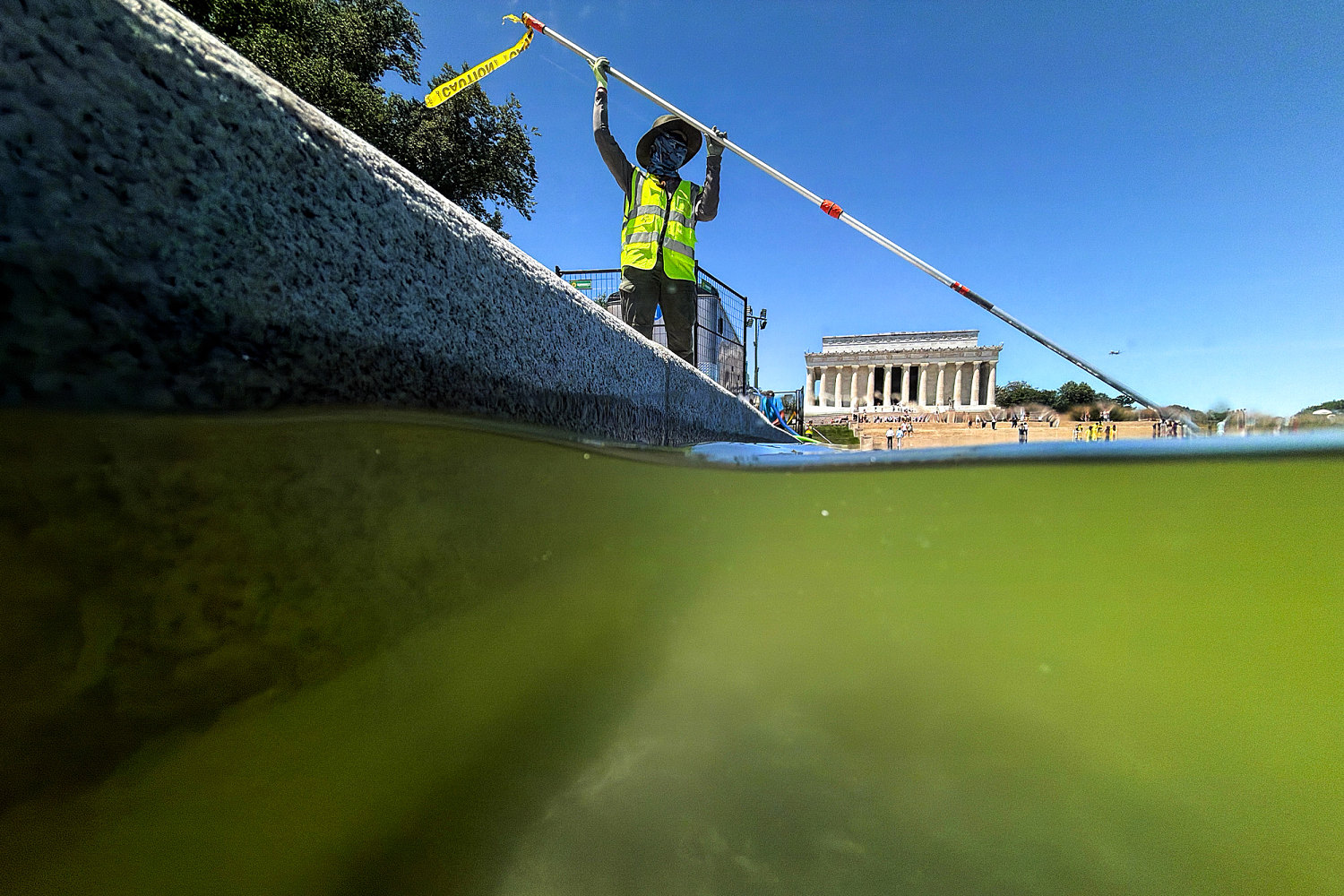
Interior Secretary Doug Burgum confirmed that the administration will bypass competitive bidding and retain the same contractors responsible for the troubled $16.4 million overhaul of the Lincoln Memorial Reflecting Pool. Despite rampant algae blooms, peeling industrial sealant, and escalating congressional scrutiny over no-bid awards given to political allies, officials insist the current vendors will handle the emergency remediation work. The decision cements a controversial procurement strategy that has transformed a high-profile national beautification effort into a case study of federal waste and infrastructure mismanagement on the National Mall.
The Cost of American Flag Blue
Federal contracting records reveal that what began as a rapid, seemingly straightforward initiative to beautify the nation’s most visible civic space before the upcoming semiquincentennial celebrations has fractured into an operational disaster. President Donald Trump personally directed that the six-acre concrete basin be lined with a specialized coating he termed "American flag blue." The administrative mechanism chosen to execute this vision bypassed traditional federal guardrails entirely.
The Department of the Interior invoked rare emergency exceptions to statutory bidding requirements. These exceptions are legally reserved to prevent imminent, serious financial or physical injury to the government. Instead, they were deployed to accelerate cosmetic upgrades.
Virginia-based Atlantic Industrial Coatings received a contract that quickly ballooned from initial modest estimates to a staggering $14.7 million to install the waterproofing sealant. Records show the firm had never previously secured a federal contract. Government auditors subsequently flagged the agreement for carrying what they termed excessive profit margins and heavily inflated overhead costs.
A secondary no-bid award went to Green Water Solutions, an Ohio-based entity registered under a trust managed by a prominent political donor whose private residence sits less than a mile from the Mar-a-Lago resort. That company received $1.74 million to deploy a patented water-remediation setup designed to eradicate organic contaminants.
Taxpayers are now on the hook for more than $16 million for a project that has yielded a pool filled with murky, discolored water and sheets of blue synthetic liner peeling away from the historic concrete floor.
The Plumbing Flaw Hidden in Plain Sight
Engineering assessments obtained through oversight channels indicate that the current repair strategy ignores the fundamental structural realities of the National Mall. The primary cause of the historic pool's degradation is not merely surface degradation or joint leakage. It is the failure of the underlying infrastructure.
An intricate network of twelve-inch plastic plumbing lines runs beneath the massive basin, linking it directly to a nearby water treatment facility. This network remains under constant, shifting pressure from the dense, saturated soil characteristic of the subterranean Washington basin. The pipes crack frequently. They leak thousands of gallons of treated water daily into the surrounding subsoil.
The multimillion-dollar contracts awarded this spring did nothing to address these broken lines.
Instead, workers applied millions of dollars of high-grade industrial coatings directly over a unstable foundation. It was an exercise in vanity over utility. When high-pressure water systems are activated without correcting the baseline pressure imbalances in the circulation loops, hydraulic force inevitably seeks the path of least resistance. That path led directly through the newly applied expansion joints.
The sealant failed two consecutive structural tests in mid-May. While the Interior Department publicly claimed that subsequent formulations passed technical benchmarks, the physical reality became undeniable within weeks of refilling. The basin became a breeding ground for thick organic matter.
The Chemistry of a Green Basin
The decision to install a deep blue lining created an unintended ecological trap. Darker surfaces absorb higher levels of solar radiation, raising the ambient temperature of the shallow, four-million-gallon water body significantly faster than the traditional light-gray concrete substrate.
Higher temperatures accelerate the germination of organic spores. The specialized filtration system brought in to neutralize this exact threat proved entirely inadequate against the compounding effects of stagnant circulation and solar heating. The water quickly turned a heavy hue described by local observers as puke green.
The administration’s public relations response has shifted the blame away from structural failures and toward external interference.
Federal prosecutors recently secured a felony indictment against a former Olympic athlete, accusing him of intentionally cutting and destroying sections of the pool liner during a confrontation with park personnel. Interior officials have used this incident, along with several other recent arrests, to characterize the peeling floor as the exclusive result of targeted vandalism rather than material failure.
Independent engineering reports tell a different story. The sheer volume of delamination visible across the seven-acre site suggests widespread adhesion failure. A human being with a pocketknife cannot cause thousands of square feet of industrial polymer to separate cleanly from concrete under four feet of water pressure. The coating lifted because the moisture barrier beneath it failed.
Retaining the Bypassed System
When pressed on why the federal government would trust the exact same entities to fix a project that has publicly degraded in full view of the capital, leadership pointed to warranty clauses. Using new contractors would void existing corporate liability, forcing the government to absorb the full cost of remediation out of pocket.
This argument presents a classic sunk-cost dilemma. By doubling down on the initial vendors, the National Park Service remains tethered to the proprietary materials and chemical formulations that caused the initial complications.
Oversight committees in both chambers of Congress have launched formal inquiries into the financial architecture of these deals. Investigators are focusing heavily on the internal justifications used to skip the competitive bidding process, as well as the rapid escalation of contract values over a mere sixty-day window.
The pool remained closed to the public during critical summer milestones. While official statements cited safety perimeters required for holiday fireworks displays, the physical state of the water and the structural vulnerability of the liner made public access impossible regardless of event logistics.
Fixing the site correctly will require draining the entire four million gallons of water yet again. This process exposes the curing compounds to fluctuating summer humidity, creating another variable that could disrupt adhesion. The administration faces a narrowing window to deliver a functioning landmark before international attention focuses heavily on the capital city.
The project has become a stark reminder of what happens when political mandates override established engineering protocols and transparent procurement laws. The blue floor remains visible in patchy, dissolving fragments beneath a layer of clouded water.