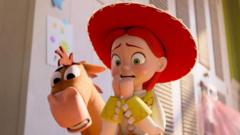
The industry needed a win, and the plastic cowboys delivered. Over the June 19-21 weekend, Disney and Pixar's Toy Story 5 pulled in an extraordinary $159.6 million domestically and $312 million worldwide, securing the biggest box office debut of 2026. Directed by veteran Andrew Stanton and co-directed by McKenna Harris, the film sets an all-time opening weekend record for the 31-year-old franchise, comfortably outpacing the $110 million and $120 million debuts of its third and fourth chapters. It is a massive victory for theater owners who spent the early summer watching expensive bets like Masters of the Universe collapse on arrival.
Yet beneath the deafening applause from Burbank, a more complicated narrative is unfolding. This historic opening weekend is not just a celebration of enduring multi-generational fandom. It is the definitive proof of a calculated, risk-averse Hollywood strategy that treats original storytelling as a secondary priority.
The Margin For Error Has Vanished
To understand why a fifth installment of a story that seemingly ended perfectly twice before exists, one must look at the brutal economic realities of modern theatrical distribution. The mid-budget original feature is effectively dead in the studio system. When a single studio film can cost $200 million to produce and another $100 million to market globally, the financial penalty for an original concept that fails to find an audience is catastrophic.
Pixar learned this lesson through painful trial and error. While original properties like Soul, Luca, and Turning Red were diverted to streaming during the pandemic era, subsequent theatrical originals struggled to recapture the cultural monolith status of the studio's golden era. The market sent a clear, unyielding signal, and Disney leadership listened.
The theatrical landscape now operates on a binary of feast or famine. Audiences are no longer going to the theater out of habit; they are going for events. A $160 million opening weekend demonstrates that the Toy Story brand remains the ultimate cinematic safety blanket, a guaranteed draw for nostalgic millennial parents and their screen-native children alike.
The Paradox of Perfect Endings
For years, Pixar built its reputation on creative autonomy and narrative finality. The bittersweet conclusion of Toy Story 3 in 2010 felt like a definitive cultural milestone, a perfect encapsulation of growing up and letting go. When Toy Story 4 arrived in 2019, critics questioned its necessity, only to be swayed by a deeply emotional goodbye that separated Woody from the rest of the ensemble.
Reopening that toy box for a fifth time requires a delicate act of narrative retrofitting. The latest narrative introduces a conflict centered around modern tech toys, specifically a character named Blaze, forcing Woody, Buzz Lightyear, and Jessie into an alliance against digital distractions. While audiences handed the film an "A" CinemaScore, the creative machinery required to undo previous "final" endings reveals the core tension at the heart of modern animation. The needs of corporate synergy and franchise maintenance will always outvote the artistic desire for a clean resolution.
The IP Dependancy Trap
Relying on established intellectual property is an incredibly effective short-term strategy, but it creates a long-term deficit in original cultural footprints. The animated features that defined the childhoods of today's parents were risks. Toy Story was an unproven digital experiment in 1995. Finding Nemo and The Incredibles were massive creative gambles that succeeded because they offered something genuinely novel.
By shifting the production pipeline toward dependable sequels, studios risk starving the ecosystem of the next generation of classic characters. If the industry only greenlights titles with a pre-existing number attached to them, it builds a creative wall around itself.
The immediate financial outlook for this latest outing remains incredibly bright. Historical box office data shows that the franchise possesses exceptionally strong theatrical "legs," rarely dropping sharply in its second and third weeks due to sustained family viewing. With major international markets like Mexico already contributing $26.6 million to the debut, Toy Story 5 is on a clear trajectory to cross the $1 billion threshold, making the series the first animated franchise to boast three separate billion-dollar titles.
Theater chains will happily take the revenue, and Disney will clock another win for its balance sheet. But the true cost of this record-breaking weekend will not be measured in ticket sales. It will be measured in the original ideas that never get made because sticking with the familiar toys is simply too safe to resist.
.jpeg?width=1200&auto=webp&trim=1%2C0%2C1%2C0)


