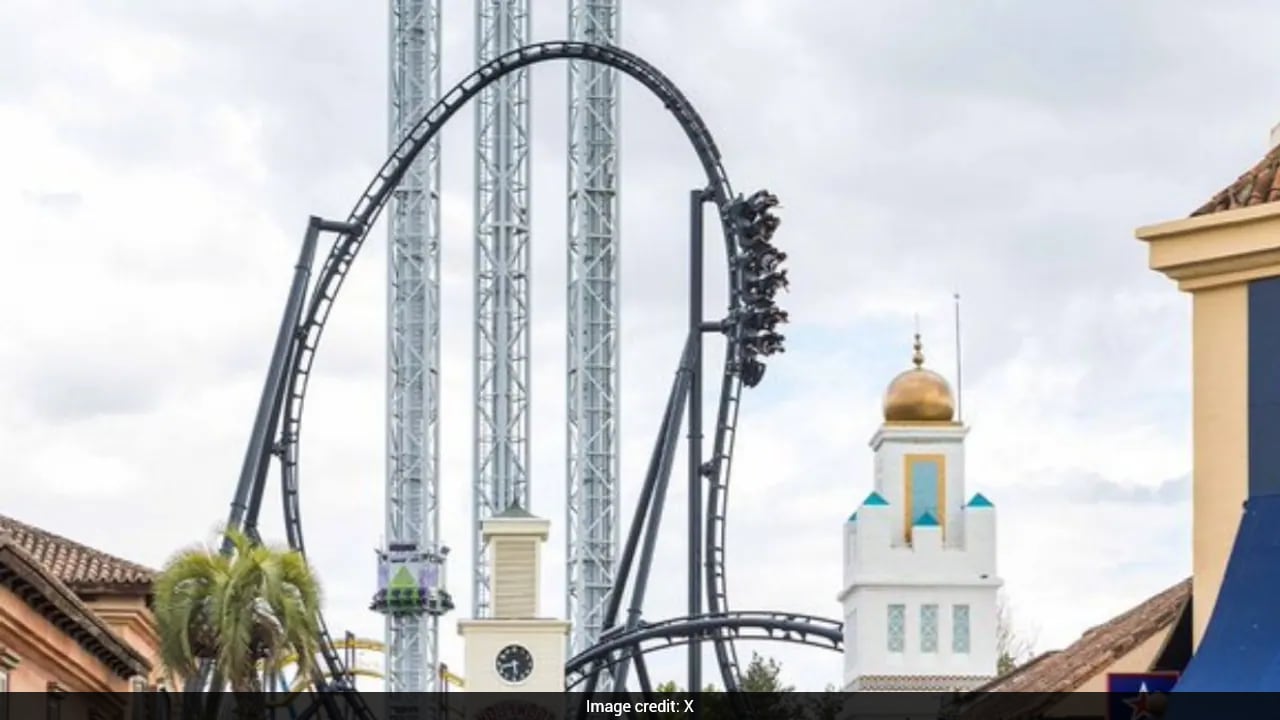
A 49-year-old man was airlifted to a Madrid hospital with severe open and closed leg fractures following a violent mechanical stoppage on the Batman Gotham City Escape roller coaster at Parque Warner Madrid. While mainstream coverage has fixated on the sensational aspects of the emergency response and eyewitness panic, the incident exposes critical questions regarding modern restraint physics, ride envelope clearances, and how high-speed steel coasters interact with unexpected bodily shifts during aggressive transitions.
The Anatomy of a High-Speed Abrupt Halt
Modern multi-launch coasters like the Intamin-manufactured Batman Gotham City Escape rely heavily on magnetic braking systems and rapid-fire propulsion elements. When a ride of this magnitude experiences an unscheduled emergency stop mid-circuit, the deceleration forces are immense. Passengers are subjected to sudden changes in momentum where kinetic energy must be shed instantaneously.
Witness accounts from the platform indicated that the victim managed to slide downward or shift out of his standard seating alignment during the sequence, placing his lower extremities in an extraordinarily vulnerable position relative to the car frame. In mechanical engineering terms, passenger containment systems are designed to distribute G-forces evenly across the pelvis and thighs. However, when an occupant's physical dimensions or seating posture deviate even slightly from baseline testing parameters, the margin for error narrows dangerously.
A sudden braking impulse combined with an unbraced posture creates a localized torque multiplier. The kinetic energy does not simply vanish; it transfers directly into whatever structural member or restraint bar happens to catch the body's momentum. In this specific case, the resulting stress concentrated on the lower limbs, bypassing standard load paths and resulting in catastrophic structural failure of human bone.
The Blind Spot of Universal Restraint Standards
Theme park safety standards rely on standardized anthropomorphic test dummies and broad percentile ranges for human sizing. Yet, human bodies vary wildly in proportion, muscle mass distribution, and joint flexibility. A restraint system that locks securely for a visitor with average torso-to-leg ratios can behave differently for someone taller or with a different center of gravity.
For instance, consider a hypothetical guest riding a hyper-coaster with a lap bar and shin guard configuration. If the primary lap restraint allows an inch of play due to clothing thickness or shifting during a multi-G launch, subsequent airtime hills can lift the rider just enough to alter their footprint in the seat. When the train hits an unexpected brake run, that minor displacement turns into a major vulnerability. The structural geometry of the car—designed to keep riders safely contained under normal operational envelopes—can inadvertently turn into a rigid trap if a limb slips outside the intended containment zone during a violent deceleration phase.
Industry regulators and park operators frequently point to daily testing protocols and computerized safety loops as foolproof guarantees. Yet, these systems primarily monitor electrical continuity, harness micro-switches, and track block zones. They do not measure real-time occupant posture changes between the moment dispatch lights turn green and the train hits the first launch track.
Beyond the Park PR Statements
In the immediate aftermath of the Madrid accident, Parque Warner Madrid issued standard corporate communications confirming that emergency protocols were enacted immediately and that the attraction would remain shut pending an official review alongside local authorities. This reflects the standard playbook for the amusement industry: isolate the asset, express cooperation with safety inspectors, and keep the remainder of the park operational to protect daily revenue streams.
Yet, this compartmentalized response ignores the broader anxiety rippling through the enthusiast community. Roller coaster safety has evolved leaps and bounds since the twentieth century, shifting from loose lap bars to over-the-shoulder restraints and hydraulic lap bars with secondary locking pawls. Despite these engineering milestones, severe mechanical malfunctions and traumatic injuries continue to punctuate the industry timeline. When rides push structural limits with tighter turns, higher speeds, and more aggressive lateral transitions, the tolerance for human physiological variability shrinks to near zero.
Inspections by civil guards and regional safety technicians will ultimately determine whether the fault lay in component wear, restraint telemetry failure, or an unpreventable anomaly of rider physics. Until those findings become public record, the Batman Gotham City Escape remains a silent monument to the thin line separating world-class thrills from medical emergencies. Safety on modern steel coasters is a cooperative contract between engineer and rider, and when that contract fractures, the consequences leave an indelible mark on the industry.
Batman Gotham City Escape roller coaster accident analysis
This video provides additional context on safety protocols and emergency responses following major roller coaster incidents in Spain.
http://googleusercontent.com/youtube_content/1