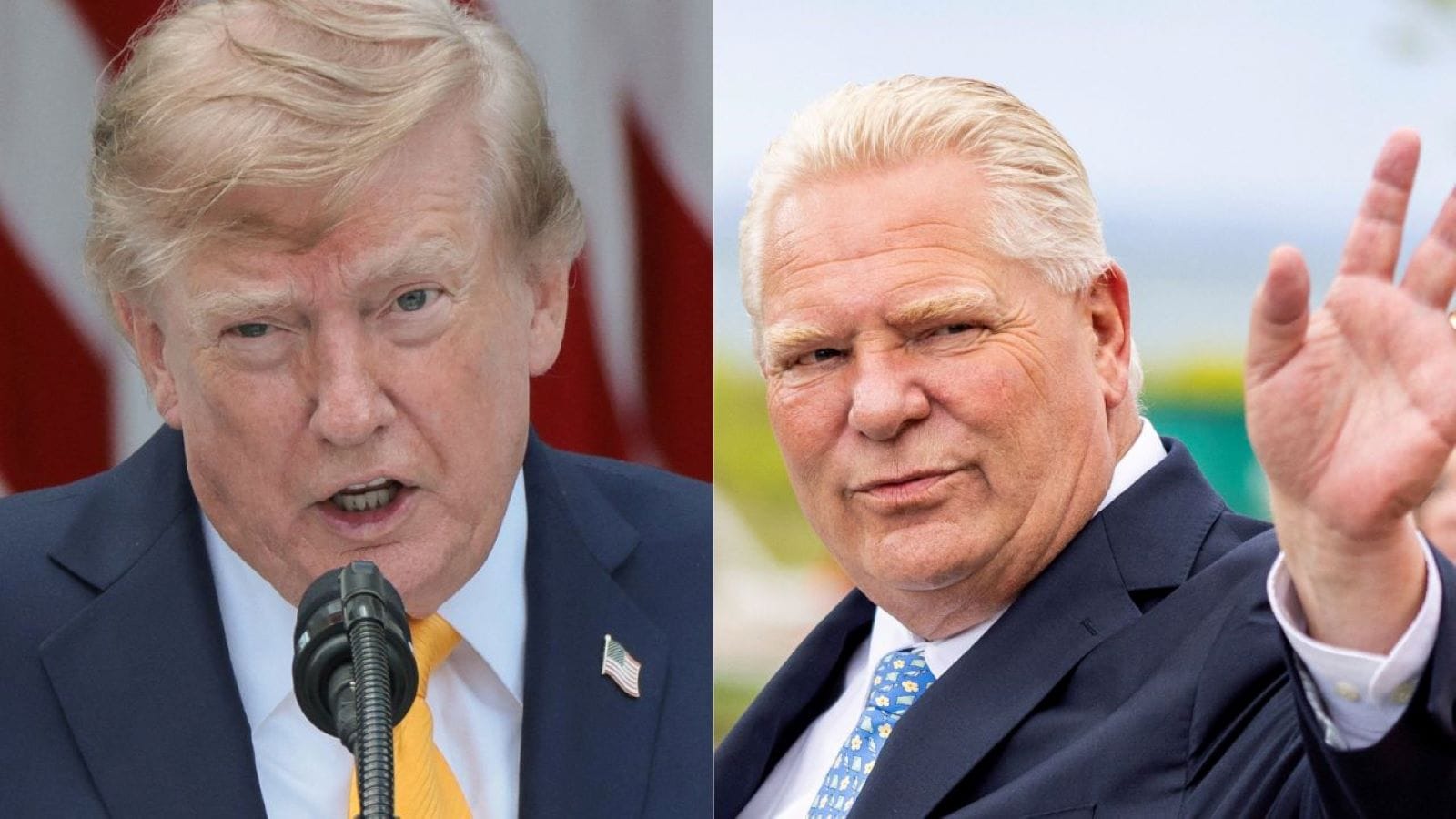
The modern art of statecraft rarely involves vernacular quite like the one broadcast across Toronto radio airwaves. When Ontario Premier Doug Ford responded to a presidential decree by inviting Donald Trump to kiss a very specific part of his anatomy, it marked a definitive nadir in cross-border relations. Gone are the polite communiques of the mid-twentieth century. In their place stands a scorched-earth trade war, fueled by fifty percent blanket tariffs on twenty-eight billion dollars of Canadian exports, broken negotiations in Ottawa, and a personal animus that has bypassed diplomatic channels entirely.
To understand how Canada's industrial heartland and Washington's economic nationalists reached a point of open hostility, one must look past the theater of insults. The collapse of the bilateral trade framework was not an accident of poor temperament. It was the structural collision of two incompatible economic philosophies. On one side sits an American administration attempting to re-engineer North American supply chains by executive fiat. On the other stands a collection of Canadian provincial and federal leaders who realize that submission to Washington’s sovereignty demands means total economic vassalage.
The Anatomy of a Breakdown
The immediate trigger for Ford's unvarnished outburst was a morning social media post from the White House. The proclamation was typical in its maximalism: fifty percent tariffs slated for January on all cars, trucks, automotive parts, and steel. Behind the rhetoric, however, lay a deeper poison pill that had quietly murdered trade talks days prior. Prime Minister Mark Carney’s administration walked away from the negotiating table after American handlers inserted clauses restricting Canada's sovereign right to pursue independent trade agreements with third nations, alongside last-minute demands to police domestic cultural and linguistic protections.
For Ontario, the stakes are existential. The province’s manufacturing base, anchored by automotive assembly lines and integrated steel mills, cannot absorb a fifty percent wall without catastrophic structural damage. Ford recognized that a diplomatic retreat would signal weakness to an administration that feeds on capitulation. His counter-offensive was swift, loud, and designed to cause maximum discomfort to American border states dependent on Canadian commodities.
The Leverage Game
Borders are porous when interdependence runs deep. Ontario does not merely export finished goods; it supplies the raw lifeblood of neighboring U.S. economies. Ford’s playbook relies on asymmetric retaliation, utilizing energy and critical minerals as economic weapons.
Consider the electricity grid. Ontario transmits power to roughly one and a half million residents and businesses across Michigan, New York, and Minnesota. During previous trade skirmishes, a provincial electricity surcharge proved potent enough to force a temporary retreat from Washington. Ford has signaled readiness to pull that lever again, alongside more radical proposals: weaponizing crude oil flows through cooperation with Alberta, taxing potash and uranium out of Saskatchewan, and restricting critical minerals vital to American technological infrastructure.
Yet, this strategy exposes a glaring vulnerability within the Canadian federation itself. A unified national front remains elusive. Provincial premiers operate under divergent economic pressures. While Ford beats the war drum for total retaliation, internal friction threatens to undermine the bargaining position. National strategy fractures when regional self-interest takes precedence over collective survival.
The Cost of Political Theater
The public exchange quickly degenerated into a personal feud. Trump fired back on digital platforms, dismissing Ford as political bluster and invoking historical family comparisons, while labeling Canadian leadership as ineffectual. Ford responded by labeling the president a dictator, a bully, and the king of bankruptcies.
This high-stakes name-calling plays well to domestic galleries looking for a fight, but it obscures the quiet devastation hitting working-class families on both sides of the border. Steelworkers, auto parts manufacturers, and logistics operators are caught in the crossfire of escalating counter-tariffs. Every percentage point added to a tariff schedule translates directly into lost contracts, stalled plant investments, and downward pressure on employment numbers.
The Road Ahead
Washington’s objective is clear. The administration seeks to decouple integrated North American markets into bilateral dependency loops where the United States dictates terms of trade unilaterally. For Canada, accepting those terms means sacrificing legislative independence.
The collision course is set. As Ottawa prepares dollar-for-dollar retaliatory measures targeting American appliances, agricultural equipment, and electronics, the era of quiet diplomacy between neighbors is officially dead. The confrontation is no longer about managing trade irritants or negotiating minor adjustments to supply management. It is a brutal test of economic endurance, where political survival depends entirely on who blinks first in the face of mounting mutual destruction.