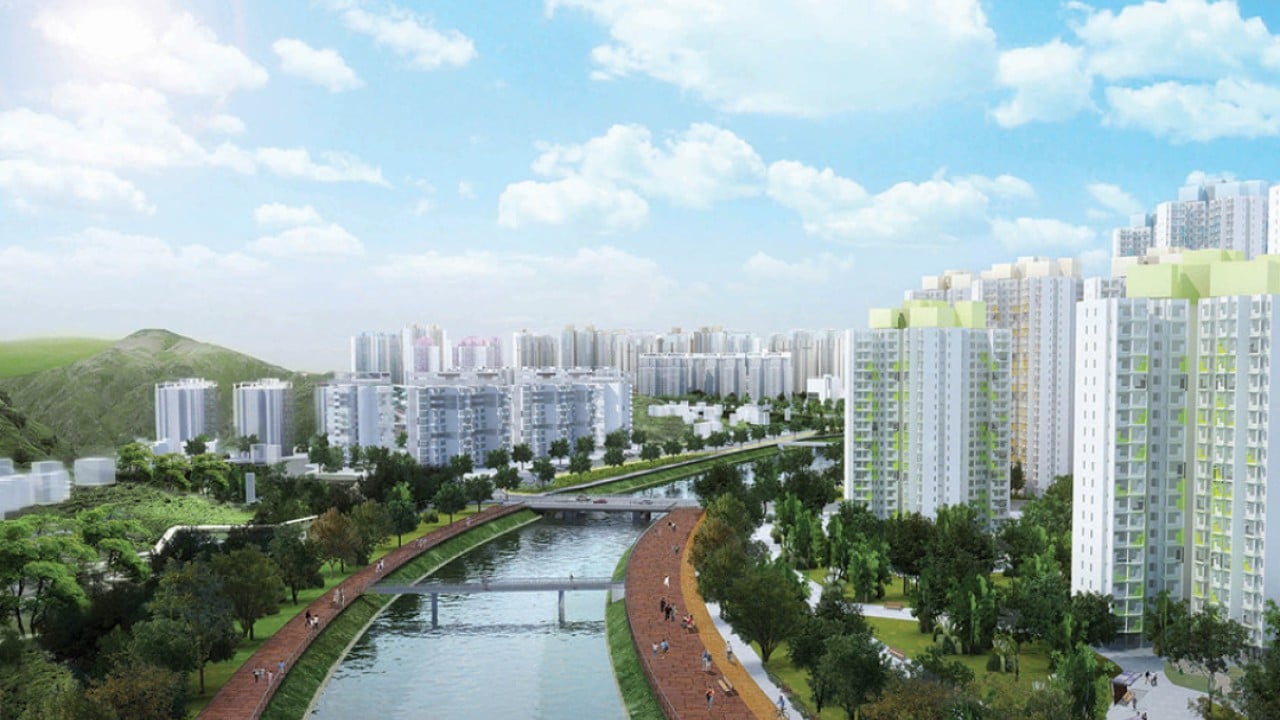
Hong Kong has long been defined by its crushing lack of space. The official blueprints for the Northern Metropolis promise a radical departure from this history, advertising a 10 to 20 percent increase in the average floor area for upcoming public housing units. This space expansion forms the core of a government narrative that equates raw square footage with a superior standard of living for the 2.5 million people expected to eventually inhabit the northern border districts. Yet an examination of the underlying economic models, transit timelines, and employment projections reveals a structural mismatch. Expanding the physical dimensions of a public flat does not resolve the deep systemic isolation that occurs when massive residential zones are built decades ahead of the transit networks and industries meant to support them.
The promise of larger flats ignores a historical pattern in Hong Kong town planning. Building bigger units in the New Territories is a recurring policy reaction to urban density, not a novel luxury. When the government developed early iterations of Tin Shui Wai and Tuen Mun in the late twentieth century, the initial selling point was similarly rooted in spaciousness and modern planning. Those districts quickly transformed into isolated communities characterized by high unemployment, mental health challenges, and exorbitant transit costs. The current strategy risks repeating these errors on a vastly larger scale by prioritizing residential numbers over immediate regional integration.
The Spatial Mathematics of Isolation
The physical layout of the proposed public housing flats in areas like Kwu Tung North and Hung Shui Kiu indicates a genuine effort to expand internal living areas. Families will have more room to breathe inside their walls. This internal breathing room shrinks dramatically when measured against the external environment. A 15 percent increase in a living room's dimensions does not offset the psychological and financial toll of a prolonged daily commute.
Transit infrastructure operates on a much slower timeline than residential construction. The Northern Link and its associated spur lines are bogged down by complex environmental assessments, financing negotiations, and engineering challenges. Residential blocks routinely open years before the high-capacity rail lines designed to connect them to the rest of the city are functional. This creates a reliance on temporary bus routes and overburdened road networks, turning a larger flat into a golden cage where residents exchange square footage for hours of lost time every single week.
The financial cost of this spatial relocation falls heavily on low-income families. Public housing applicants are, by definition, individuals and families who qualify under strict income and asset caps. Moving these demographics to the outermost periphery of the territory increases their monthly expenditures on transport. A worker traveling from the northern border to a service job in Kowloon or Hong Kong Island can expect to spend a substantial portion of their daily wage just on transit fares. The expanded interior space of the flat is effectively paid for through an ongoing drain on the household budget.
The Innovation Hub Mismatch
The core economic justification for the Northern Metropolis is its identity as an innovation and technology hub. The newly established San Tin Technopole Company Limited aims to drive high-end manufacturing, biotechnology, and artificial intelligence ventures. This industrial focus creates a direct contradiction with the demographic composition of public housing. The jobs being generated in these zones require advanced degrees, specialized technical skills, and global corporate experience.
Public housing tenants rarely match the recruitment profiles of international technology conglomerates or research laboratories. This creates a severe home-job imbalance. While high-earning tech professionals will likely choose to commute from established luxury enclaves or live in specialized talent accommodation, the local public housing population will be forced to travel outward for manual labor, retail, and service sector jobs. The dream of a self-sustaining community where residents live near their workplaces dissolves under economic scrutiny.
The government has attempted to address this by allocating space for modern logistics hubs and high-end professional services in areas like Hung Shui Kiu. These sectors are also undergoing rapid automation. Automated warehouses and digitized logistics chains require far fewer low-skilled workers than the traditional industrial estates of the past. The structural reality is that the Northern Metropolis is being designed for a high-tech workforce, while its residential capacity is overwhelmingly skewed toward public housing that accommodates the city's lowest earners.
Fiscal Realities and the Infrastructure Deficit
Funding a mega-project of this magnitude requires unprecedented capital allocation. The newly formed Northern Metropolis Financial Advisory Taskforce highlights the growing concern over how to balance the territory's books while executing massive reclamation and construction projects simultaneously. With fiscal reserves facing persistent pressure, the administration has resorted to piloting large-scale land disposal approaches and "Pay for What You Build" schemes to entice private developers into building public amenities.
This financial strain directly impacts the quality of public housing estates. To make these projects financially viable for private consortia or manageable for the public purse, cost-cutting measures are inevitable. The broader public housing blocks are built using highly standardized, prefabricated modules. This ensures rapid construction but results in monotonous, high-density environments that lack organic community spaces. The promised green living and eco-recreation zones, such as the Sam Po Shue Wetland Conservation Park, are expensive to develop and maintain. When budgets tighten, public parks and community centers are frequently delayed or downscaled, leaving residents with larger rooms inside but barren concrete environments outside.
The reliance on private developers to build out public infrastructure introduces commercial volatility into social housing. If the property market experiences a sustained downturn, private partners delay their phases of the development to protect their profit margins. Public housing towers, constructed directly by the Housing Authority, continue to rise regardless of market conditions. This imbalance creates a situation where thousands of tenants move into completed estates only to find that the promised commercial complexes, wet markets, and clinics are still empty construction sites.
The Ghost of Tin Shui Wai
Town planners frequently speak of urban resilience without acknowledging the lessons of the past. The early development of Tin Shui Wai earned it the grim moniker of the city of sorrows due to the severe lack of local support structures, high transport costs, and structural unemployment. The Northern Metropolis is three times larger, yet the underlying planning methodology remains explicitly infrastructure-led, meaning the residents arrive first and the infrastructure follows later.
The social costs of this approach are cumulative. When young families are placed in remote districts without immediate access to extended family networks, child care facilities, or varied youth services, social isolation spikes. The planning guidelines state that an integrated children and youth services center will be planned for every 12,000 young people. These ratios are based on static demographic projections that rarely reflect the rapid influx of high-needs families that typically populate new public estates.
The focus on larger flats serves as an effective public relations tool to divert attention from these systemic shortfalls. It allows authorities to point toward quantifiable metrics of progress, such as square meters per person, while ignoring qualitative deficits in community cohesion, mental well-being, and economic mobility. A larger room cannot care for a child when both parents are stuck on a two-hour bus journey back from an urban service job.
The Failure of the Dual Engine Concept
The strategic vision positions the Northern Metropolis as part of a dual-engine economy, working in tandem with the financial hub of Central. This geographical division assumes that capital and labor will flow dynamically between the two nodes. In reality, the distance creates a physical and economic barrier that reinforces class divisions. The wealthy and highly skilled populate the southern financial core and the specialized northern tech parks, while the public housing population remains trapped in the residential zones in between, servicing the infrastructure without capturing the economic upside.
The cross-boundary integration with Shenzhen further complicates this dynamic. While seven land-based boundary control points facilitate the movement of goods and corporate personnel, they offer little direct economic benefit to a standard public housing tenant. Cheap retail and entertainment options in Shenzhen draw local consumption away from northern Hong Kong businesses. Small shop owners in the new public housing estates must compete with the lower prices across the border, stifling the development of a localized grassroots economy that could provide flexible, close-to-home employment for residents.
The spatial expansion promised in the Northern Metropolis public flats is a superficial solution to a multi-dimensional crisis. Without a synchronized delivery of high-capacity transit, a realistic alignment between local skills and regional jobs, and a protected budget for social infrastructure, these larger flats will merely distribute urban poverty across a wider geographic area. The territory cannot build its way out of structural inequality simply by widening the margins of its public housing blueprints.

:max_bytes(150000):strip_icc()/parts-of-a-swamp-cooler-2718628-a477e6f0787b4f8bb62ddf2def31d495.png)