Global financial markets are plunging because an fragile truce in the Middle East just disintegrated in front of a live microphone. When U.S. President Donald Trump stood alongside NATO leadership in Ankara and declared that the interim ceasefire agreement with Iran was completely over, he ended a brief respite in a destructive regional war. Crude oil prices immediately surged by over six percent, sending shockwaves through equity markets from New York to Tokyo. Investors who had spent the last month betting on an extended diplomatic cooling-off period are now facing the reality of an unmanaged escalation in the world's most critical energy corridor.
The immediate catalyst was a rapid-fire sequence of military exchanges in the Persian Gulf, followed by a total revocation of American sanctions waivers. For a few weeks, the June memorandum of understanding offered a glimpse of stability, allowing Iranian crude to flow temporarily while diplomats attempted to carve out a longer-term settlement to the conflict that began earlier this year. That window has closed. The collapse of this fragile understanding exposes the deeper systemic vulnerabilities of a global economy running on depleted emergency reserves and hyper-sensitive algorithmic trading.
The Shortest Peace in the Gulf
It lasted less than forty days. The interim deal was always a desperate gamble, designed to put a temporary floor under a market that had seen crude oil spikes well above one hundred dollars a barrel following the initial outbreak of U.S.-Israeli strikes on Iran. Under the temporary rules of engagement, Iran was supposed to permit unhindered commercial transit through the Strait of Hormuz for sixty days, while Washington granted a temporary license for Tehran to export limited amounts of crude oil.
The arrangement broke down over a fundamental disagreement about who commands the water. Iran insisted on rewriting the maritime rulebook, demanding that all commercial vessels follow specific, Tehran-mandated transit corridors and signaling its intent to levy transit fees once the initial sixty days expired. Washington viewed this as an illegal attempt to upend decades of international maritime law. When three commercial tankers chose to navigate closer to the coast of Oman rather than obeying Iranian routing orders, they were targeted.
The American response was swift and heavy. A wave of retaliatory strikes hit Iranian facilities, which prompted Iranian Revolutionary Guard units to launch missile attacks against U.S. military positions in Bahrain and Kuwait. By the time Trump sat down at the NATO summit, the diplomatic track was nothing more than fiction. The formal cancellation of the U.S. Treasury Department's oil export license, which was originally set to run until late August, served as the final corporate execution of the deal.
Anatomy of a Shipping War
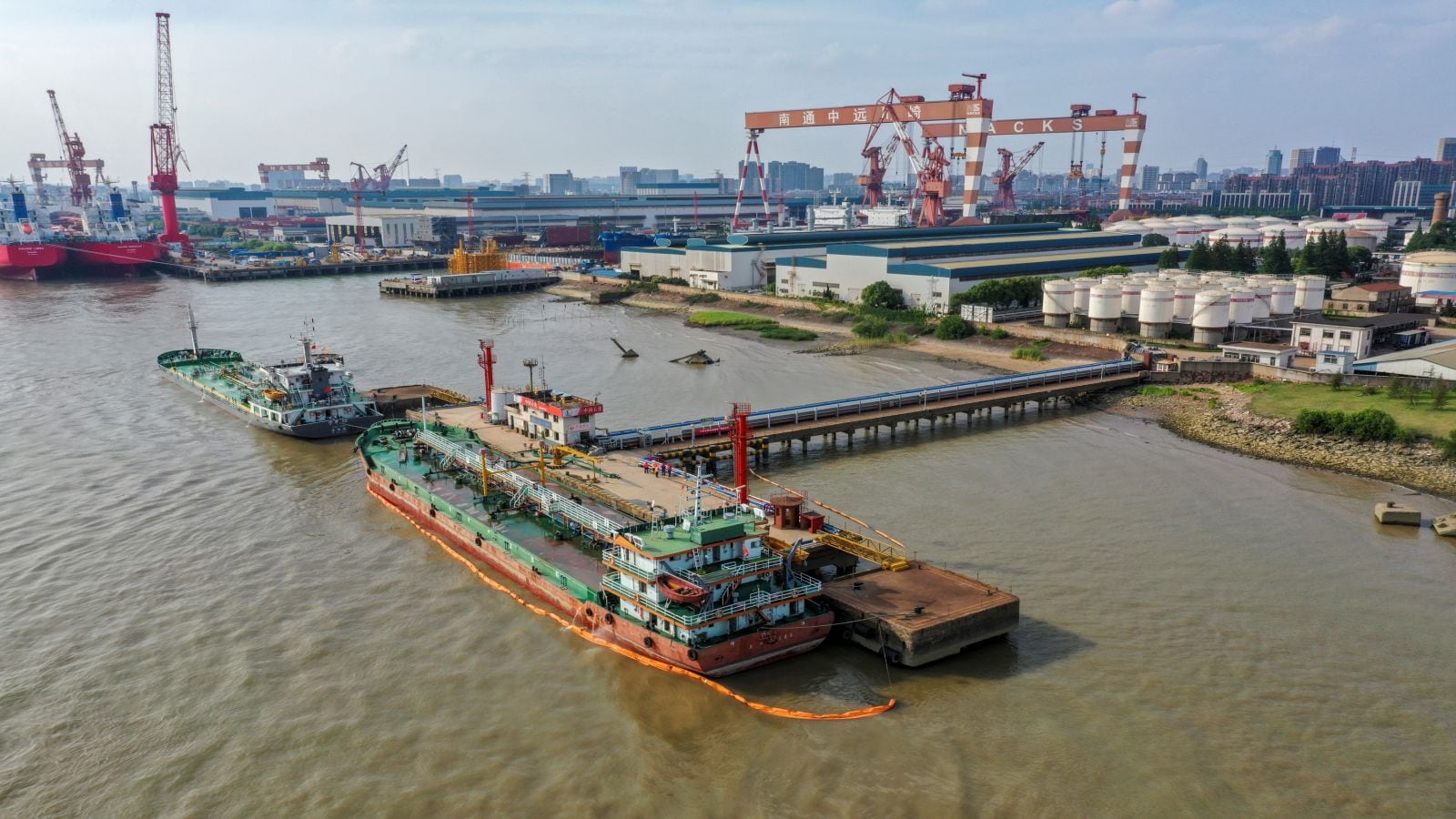
Shipping lanes cannot operate under conditions of active artillery fire. The Strait of Hormuz is not just a geographic feature; it is the central artery of the industrialized world. Roughly one-fifth of global petroleum consumption passes through this narrow stretch of water every single day. When insurers see reports of explosions near Oman, insurance premiums for commercial hulls do not merely tick upward—they multiply.
The physical reality of moving oil requires absolute predictability. Tanker captains are now refusing to enter the Gulf without explicit military escorts, a logistical burden that Western navies are poorly equipped to sustain indefinitely. The immediate six-percent jump in Brent crude futures to more than seventy-eight dollars a barrel is a modest reaction compared to what happens if the waterway faces a prolonged blockade. The market is currently pricing in the fear of a complete shutdown, a scenario that would instantly remove millions of barrels of supply from a global market that operates on razor-thin margins.
Tehran knows exactly how much economic pain it can inflict by making the strait untraversable. By forcing ships to choose between Iranian defiance and Western air defense, Iran has turned a regional dispute into an existential question for energy-importing nations across Asia and Europe. Countries like South Korea and Japan, which depend almost entirely on Middle Eastern crude to keep their heavy industries functioning, saw their primary stock indices drop by more than five percent within hours of the announcement.
Why the Strategic Petroleum Reserve Cannot Save Us
Washington has a math problem. In previous energy crises, the White House could lean heavily on the Strategic Petroleum Reserve to inject liquidity into the physical market and drive down runaway prices. That option is largely off the table. Years of successive drawdowns have drained the reserve to its lowest level since 1983, leaving the domestic insurance policy severely depleted before this conflict even started.
U.S. Strategic Petroleum Reserve Levels (Historical Comparison)
============================================================
1980s Peak:     ~727 Million Barrels
2020 Average:   ~650 Million Barrels
Current 2026:   Lowest operational capacity since 1983
============================================================
This empty warehouse effect changes the psychological dynamic of the trading floor. Speculators know that the U.S. government cannot execute a massive, multi-month release of crude to counter Iranian disruptions without risking total depletion of its domestic emergency stocks. Private inventory levels across the globe are similarly depressed, as commercial refiners spent the early summer months drawing down their own supplies in expectation of a successful negotiation. The world is entering an active shipping war with empty pockets.
The structural deficit cannot be quickly bridged by domestic shale production either. While American oil fields are pumping near record levels, the infrastructure required to scale up production further requires capital investment that cannot materialize in a matter of days. Exploration and production companies have spent years favoring capital discipline and shareholder returns over aggressive drilling campaigns. They are not going to alter their five-year capital expenditure plans based on a series of statements made at a NATO summit.
The False Promise of Deterrence
Military force has failed to produce economic stability. The core assumption of Western strategy was that a display of overwhelming firepower would compel Iran to accept the maritime status quo. The opposite occurred. Every targeted strike by Western forces has been met with an asymmetric response, proving that the cost-benefit analysis inside Tehran is not aligned with Western expectations.
The Iranian leadership appears to have calculated that it can endure a high degree of kinetic damage if it means proving it can dictate terms in the Gulf. This miscalculation by Western planners has left corporate boardrooms exposed. Companies that built their supply chain models on the assumption of cheap, uninterrupted energy flows are discovering that deterrence is a highly unstable foundation for global commerce.
The Financial Fallout Beyond Crude Oil
The panic is spreading far beyond the energy sector. The sudden return of inflation risks via the oil patch has triggered a major sell-off in the global bond market. Benchmark ten-year U.S. Treasury yields surged to a one-month high of nearly 4.6 percent, reflecting deep anxieties that central banks will be forced to keep interest rates elevated for much longer than previously anticipated.
This bond market volatility is colliding directly with an already overextended technology sector. For the past eighteen months, global equity valuations have been driven almost exclusively by massive investments in artificial intelligence infrastructure, data centers, and advanced semiconductor manufacturing. These investments were predicated on a backdrop of stable borrowing costs and predictable operating expenses. Higher energy costs mean more expensive electricity for power-hungry data hubs, while rising bond yields reduce the present value of far-off technology earnings.
| Market Indicator | Immediate Reaction | Broader Economic Implication |
|---|---|---|
| Brent Crude | Jumps over 6% past $78/barrel | Immediate increase in global transport and refining costs. |
| US 10-Year Treasury | Yields climb to 4.58% | Rising borrowing costs, crushing hopes of near-term rate cuts. |
| Global Equities | Broad-based declines exceeding 2% | Capital fleeing high-growth tech toward defensive assets. |
The intersection of geopolitical instability and overstretched technology valuations is a dangerous mix for institutional portfolios. If the conflict escalates to include direct cyber infrastructure targeting or broader regional energy disruptions, the downside for equity markets will expand significantly.
The illusion that the global economy could decouple its financial performance from physical security has been shattered. The coming weeks will test whether international supply networks can bend without breaking, or if the collapse of the Ankara talks marks the beginning of a structural shift toward permanently higher inflation and restricted trade routes. Energy independence is no longer a political slogan; it is an immediate operational necessity for any business attempting to survive the decade.