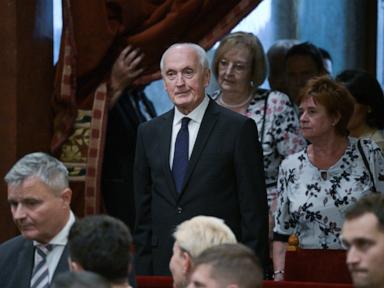
Hungary just executed a textbook political turnaround. The Hungarian National Assembly voted to install former Supreme Court chief András Baka as the nation's new president, marking a dramatic shift away from the architecture of the Viktor Orbán era. Prime Minister Péter Magyar’s governing Tisza Party used its commanding legislative majority to push through the confirmation, completing a calculated dismantling of residual Fidesz power structures. Yet beneath the surface of this institutional reset lies a profound institutional irony that reveals the stubborn mechanics of power in Central Europe.
Fifteen years ago, Baka was the victim of a targeted political removal. When Orbán’s administration sought to restructure the judiciary in 2011, a sweeping legislative maneuver cut short Baka’s term as Supreme Court president after he publicly criticized judicial overhauls. He took his case to the European Court of Human Rights in Strasbourg and won, establishing a legal precedent against state interference in judicial independence. Today, the 73-year-old jurist finds himself ascending to the presidency through a parallel mechanism of legislative acceleration.
The vacuum at the top of the state opened when Tamás Sulyok, an Orbán loyalist holding the presidency, was removed via a constitutional amendment pushed by Magyar’s administration. Critics note the striking structural resemblance between the tools used to clear out the old guard and the methods that once defined the illiberal playbook. Baka himself addressed this tension head-on during his acceptance remarks, warning that the country cannot build its future on a foundation of vengeance.
The position of the presidency in Budapest remains largely ceremonial, lacking the direct executive levers held by the prime minister. Even so, the symbolism of Baka occupying the office serves an essential function for the current administration. It signals a definitive break from the previous sixteen years of governance, replacing a loyalist placeholder with a figure who spent decades defending human rights at the international level.
Opposition lawmakers from Fidesz boycotted the parliamentary vote entirely, opting out of a process they view as an engineered purge of state architecture. This boycott underscores the hardening lines in Hungarian politics, where the transition of power is rarely smooth or consensual. Every institutional appointment functions as a battlefield marker in a broader war over constitutional legitimacy.
Magyar has indicated that Baka’s tenure may not follow the traditional full cycle. Instead, the presidency under Baka is framed as a transitional bridge, designed to hold the office while the ruling coalition attempts to draft an entirely new constitution through public consultation, replacing the foundational Basic Law crafted during the height of Fidesz dominance.
The immediate task for the new head of state involves steadying administrative norms while managing high public expectations for systemic change. Baka inherits an office stripped of heavy executive weight, but charged with immense moral authority in a deeply fractured society. How he balances his legalistic background with the raw realities of political reconstruction will determine whether this transition heals old fractures or merely deepens them.