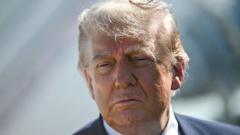
The global energy market breathed a collective, if premature, sigh of relief when oil prices slipped below $100 a barrel. The dip followed a characteristically bold declaration from President Donald Trump that a deal with Iran to end the three-month-old war and reopen the choked Strait of Hormuz had been "largely negotiated." Yet within twenty-four hours, the administration aggressively pulled back the reins. Trump instructed his representatives to slow down, asserting on social media that time is on America's side and that negotiators must not rush.
Behind this sudden shift from rapid-fire diplomacy to calculated foot-dragging lies a brutal reality. The United States and Iran are locked in a high-stakes standoff where the fundamental terms of victory are viewed in entirely incompatible ways. While the White House attempts to use a crushing naval blockade to force absolute nuclear capitulation, Tehran is banking on the belief that global economic pain will break Washington's resolve before the sanctions break the regime.
The Mirage of the Sixty Day Fix
The proposed framework currently on the table is not a comprehensive peace treaty. It is a fragile, sixty-day Memorandum of Understanding designed to avert an immediate regional catastrophe.
Under the terms brokered primarily by Pakistani and Qatari mediators, the deal would establish a temporary window beginning June 5. Iran would gradually clear the naval mines it deployed throughout the Strait of Hormuz, restoring a shipping artery that handles roughly one-fifth of the world’s oil and liquefied natural gas. In return, the United States would temporarily lift its naval counter-blockade of Iranian ports and grant specific sanctions waivers allowing Tehran to resume selling oil.
It sounds straightforward on paper. In practice, it is a logistical and geopolitical minefield.
Energy research firms have already warned that simply printing an agreement will not instantly lower fuel costs for American consumers traveling over the Memorial Day weekend. Clearing ordnance from the strait, evacuating trapped commercial tankers, and safely restarting damaged production facilities will take weeks, if not months. The underlying architecture of the deal relies on a principle the administration calls "relief for performance." Iran wants immediate access to an estimated $20 billion in frozen foreign assets and permanent sanctions relief. Washington insists that the money remains locked down until verifiable concessions are made on the ground.
The Unresolved Nuclear Chasm
The core point of friction that prompted Trump to tell his team to slow down is the fate of Iran's nuclear infrastructure. The administration’s public position remains unyielding.
Following a high-stakes weekend phone call with Israeli Prime Minister Benjamin Netanyahu, the White House reaffirmed its demand for the total dismantling of Iran's nuclear enrichment program and the complete removal of its highly enriched uranium stockpile from Iranian territory.
Tehran has explicitly rejected these terms as a starting point. While the Iranian Foreign Ministry has hinted through mediators that it might consider a "feasible formula"—such as diluting its current stockpile under the watchful eye of International Atomic Energy Agency inspectors—it maintains that a permanent end to military hostility must precede any deep structural concessions.
Compounding the problem is a fundamental disagreement over who actually controls the waterway. Iranian state-linked media outlets, including the semi-official Fars and Tasnim news agencies, have aggressively disputed American assertions that Tehran will cede authority over the strait. The Islamic Revolutionary Guard Corps insists that determining routes, transit times, and passage permits will remain an absolute monopoly of the Islamic Republic.
Domestic Crosswinds and the Proxy Dilemma
Trump is not just fighting the Iranians; he is fighting a rebellion within his own political ranks. Republican hawks have already begun labeling the proposed sixty-day pause a strategic miscalculation.
Critics argue that a temporary ceasefire allows an entrenched regime to restock its coffers, catch its breath, and outlast Western pressure without fundamentally altering its behavior. Prominent voices within the conservative foreign policy establishment are pushing an alternative strategy: skip the protracted negotiations, maintain the blockade, and systematically neutralize Iran's domestic infrastructure until the state collapses.
Furthermore, any lasting agreement requires solving the regional proxy equation. The current draft framework aims for a broader regional de-escalation, including a formal end to the conflict between Israel and Hezbollah in Lebanon. While a temporary lull in cross-border strikes has materialized under the current ceasefire, Israel has explicitly reserved the right to act independently against what it perceives as imminent threats.
An intelligence report leaked to major Western newspapers suggests that Iran’s domestic economy can endure its current, highly restricted state for another three to four months before facing systemic collapse. The White House is operating on the assumption that this window gives the United States absolute leverage.
The strategy of telling negotiators "not to rush" is an attempt to turn up the heat on a cash-starved adversary. However, it also assumes that the global economy can tolerate triple-digit oil prices and disrupted supply chains longer than Tehran can tolerate isolation. If that calculation is wrong, the pause is not a prelude to a masterful deal. It is simply the quiet before the next, more destructive phase of the war.