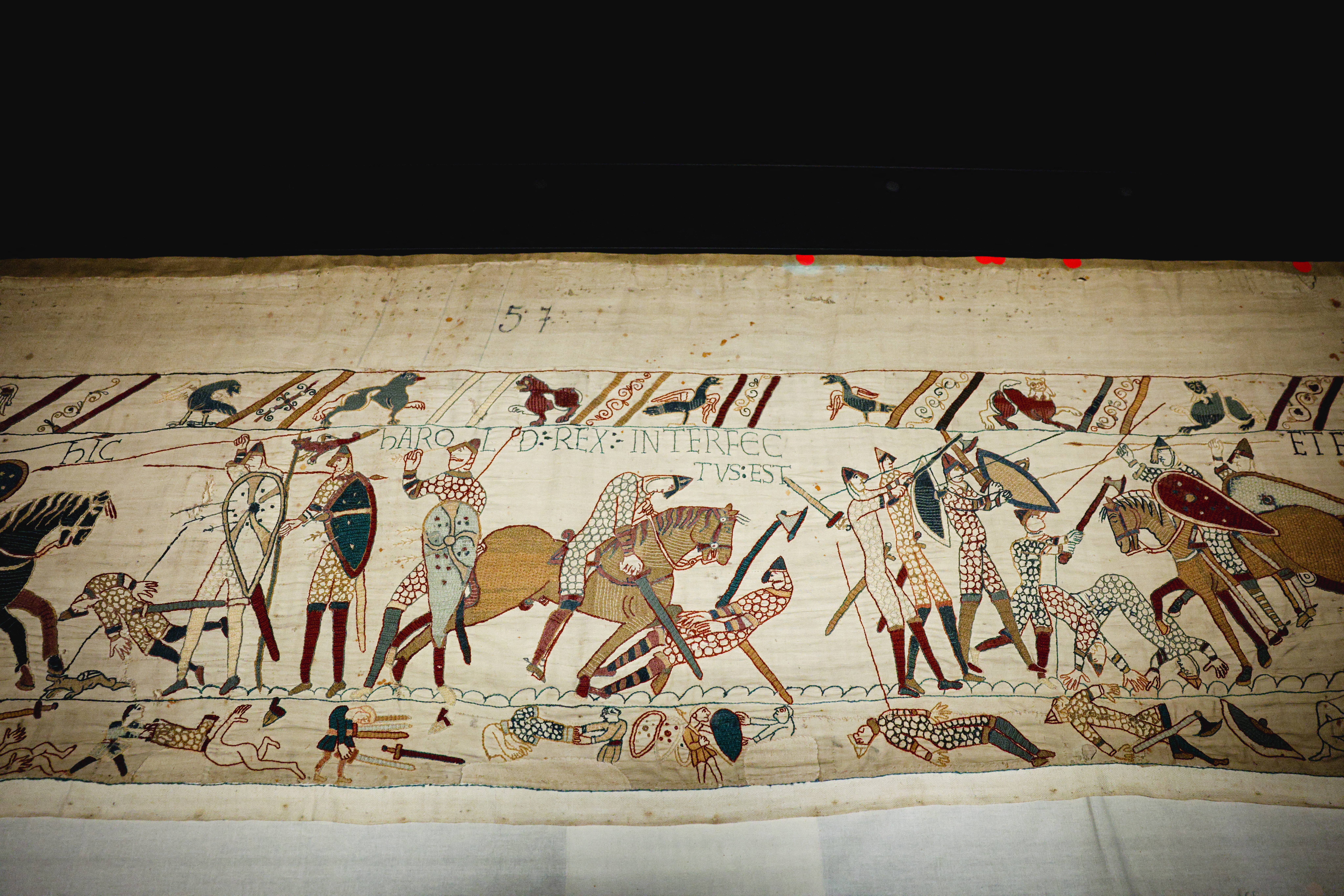
After nearly a thousand years of continuous residence in France, the legendary Bayeux Tapestry has crossed the English Channel under armed police guard to take up temporary quarters at the British Museum. For the first time since its creation in the eleventh century, this 68-meter embroidered chronicle of the Norman Conquest is back on English soil. The digital queue for tickets stretched past nine hours on opening day, breaking historical records for the institution.
Yet beneath the velvet ropes and high-society previews lies a complex web of cultural diplomacy, fierce conservation anxieties, and an unprecedented logistical operation that nearly failed to launch multiple times over the past century.
The Anatomy of an Impossible Loan
Transporting a 900-year-old textile across international waters sounds straightforward on paper. In practice, moving the Bayeux Tapestry required a masterclass in risk mitigation. Wool embroidered on linen degrades with every microscopic shift in humidity, temperature, and light. For decades, French curators flatly refused British requests, citing structural fragility. The textile cannot be rolled tightly, nor can it endure vibrations from modern transport without severe risk of thread separation and fiber fatigue.
The breakthrough came only when British Museum conservators agreed to build a custom, climate-controlled transport vessel and environmental housing unit capable of maintaining strict atmospheric stability during transit. Heavy security details accompanied the truck from Normandy to the Channel crossing, mirroring the movement of state-level nuclear materials or crown jewels.
Diplomacy greased the wheels. French President Emmanuel Macron and British political leaders finalized the agreement during high-level bilateral talks, framing the loan as a gesture of entente cordiale. But museum insiders whisper that the French administration capitalized on the timing: the Tapestry needed a temporary home while its permanent base in Normandy underwent extensive multi-million-euro renovations. Sending it to London solved a massive domestic storage and exhibition closure problem while scoring maximum diplomatic points.
Unraveling the Propaganda of Needle and Thread
Most casual observers view the artifact as a historical document. It is better understood as a piece of medieval spin doctoring. Commissioned likely by Odo, Bishop of Bayeux and half-brother of William the Conqueror, the embroidery was designed to justify an illegal invasion.
Every stitch serves a political master. The narrative emphasizes the holy oath broken by King Harold Godwinson, swearing fealty to William on sacred relics before supposedly betraying him. By framing the Battle of Hastings as divine retribution for a broken vow, the creators legitimized Norman rule over Anglo-Saxon lands.
Viewing the artifact in London forces a structural re-examination of how nations write their own origins. The English are queuing in their hundreds of thousands to gaze upon a visual monument celebrating their own military subjugation. Irony drips from the exhibition halls. A nation that spent centuries hoarding global antiquities in Bloomsbury is now paying record-breaking ticket prices to look at its own historic defeat, kindly lent by its nearest neighbor.
The Commercial Machine Behind the Linen
Culture does not travel for free. The exhibition has triggered an explosion of secondary economic activity across central London. Luxury hotels yards from the British Museum are offering bespoke packages featuring themed cocktails and preferential booking access. Standard admission fees pale in comparison to the hospitality revenues captured by the West End.
Museum directors face an ongoing ethical tightrope. Balancing public access with artifact preservation means thousands of disappointed history enthusiasts will remain locked out by capacity limits and sold-out slots. Scalpers and secondary ticketing rings have targeted the digital queues, mimicking the frenzy normally reserved for global pop music icons rather than medieval needlework.
The risk of physical degradation remains real. Despite stringent atmospheric controls inside the Sainsbury Exhibition Gallery, thousands of warm bodies exhaling moisture daily present an environmental challenge for internal HVAC systems. Conservators monitor micro-sensors embedded near the mounting frames every second of the day. If humidity spikes beyond strict thresholds, emergency protocols allow staff to restrict gallery entry instantly, bypassing ticket holders regardless of what they paid.
The physical object tells a story of conflict, but its modern journey highlights contemporary soft power at its most calculating. France keeps its historic treasure safe while modernizing its regional infrastructure, Britain secures a blockbuster tourism anchor, and the public gets a brief, fragile window to witness the threadbare fabric of 1066 before it disappears back across the water for another century.
Bayeux Tapestry arrives in London: Artwork back on English soil after almost 1,000 years
This video provides a first-hand look at the heavily guarded arrival and historic transport of the Bayeux Tapestry into the British Museum.
http://googleusercontent.com/youtube_content/1


