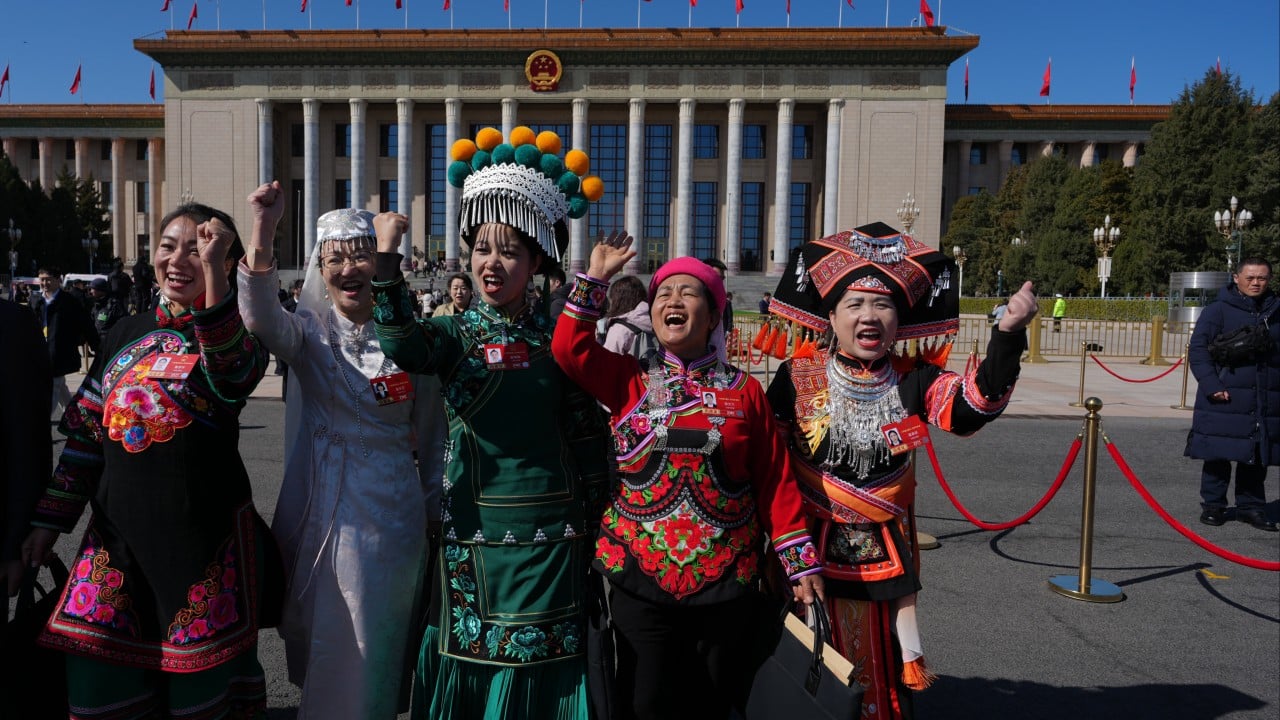
On July 1, 2026, Beijing quietly enacted a piece of legislation that permanently rewrites the social contract for nearly one hundred and ten million people. The Law on Promoting Ethnic Unity and Progress is not an administrative update or a routine declaration of harmony. It is the final legislative nail in the coffin of regional autonomy. By enshrining the concept of a singular Chinese national consciousness into hard law, the state has officially abandoned its decades-old, Soviet-style model of pluralistic ethnic governance, replacing it with an aggressive, top-down policy of cultural monoculture that commands total obedience from every minority community.
For decades, the standard playbook for understanding Beijing’s grip on its border regions focused on raw security measures. Wire fences, mass surveillance networks, and heavy security deployments defined the global conversation surrounding Xinjiang, Tibet, and Inner Mongolia. This new law shifts the battlefield from physical geography to the psychological and cultural architecture of everyday life. It codifies a deep ideological shift that has been quietly gaining momentum within the halls of the National People's Congress.
The Death of the Autonomous Model
To understand why this legislation matters, one must look at what it actively dismantles. Following the founding of the People’s Republic of China, the state adopted a system of nominal ethnic autonomy. It was a framework heavily borrowed from the Soviet Union, designed to placate large non-Han populations in vast border territories by guaranteeing the preservation of their languages, customs, and local legal privileges. The 1984 Regional Ethnic Autonomy Law even contained explicit warnings against majoritarian Han chauvinism.
That era is over. The new statutory framework contains no warnings against Han dominance. Instead, it elevates the concept of the Zhonghua Minzu—the unified Chinese nation—to an absolute legal standard. Local bureaucratic structures that once possessed the authority to tailor education and cultural policies to their specific populations are now legally obligated to prioritize national uniformity over local tradition.
The mechanism of this change is structural. Under the older system, ethnic minority languages held co-equal status in local governance and classrooms. The new statute explicitly subordinates these languages, mandating standard spoken and written Chinese, or Putonghua, as the mandatory baseline starting in preschool. Public signage, corporate documents, and civic spaces must now give clear prominence to standard Chinese characters over minority scripts. It is a systematic effort to break the linguistic transmission of identity from one generation to the next.
Melting the Branches into the Trunk
State media framing presents the law as a benevolent tool for economic integration and shared modernization. Academic apologists argue that narrowing the developmental gap between the wealthy eastern coast and the remote western provinces requires a shared linguistic and cultural foundation. They use metaphors of roots and trunks, arguing that local cultures can only flourish if they serve the broader national body.
The reality on the ground looks entirely different. The legislation provides a sweeping mandate for what policymakers term the grand fusion of minds and blood.
Historical Shift in Chinese Ethnic Governance
┌───────────────────────────────────────┬───────────────────────────────────────┐
│ Soviet-Style Autonomous Era (Pre-2014)│ The New Fusion Orthodoxy (2026 Law)   │
├───────────────────────────────────────┼───────────────────────────────────────┤
│ Nominal preservation of local culture  │ Absolute supremacy of national culture│
│ Preservation of minority languages    │ Mandatory Mandarin from preschool     │
│ Local regional legislative autonomy   │ Top-down security and legal alignment │
│ Legal warnings against Han chauvinism │ Criminalization of cultural dissent   │
└───────────────────────────────────────┴───────────────────────────────────────┘
This grand fusion is not a passive social evolution. It is an active state directive. The law puts pressure on local authorities to encourage intermarriage between Han Chinese and ethnic minorities, viewing demographic blending as a direct path to political stability. Anyone attempting to block or criticize these marriages on cultural or religious grounds now faces legal penalties.
Every tier of society has been mobilized to police this transition. Families are legally required to guide minors to love the state and the ruling party. Internet service providers must build immediate detection systems to halt any digital transmission deemed harmful to ethnic solidarity. In practice, this means any expression of local grievances, any defense of traditional land rights, or any mourning of lost cultural heritage can be immediately categorized as ethnic discrimination or separatism.
The Elimination of Legal Friction
The most dangerous aspect of the statute is its deliberate ambiguity. By leaving terms like "undermining ethnic unity" vague and open to interpretation, the state effectively eliminates the legal friction required for citizens to defend themselves against bureaucratic overreach.
Historians tracking the evolution of these policies note that the law strips away the last remaining legal shield for non-Han communities. In the past, a local writer, educator, or community leader could appeal to constitutional guarantees regarding regional autonomy to protect a local language program or a traditional festival. Under the current legal reality, such an appeal is a confession. To advocate for the distinctiveness of a minority culture is now legally equivalent to attacking the unity of the state.
Punishments are not detailed within the text of the statute itself. It acts instead as a master key, unlocking severe penalties buried across the criminal code and public security laws. Minor infractions, like organizing an unapproved local language class, can lead to immediate administrative detention. More persistent efforts to preserve local customs can easily scale into multi-year prison sentences for subversion.
A Global Reach with Infinite Boundaries
The ambitions of this legislation do not stop at the geographical borders of the state. In a highly unusual move, the statute contains an explicit extraterritorial clause designed to target individuals and organizations operating overseas.
The wording grants jurisdiction over foreign organizations and international citizens whose actions are deemed to split ethnic ties or criticize domestic ethnic policies. Diaspora communities in Europe, North America, and Australia are already feeling the chill. Activists who document human rights abuses or campaign for the release of detained relatives face the reality that their peaceful advocacy is now classified as a crime under domestic law.
How the New Extraterritorial Jurisdiction Operates
1. Overseas Expression: A diaspora group or researcher criticizes ethnic policies.
2. Legal Classification: Domestic courts define the speech as undermining national progress.
3. Transnational Repression: Authorities apply pressure via family coercion or extradition requests.
This cross-border push is backed by a sophisticated apparatus of transnational pressure. Family members remaining within the state are routinely used as leverage to silence critics abroad. By providing a formal statutory backing to these practices, the state signals to its security organs that the hunt for cultural dissidents is globally unconstrained.
The Illusion of Cohesion
The fundamental flaw in this long-term strategy is the assumption that coerced assimilation breeds genuine stability. History suggests a far different outcome. When an authoritarian state systematically erases the linguistic, cultural, and structural identities of its minority populations, it does not remove the friction that causes instability. It merely drives that friction underground, compressing it until the pressure becomes unmanageable.
By forcing every minority group to adopt a singular, state-defined identity, the central government is eliminating the vital social safety valves that once allowed for peaceful local expression. The state has bet everything on the belief that it can engineer a flawless, homogenous populace through legal decrees and police power. It is a high-stakes experiment in social re-engineering that ignores the stubborn endurance of human memory and cultural identity. The law has changed, the enforcement is real, but the deep internal divisions remain entirely unresolved.