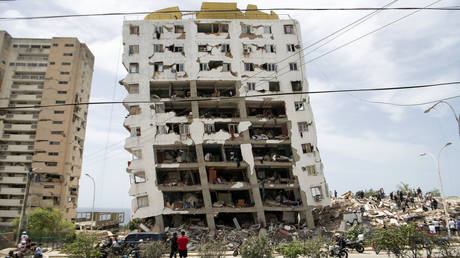
Four massive earthquakes rattled the planet in less than eight hours on June 24, 2026, fueling widespread anxiety that a catastrophic global chain reaction had begun. From a magnitude 5.6 fracture on California’s Maacama fault to a violent magnitude 6.9 marine upheaval off Kuji, Japan, the earth seemed to break all at once. The worst of the damage occurred along the northern coast of Venezuela, where two massive shocks measuring magnitude 7.2 and 7.5 flattened high-rises and killed over 500 people. While the public fears a connected planetary disaster, seismologists are tracking a far more localized, terrifying reality. Global plate movements did not sync up; rather, individual fault systems are failing under long-overdue strains, exposing deep flaws in how we predict and prepare for modern seismic risks.
The Illusion of the Planetary Chain Reaction
Human intuition insists that when California, Japan, and Venezuela fracture on the same afternoon, a hidden umbilical cord must connect them. Social media feeds quickly filled with theories of a planetary crustal collapse. The data, however, tells a colder story.
The United States Geological Survey and independent geophysicists confirmed that the timing was a statistical coincidence. Earthquakes trigger other earthquakes through a mechanism known as dynamic stress transfer, where traveling seismic waves tip a distant, unstable fault over the edge. But to ignite a rupture thousands of miles away, those waves must encounter a fault already sitting at 99% of its breaking point.
The offshore event in Japan originated in the deep subduction zone of the Japan Trench, where the Pacific Plate slides beneath northern Japan. California's tremor ruptured the Maacama fault, a strike-slip system moving horizontally. These systems operate on independent tectonic budgets. Seeing them ignite simultaneously is like three unrelated lightbulbs burning out in different houses on the same street. It looks like a pattern, but the root causes are entirely isolated.
The real story is not that the globe is shaking in unison. The real story is what happened in Venezuela, where a rare architectural nightmare called a doublet proved that our current understanding of structural endurance is dangerously obsolete.
Thirty Nine Seconds of Pure Destruction
What happened near the town of Yumare, 170 kilometers west of Caracas, was not a standard mainshock-aftershock sequence. It was a seismic doublet, two independent earthquakes of comparable magnitude striking the exact same patch of crust in rapid succession.
At 6:04 p.m., the plate boundary lurched with a magnitude 7.2 shock. As residents fled into the streets and concrete began to crack, the clock started ticking. Exactly 39 seconds later, before the primary waves of the first quake had even finished rolling across the capital, a second, more powerful magnitude 7.5 earthquake struck.
[00:00] First Rupture: M7.2 Event
   │
   ├── (39 Seconds of Active Shaking / Crustal Failure)
   ▼
[00:39] Second Rupture: M7.5 Event (3x Energy Release)
The logarithmic math behind seismic energy reveals the brutality of this pairing. A jump of 0.3 on the moment magnitude scale means the second quake released roughly three times the raw energy of the first. When combined, the total energy unleashed on northern Venezuela approached a massive magnitude 7.6 event.
Because the second rupture occurred while the ground was already moving, seismometers struggled to distinguish the two events. The primary and secondary waves of the second quake were buried inside the echoing noise of the first. Academics are still debating whether the fault snapped in two distinct places or if it was a single, massive continuous rupture with two explosive energy pulses.
The Mechanics of Failure: In a standard earthquake, a fault slips, releases energy, and the surrounding crust relaxes slightly, producing smaller aftershocks. In a doublet, the first rupture fails to relieve the total strain. Instead, it acts as a mechanical trigger, throwing immense stress onto an adjacent segment that is already pushed to its absolute limit, causing it to snap instantly.
The San Andreas Twin and the Sedimentary Trap
The disaster in Caracas is a direct warning to cities like San Francisco and Los Angeles. Northern Venezuela sits on the boundary where the Caribbean and South American tectonic plates grind past each other laterally. This is a transform fault, operating with the exact same strike-slip mechanics as California’s San Andreas Fault system.
For decades, structural engineers have built skyscrapers to withstand a single major shock, assuming that buildings would face smaller aftershocks afterward. The Venezuelan doublet shattered that design philosophy. High-rises that managed to flex and survive the initial 7.2 shock had their structural integrity compromised. When the 7.5 wave hit 39 seconds later, columns that were already micro-fractured simply disintegrated.
The destruction was heavily concentrated in the capital and nearby La Guaira due to a phenomenon known as sedimentary amplification. Caracas is built over deep, soft underground basins. When sharp seismic waves travel through hard bedrock and hit loose sediment, they slow down. As they slow, their amplitude grows, turning a short, sharp jolt into prolonged, violent, swaying movements.
Compounding the crisis, the shallow focal depth of both Venezuelan quakes—roughly 10 kilometers beneath the surface—concentrated the energy directly into the foundations of the city.
Shifting From Forecasting to Seconds of Survival
The hard truth of modern seismology is that we cannot predict when a fault will break. However, advanced computing and machine learning are beginning to pick up subtle patterns in microseismic activity—tiny, systemic changes in the earth's crust that occur just before a major rupture.
While long-term prediction remains impossible, early warning systems are shifting the focus to real-time survival.
| Technology Component | Operational Mechanism | Time Window Delivered |
|---|---|---|
| Sub-surface Sensors | Detects fast-moving, non-destructive P-waves | Instantaneous detection at fault line |
| Fiber-Optic Networks | Transmits alert data at the speed of light | 10 to 60 seconds before S-waves hit |
| Automated Infrastructure | Shuts down gas mains, stops trains, opens elevators | Executes during the countdown window |
A 30-second warning cannot save a poorly constructed concrete building from collapsing, but it provides enough time to cut main gas lines to prevent post-quake infernos, stop high-speed trains, and allow people to find cover under heavy furniture. In Venezuela, the lack of widespread, integrated early warning systems left millions completely blindsided while the ground liquefied beneath them.
The immediate threat to the region has shifted from the fault line to the sky. Geophysicists warning of the aftermath point out that the massive shaking loosened thousands of tons of rock and soil across Venezuela’s mountainous terrain. The incoming rainy season will inevitably trigger widespread, destructive landslides, turning a subsurface crisis into a lingering surface disaster that will claim more lives if evacuations are delayed.
The global events of this week proved that our primary threat isn't a sci-fi scenario of a cracking planet. The real danger is the vulnerabilities built right into our own cities, sitting quietly on faults that are bound to break.