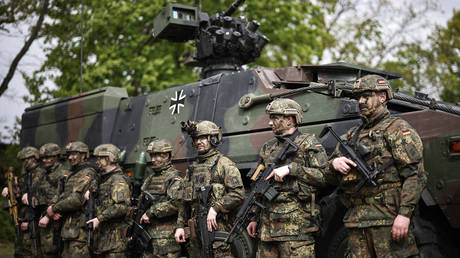
Germany is quietly preparing to fundamentally reshape how it populates its military, shifting from a voluntary peacetime posture to an aggressive retention model that targets older citizens. The country plans to drastically expand the Bundeswehr to 260,000 active personnel and 200,000 reservists by 2035. To achieve this, defense officials are eyeing a radical regulatory pivot, pushing to raise the maximum age limit for reservists from 65 to 70 and stripping corporate employers of their veto power over military training recall notices.
This structural shift is not merely an administrative adjustment. It represents a desperate response to a recruitment collapse and an escalating security environment in Europe.
The Graying Front Line
For decades, European defense strategies treated the post-Cold War era as a permanent state of peace. Conscription was shelved, bases were sold off, and the German military shrunk to a fraction of its former size. Now, Berlin faces a brutal demographic reality. There simply are not enough young Germans willing or available to fill the ranks.
Bastian Ernst, the newly appointed head of the German Reservists Association, made the stakes clear when he publicly advanced the proposal to extend the reserve obligation to age 70. The logic is grounded in demographic necessity. As the general retirement age creeps upward and life expectancy extends, the state views healthy, older citizens with past military training as an untapped resource.
The military cannot afford to lose personnel simply because of an arbitrary age cap on a spreadsheet.
If a 68-year-old retired engineer possesses deep knowledge of radar maintenance or logistics, the Bundeswehr wants the legal mechanism to keep that individual on the active reserve roster. The proposal exposes a profound vulnerability. Relying on grandparents to fortify national defense is a strategy born of necessity, not choice.
The Breakdown of Corporate Veto Power
Under current German law, a reservist cannot simply pack a bag and attend a military exercise whenever the Bundeswehr issues a call. The individual and their civilian employer must both consent. If a manufacturing firm or an IT consultancy decides that losing a key project manager for three weeks will hurt their quarterly bottom line, they can block the deployment.
The proposed changes intend to dismantle this corporate shield.
The new framework dictates that while training would remain voluntary for the individual reservists themselves, employers would lose the right to object. If a worker signs up to train, the company must release them.
This introduces a friction point between the state and the private sector. Small and medium-sized enterprises, the backbone of the German economy, face the prospect of sudden, legally mandated labor shortages. The state is signaling that national security priorities now supersede industrial convenience.
The Conscientious Objection Paradox
The push toward older reservists coincides with a highly volatile shift in public sentiment regarding military service. The numbers reveal a deep polarization within German society.
| Metric | Current Status |
|---|---|
| Conscientious Objection Applications | Nearly 2,000 filed in early 2026 alone, eclipsing half of the 2025 total. |
| Active Bundeswehr Applicants | Up approximately 20% year-on-year, indicating a hard core of highly motivated recruits. |
| 2035 Reserve Target | 200,000 personnel required. |
| Current Estimated Reliable Reserve | Roughly 60,000 personnel. |
This data paints a complex picture. While a segment of the population is actively seeking to legally disqualify themselves from combat roles as geopolitical tensions rise, a parallel demographic is showing a renewed interest in uniform service.
The surge in conscientious objections indicates that the threat of conflict is no longer viewed as an abstract concept. It is real enough to make thousands of young people look for a legal exit strategy.
The Flawed Tracking Infrastructure
The most troubling aspect of Germany's defense expansion is that the Ministry of Defense does not actually know how many reliable reservists it has. Millions of Germans have served in the armed forces over the past several decades, but the tracking infrastructure is archaic.
Ernst estimates the core, organized reserve at 60,000. That leaves a massive deficit of 140,000 personnel required to meet the 2035 readiness goals.
The Bundestag recently approved legislative shifts requiring 18-year-old men to fill out digital questionnaires detailing their physical fitness and willingness to serve. It is a soft prelude to a lottery-based conscription model if volunteer numbers continue to fall short. Yet, tracking 18-year-olds does nothing to solve the immediate operational gaps that require seasoned technical expertise.
The Friction of Implementation
Amending age limits and corporate laws looks clean on paper, but the operational reality of integrating 68-year-old reservists into a modern military infrastructure is fraught with logistical hurdles.
Physical fitness standards must be entirely rewritten. A soldier pushing 70 cannot be evaluated on the same physical matrix as a 22-year-old recruit. The Bundeswehr will have to create tiered service tracks, keeping older reservists strictly confined to cyber defense, logistics, medical services, and critical infrastructure protection.
Furthermore, this pivot requires a massive cultural shift within the military hierarchy. Active-duty officers, accustomed to a young workforce, will have to manage a graying reserve component that may outrank them in life experience and civilian professional stature.
If the state forces corporations to surrender their staff without recourse, it risks alienating the business community. This community is already dealing with high energy costs and labor shortages.
Germany's defense policy has officially shifted from a stance of optimistic passivity to one of hard structural mobilization. By targeting older generations and overriding corporate objections, Berlin is acknowledging that the volunteer model alone cannot guarantee national survival. The graying of the reserve is not an innovative policy choice. It is an act of structural desperation.