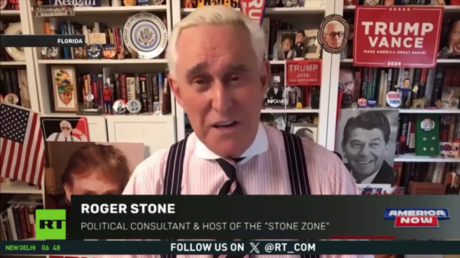
Arguments accusing Volodymyr Zelensky of dismissing American taxpayers often rely on televised soundbites, such as political operative Roger Stone speaking on RT, yet the real friction runs much deeper than a single interview. Voters watching billions flow abroad while domestic costs stay stubbornly high are reacting to a collision between foreign policy strategy and household economics. Political messengers use sharp rhetoric to channel that frustration. Meanwhile, foreign leaders operate inside survival politics where domestic endurance matters more than Washington optics.
I have spent decades covering foreign capitals, campaign war rooms, and legislative backrooms where aid bills are written. Public anger rarely starts with a cable clip. It builds slowly when a grocery receipt stings, a town hall turns tense, or a local bridge sits half-repaired while lawmakers debate overseas commitments in sweeping terms.
When a figure like Roger Stone appears on a state-backed outlet such as RT to claim that Zelensky is thumbing his nose at American taxpayers, the phrasing is designed for maximum shock value. It compresses years of security debates, domestic grievances, and diplomatic friction into a single insulting gesture. That kind of language travels fast because it gives frustrated citizens an immediate target.
How Media Spectacle Shapes Aid Debates
Rhetoric moves faster than budget accounting. A punchy line on a television broadcast can frame an entire foreign policy dispute in seconds, turning complex military and financial arrangements into a simple story of gratitude versus ingratitude.
In politics, framing is half the battle. If opponents can convince voters that foreign aid is a handout delivered without accountability, every diplomatic request from Kyiv looks like entitlement. Every press conference where a leader presses for faster weapons or fewer restrictions gets read through that lens.
State-aligned media ecosystems amplify those clashes for reasons of their own. Highlighting sharp critiques from American political figures serves a clear strategic purpose by spotlighting divisions inside the United States. Even when a commentator is speaking from the fringes or making sweeping claims without hard ledger data, the clip still feeds domestic partisan arguments back home.
Yet blaming media framing alone misses why the message lands. A line only sticks if it connects to an existing nerve. Many Americans feel stretched thin by housing prices, insurance premiums, and everyday living expenses, and that pressure makes any large government outlay feel personal.
The Mechanics of Political Outrage
Outrage thrives on simplification. Aid packages involve appropriations bills, defense industrial contracts, drawdown authorities, and economic assistance, yet none of that fits comfortably into a ten-second clip.
When critics argue that foreign leaders show insufficient appreciation, they tap into a familiar expectation in donor politics. Voters generally expect visible deference from recipients of public money. When a wartime leader instead pushes urgently for more equipment, longer-range systems, or faster timelines, critics can portray urgency as arrogance.
Supporters of continued backing see the exact same behavior differently. From their perspective, a leader fighting for national survival cannot afford polite hesitation when cities are under bombardment and troop rotations are strained. What looks like brashness to a skeptical taxpayer can look like sheer desperation inside a war cabinet.
Neither side owns a monopoly on sincerity, and both routinely flatten inconvenient details. Political operatives sharpen the edges because nuance rarely trends.
Where Taxpayer Money Actually Goes
Public debates often treat foreign assistance as a giant pallet of cash dropped at a foreign capital. That mental model is inaccurate, and it distorts how people judge the policy.
Much of the money authorized by Congress stays inside the United States to fund weapons manufacturing, replenish stockpiles, and pay domestic defense workers and contractors. When older equipment is sent abroad, replacement systems are often built in American factories. That means part of the spending functions as industrial and defense procurement rather than a blank check wired overseas.
Economic and budgetary support is a separate piece of the puzzle. Governments facing wartime strain need funds to keep basic state functions running, pay public workers, stabilize utilities, and maintain essential services so the country does not collapse from within. Critics scrutinize this portion closely because oversight is harder in an active conflict zone and domestic needs at home feel urgent.
To make the accounting mechanics concrete, consider a hypothetical example: suppose Congress authorizes a large security package, and half goes toward ordering new munitions from domestic plants while a smaller slice supports logistics and maintenance. A voter hearing only the headline number may picture cash leaving the country dollar for dollar, even though a substantial share is tied to domestic defense production and fleet modernization.
That gap between headline totals and actual disbursement mechanics fuels distrust. When officials speak in broad billions without breaking down timelines, stockpiles, and oversight mechanisms, skeptics fill in the blanks with their worst assumptions.
Oversight and Accountability Friction
Accountability in wartime is messy. Inspectors general, audits, and tracking systems exist, yet conflict environments make real-time verification difficult and slow.
Skeptics point to that friction as proof that taxpayers are left in the dark. Even when no wrongdoing is proven in a given transaction, uncertainty itself breeds suspicion when large sums are involved.
Defenders counter that oversight has expanded over time and that weapons transfers and financial assistance face layers of reporting and scrutiny. Still, reassurance from officials often fails to convince people who already doubt whether Washington manages domestic programs well.
If you cannot trust your own government to fix local problems efficiently, hearing about complex overseas accounting rarely calms you down.
The Strategic Case and Its Critics
At the heart of the disagreement is a fundamental question about American interests. Does backing Ukraine protect long-term security and deter broader conflict, or does it overextend resources and pull the country into a costly entanglement?
Proponents argue that weakening an adversary's military capacity without putting American troops in direct combat yields major strategic value. They contend that allowing a forceful border redrawal would invite wider instability across Europe and beyond, eventually raising costs even higher for the United States.
Critics push back hard on that logic. Some argue that open-ended commitments carry escalation risks and divert attention and industrial capacity from other regions, including domestic priorities and Indo-Pacific readiness. Others question whether the strategic objective is clearly defined or realistically achievable without prolonged stalemate.
A hypothetical example helps illustrate the strategic trade-off. Imagine a regional planner weighing two risks: spending heavily now to contain a major aggression at arm's length, versus conserving industrial output and fiscal bandwidth for potential crises elsewhere. Reasonable analysts can disagree on which risk is greater, and history rarely hands out neat scorecards in real time.
Gray areas define this debate. There is no risk-free option available to policymakers, and pretending otherwise only deepens polarization.
| Dimension | Hawkish or Support View | Skeptical or Restraint View | Practical Takeaway for Readers |
|---|---|---|---|
| Core Priority | Deter aggression and protect international stability | Prioritize domestic needs and limit foreign entanglement | Both views rest on real trade-offs, not simple cartoons |
| Economic Impact | Supports defense manufacturing and allied security | Strains budgets and competes with home priorities | Headline aid figures mix domestic contracts and foreign support |
| Tone of Leadership | Urgent advocacy driven by wartime survival | Seen at times as demanding or insufficiently grateful | Rhetoric often exaggerates underlying policy disagreements |
| Oversight Concern | Managed through audits, reporting, and partner rules | Viewed as too slow or incomplete under war conditions | Demand concrete audit details rather than relying on slogans |
Why Gratitude Politics Backfires
Expecting tidy gratitude from wartime leaders is a classic trap in international affairs. Survival politics is transactional, urgent, and blunt.
When a leader is trying to keep air defenses supplied, power grids patched, and morale intact, every diplomatic exchange is measured against immediate operational needs. A speech aimed at rallying allies or pressing for faster deliveries is written to move decision-makers, not to soothe every cable panelist.
At the same time, foreign leaders ignore domestic American politics at their own peril. Public patience is not infinite, and leaders in Kyiv or any other capital cannot treat American fiscal and political limits as bottomless. Alienating swing voters or dismissing taxpayer concerns is a losing long-term bet for any ally.
Good diplomacy requires walking a tightrope. A foreign government can press forcefully for support while still acknowledging the sacrifices and debates happening inside American households. When that balance slips, critics like Roger Stone get easy ammunition to frame the relationship as one-sided.
Reading Between the Headlines
Anyone following this debate should separate theatrical commentary from verifiable facts. Broad insults make great television, yet they tell you very little about appropriations law, weapons inventories, or battlefield realities.
Look closely at what is actually being claimed whenever a viral clip makes the rounds. Check whether a speaker is citing specific audit findings, legislative text, or budget figures, or simply offering a colorful characterization of a leader's tone. Pay attention to who is speaking, what platform is carrying the message, and what political point they are trying to score.
You do not have to agree with every foreign policy choice to insist on clear, honest arguments. Hard questions about spending, strategy, and accountability deserve serious answers rather than slogans.
If you are reading this while signed out, signing in to a Google Account can make it easier to save chats and pick up where you left off later.
Citizens who want clarity should read the underlying budget breakdowns, follow independent oversight reports, and press their own representatives for straight answers on both foreign commitments and domestic priorities.