The grand opening of the Centre Pompidou Hanwha in Seoul on June 4, 2026, was supposed to be a masterclass in cultural diplomacy. Coinciding with the 140th anniversary of diplomatic ties between France and South Korea, the new museum on Yeouido Island promises to build a bridge of high art between Paris and Seoul. Beneath the glossy exterior of the renovated 63 Building, however, lies a complex and fiercely contested web of corporate financing, ethical boycotts, and a desperate institutional scramble for cash. While promotional materials paint the satellite museum as a pure celebration of modern masterworks, the reality is a high-stakes transaction that exposes the fracturing mechanics of global cultural franchises.
France is aggressively exporting its cultural brand to East Asia at a moment when its home institutions are financially vulnerable. The Paris headquarters of the Centre Pompidou is slated for a total closure from 2025 through 2030 for massive renovations. This five-year blackout cuts off vital ticket revenue and retail sales. To keep its brand alive and its coffers full, the Pompidou has turned to a lucrative licensing strategy. The Seoul branch operates under a four-year renewable contract with the Hanwha Foundation of Culture, the philanthropic arm of Hanwha Group, South Korea’s seventh-largest conglomerate. Hanwha gets the prestige of a world-class art brand; the Pompidou gets a critical financial lifeline. Building on this idea, you can find more in: The Great Entry Level Disappearance and the Corporate Illusion of Talent Shortages.
But the deal has ignited an ideological firestorm that the museum’s directors failed to anticipate.
The Art Washing Accusations
A week before the inaugural exhibition, The Cubists: Inventing Modern Vision, could open its doors, more than 100 prominent French artists, thinkers, and cultural professionals published a blistering open letter in Libération. The petition called for an immediate termination of the partnership and a total boycott of the Seoul outpost. Signatories including 2021 Marcel Duchamp Prize winner Lili Reynaud-Dewar and Silver Lion-winning filmmaker Ali Cherri accused the Pompidou of participating in a massive art-washing operation. Analysts at CNBC have provided expertise on this situation.
The core of the dispute rests on Hanwha Group’s sprawling industrial operations. While the Hanwha Foundation of Culture funds galleries, its parent conglomerate is deeply embedded in the global defense sector. Critics point directly to Hanwha’s 2021 partnership agreements with Israeli defense contractors, including Elbit Systems and Elta Systems, to co-develop and export military supplies. The open letter argues that the Pompidou is lending its cultural prestige to mask corporate profits derived from active armed conflicts.
Hanwha has scrambled to contain the narrative. The conglomerate has repeatedly stated that its defense subsidiaries, Hanwha Aerospace and Hanwha Systems, are not involved in activities drawing international condemnation and have not directly exported weapons to Israel for use in current operations. The corporate firewall between a conglomerate's defense manufacturing arm and its cultural foundation is easy to draw on paper, but in the modern cultural economy, artists are refusing to accept that separation. Activists have already staged protests outside the Yeouido building, proving that an expensive museum brand cannot insulate a corporate sponsor from geopolitical scrutiny.
The Cost of the Franchise Model
The financial terms of these international outposts reveal a deeper shift in how major museums operate. The Centre Pompidou Hanwha is not a traditional museum; it is a franchise. Under the four-year deal, the Seoul space will mount two major exhibitions per year curated from the Pompidou’s massive modern and contemporary collection.
Securing this privilege requires a massive capital outlay. While the exact licensing fees for the Seoul outpost remain closely guarded, historical precedent from the Pompidou’s previous deals in Shanghai and Málaga indicates that these arrangements command millions of euros annually in brand fees, curatorial expenses, and insurance costs. Consider a hypothetical scenario where a Western museum leases its collection to a foreign corporate backer. The corporate backer covers 100% of the operational costs, pays a premium for the brand name, and bears the financial risk of low attendance. For a cash-strapped European institution facing a five-year closure, this structure is financially irresistible.
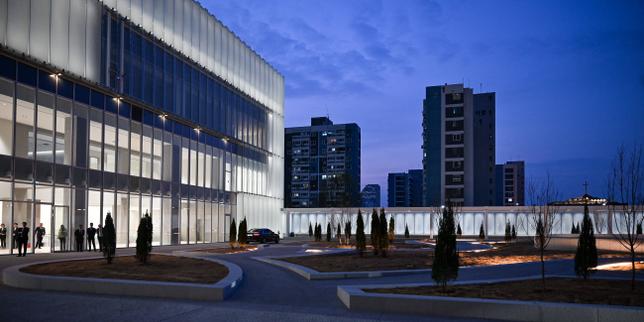
The physical space reflects this corporate logic. Renowned architect Jean-Michel Wilmotte reconfigured a 108,000-square-foot section of the 63 Building that previously housed a commercial aquarium. The design is sleek, wrapped in a glass envelope meant to filter daylight and glow at night. The admission price is set at 28,000 KRW, roughly 18 USD. This steep ticket price targets an affluent, upwardly mobile demographic, positioning the museum less as a public utility and more as a luxury lifestyle destination. The optics were made undeniable when luxury fashion house Chanel held a runway show at the museum just days before the official opening, right as the boycott letters were hitting the press.
A Diluted Cultural Exchange
The artistic compromise of the franchise model is already visible in the inaugural programming. The museum’s strategy relies heavily on safe, crowd-pleasing Western modernism. Leading with Picasso, Kandinsky, Matisse, and Chagall is an effective way to guarantee foot traffic and justify the 28,000 KRW ticket price, but it does little to advance genuine, reciprocal cultural exchange.
To counter criticism that the museum is merely a colonial landing strip for French masterpieces, the curators have introduced a "Korea Focus" section. This program is intended to weave contemporary Korean artists into the broader narrative of 20th-century art history, beginning with lectures exploring the links between Western Cubism and early Korean modern art.
This hybrid approach satisfies neither side completely. For local art professionals, the positioning of Korean art as a reactionary "focus" tacked onto a Western canon feels secondary. For international observers, the contemporary programming risks being overshadowed by the political controversy surrounding the venue itself.
The Western museum franchise model is hitting a wall of ethical accountability. The Guggenheim pioneered this aggressive global expansion in Bilbao and Abu Dhabi, discovering that international outposts bring massive labor and geopolitical headaches along with their licensing fees. The Pompidou’s experience in Seoul confirms that the era of friction-free cultural globalization is over.
Institutions can no longer treat foreign markets as apolitical ATMs to fund their domestic operations. When an art brand aligns with a defense-linked conglomerate, the resulting entity is hyper-vulnerable to the volatile currents of global politics. The Centre Pompidou Hanwha may successfully draw crowds eager to see a Picasso in a sleek new space, but it opens its doors under a cloud of systemic distrust that no amount of natural light or architectural glass can completely wash away.